
A Comprehensive and Analytical Study of President Donald Trump’s Leadership Vision in His Current Campaign

According to various newspaper columns, President Donald Trump’s ongoing political campaign has generated significant influence not only within the United States but also across global political landscapes. The priorities, leadership style, and international outlook presented in his campaign have attracted strong support from his followers while simultaneously opening new dimensions for debate among his critics. From the perspective of his supporters, Trump’s campaign is built upon the goal of making the United States a more powerful, independent, and decisive force in world politics. This essay presents an extensive analysis of his leadership vision, economic strategies, diplomatic behavior, and political style as understood by those who support him.
A central foundation of Trump’s campaign lies in the idea of strong and decisive national leadership. Supporters argue that the global political environment has become increasingly competitive, uncertain, and complex. In such circumstances, traditional diplomatic approaches alone are insufficient. They believe that leaders like Trump—who speak clearly, are willing to take risks, and prioritize national interests above all—are effective in navigating such challenging conditions. Supporters describe Trump’s leadership style as “bold” and “unwavering.” They argue that if international institutions, trade agreements, or diplomatic structures undermine American interests, Trump possesses the courage and capability to challenge them. This, they believe, helps reestablish the United States’ global influence and strengthens its position in world affairs.
Another major pillar of Trump’s campaign is economic independence. Supporters argue that increasing global competition, instability in supply chains, and dependence on foreign powers have created long term challenges for the United States. Trump’s economic vision seeks to address these issues through strategic reforms. He emphasizes revitalizing domestic industries, bringing manufacturing back to the United States, and prioritizing the interests of American workers. Supporters believe this approach ensures job creation, industrial stability, and economic independence. They argue that an economy rooted in domestic production is better protected from external pressures and foreign manipulation.
Trump has also expressed that many past trade agreements were not beneficial to the United States. His commitment to renegotiating or replacing such agreements is seen by supporters as a step toward strengthening American competitiveness and balancing foreign economic influence. They view the concept of “fair trade” as central to Trump’s economic philosophy. Furthermore, global crises have exposed vulnerabilities in international supply chains, prompting Trump to emphasize the need to secure and stabilize supply chains domestically. Supporters believe this strengthens both national security and economic resilience, especially in strategic industries such as pharmaceuticals, technology, and energy.
Trump’s leadership style is one of the most widely discussed aspects of his political identity. He is known for his direct, clear, and sometimes controversial communication. Supporters view this as a reflection of his confidence, transparency, and determination. Trump prefers direct communication over traditional political channels. Through social media, public speeches, and open statements, he maintains close contact with the public. Supporters believe this makes him a leader who “listens to the people.” They argue that direct communication increases transparency and presents the leader’s true intentions to the public. Trump also frequently challenges traditional political structures. Supporters believe this approach helps reform outdated, ineffective, or corrupt systems. They argue that his leadership has brought new energy, new perspectives, and new possibilities into the political arena.
In addition to these contemporary factors, some analysts argue that Trump’s foreign policy posture echoes earlier American doctrines. They point to President James Monroe’s 1823 principle asserting U.S. influence in its sphere and President James K. Polk’s 1845 expansionist interpretation as historical precedents that emphasized national sovereignty and strategic dominance. Likewise, discussions about U.S. actions toward Iran are often framed through the historical lens of the 1953 CIA backed overthrow of Iran’s elected Prime Minister and the reinstatement of the Shah. Although Trump himself does not explicitly cite these historical precedents, both supporters and critics frequently interpret his decisions within these long standing patterns of American strategic behavior.
Although President Trump has faced significant criticism for the recent military intervention in Iran, many of his supporters continue to view him through a very different lens. Even though he is being criticized for the invasion of Iran, his supporters at home regard him as a hero whose patriotic determination, in their view, is directed toward confronting and dismantling what they describe as Iran’s brutal and oppressive regime. From their perspective, his actions reflect a willingness to take decisive measures in the face of global threats, and they argue that such bold leadership is necessary to protect American interests and promote stability in regions dominated by authoritarian rule. This divergence between domestic support and international criticism highlights the complexity of his leadership style and the polarized responses it generates.
Trump’s campaign also presents a distinct approach to international relations. Supporters argue that his diplomatic style is rooted in the principle of “America First,” which prioritizes national interests above all else. They believe Trump’s assertive diplomatic style helps maintain the balance of power in global politics. Supporters argue that he is capable of establishing firm yet clear relationships with competing nations, which helps the United States maintain its influence in world affairs. Trump’s emphasis on national security is another appealing aspect for his supporters. They believe that strong security policies, strengthened borders, and decisive responses to international threats are essential for long term stability. Supporters argue that such policies ensure the nation’s safety and strategic advantage.
In summary, President Donald Trump’s current campaign is built upon the principles of national strength, economic independence, and assertive global leadership. From the perspective of his supporters, his campaign aims to make the United States a more powerful, independent, and decisive force in world politics. Although public opinion about his approach varies widely, supporters believe that his leadership style, economic strategies, and diplomatic outlook have the potential to guide the nation in a new direction. Understanding these perspectives is essential for analyzing the broader impact of his campaign on American politics and international relations.
Persuasive conclusion:
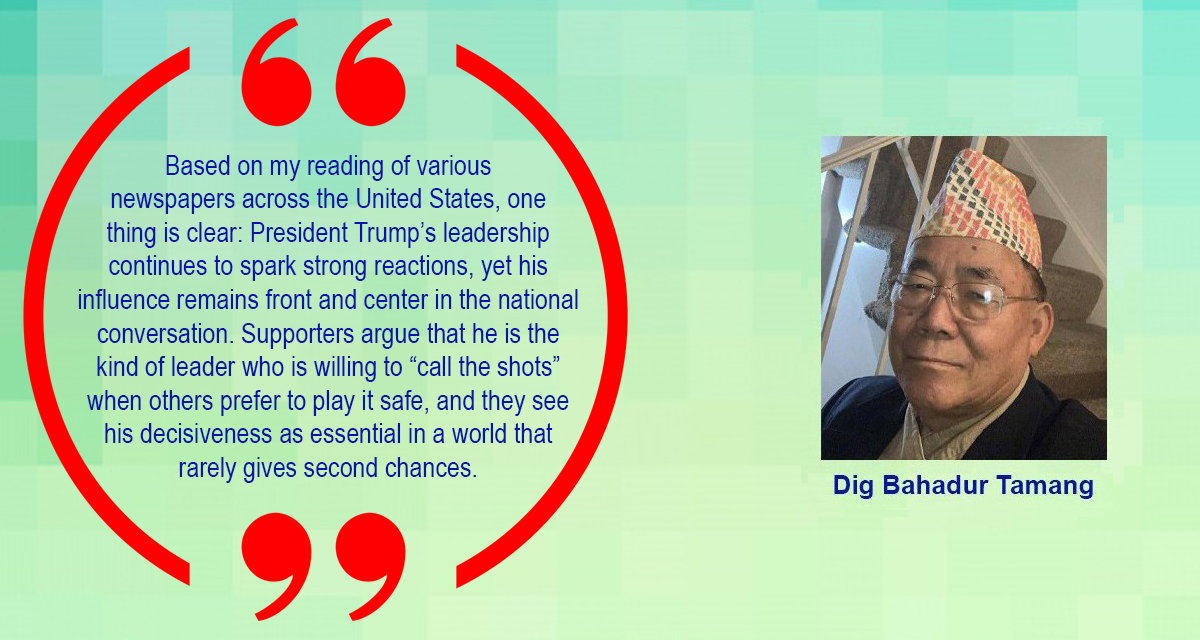
Based on my reading of various newspapers across the United States, one thing is clear: President Trump’s leadership continues to spark strong reactions, yet his influence remains front and center in the national conversation. Supporters argue that he is the kind of leader who is willing to “call the shots” when others prefer to play it safe, and they see his decisiveness as essential in a world that rarely gives second chances. To them, Trump’s focus on sovereignty, economic resilience, and strategic strength shows a leader determined to “stand his ground” and put American interests first. Whether one agrees with this perspective or not, his campaign has undeniably changed the way Americans talk about leadership and foreign policy. As the political landscape keeps shifting, Trump’s vision — and the loyal base that rallies behind it — will continue to shape America’s role on the global stage for years to come.
Facebook Comment
Related News



latest Video
Trending News
- This Week
- This Month