
Spring in the Himalayas: The New Loom, Unified Hands, and Nepal’s Geopolitical Awakening

Not long ago, I wrote that Nepal could no longer be sewn with an old thread. For nearly eight decades, the nation had been trapped in a cycle of stitching and restitching a decaying political garment using medieval tools. We witnessed the fatigue of a system paralyzed by partisan toxicity, where governments fell like autumn leaves and the state’s architecture was treated as the private spoils of tired, unimaginative elites. The diagnosis was stark: Nepal did not merely need a change of government; it required a completely new loom, new hands, and a new political imagination.
Today, as the harsh, biting winter of our political discontent begins to thaw, a profound metamorphosis is unfolding. In nature, spring does not arrive with a subtle whisper; it declares itself with the sudden, undeniable bursting of new buds. The rhododendrons that ignite the Himalayan foothills in vibrant crimson do not ask the frost for permission to bloom. Similarly, a new generation of leadership has taken the helm of the Nepali state, bringing with them the vitality, audacity, and clarity of a new season. The old, cracked loom has finally been cast aside, and the young, unified hands weaving the nation’s future are proving that they understand not just the craft of governance, but the sacred art of nation-building.
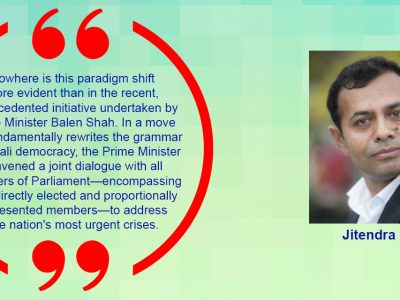
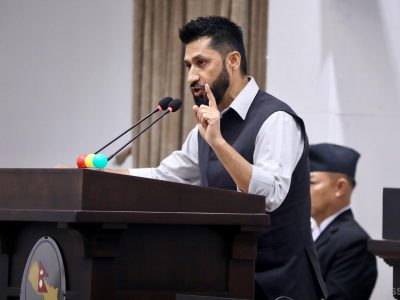
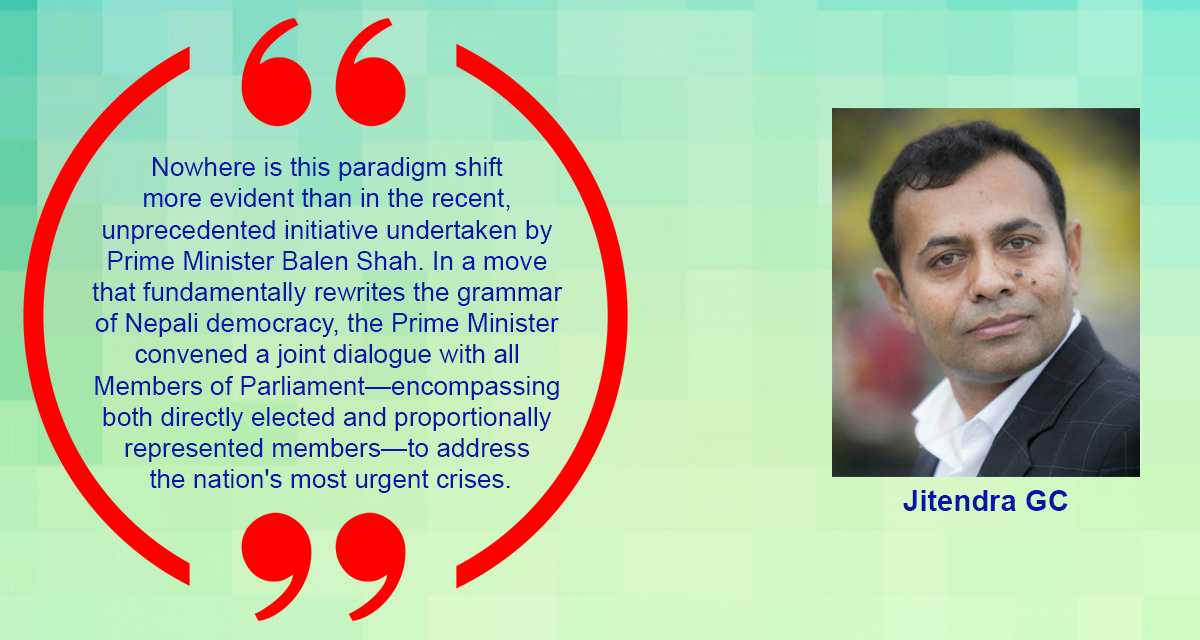
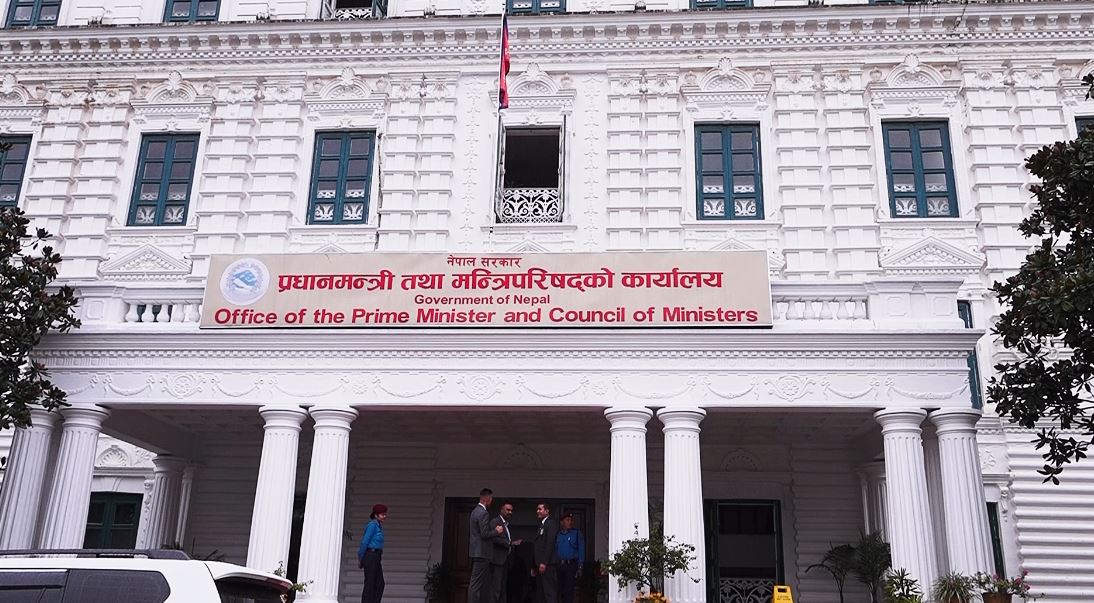
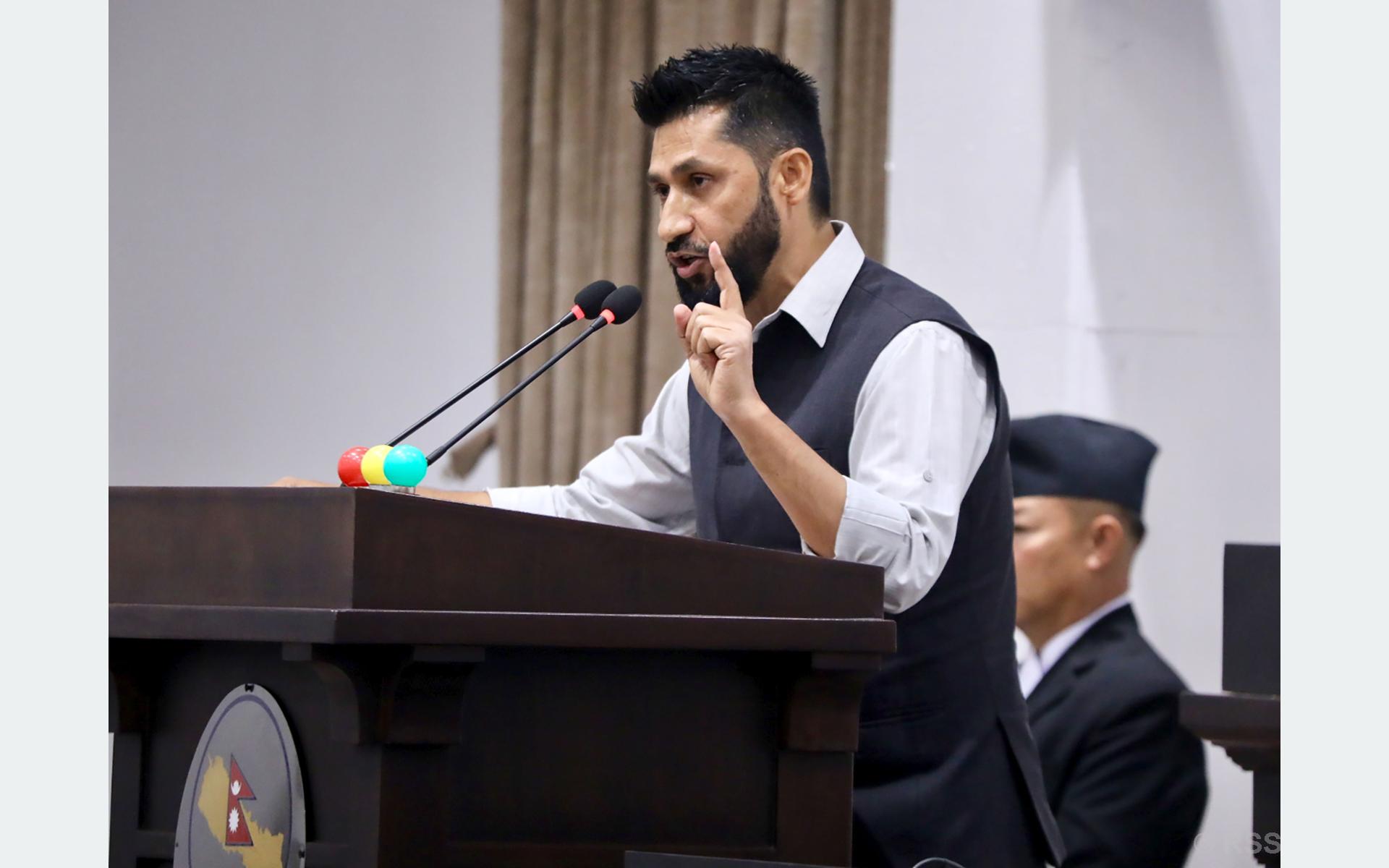
Nowhere is this paradigm shift more evident than in the recent, unprecedented initiative undertaken by Prime Minister Balen Shah. In a move that fundamentally rewrites the grammar of Nepali democracy, the Prime Minister convened a joint dialogue with all Members of Parliament—encompassing both directly elected and proportionally represented members—to address the nation’s most urgent crises.
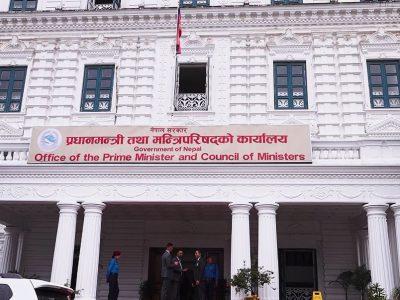
Historically, the halls of Singha Durbar and Baneshwor have been arenas of gladiatorial partisanship. Proportional MPs were often treated as second-class political citizens, and the opposition was viewed merely as a nuisance to be managed or outmaneuvered. The Westminster model, in its most corrupted Nepali iteration, demanded that MPs act as rigid cogs in their respective party machines. Prime Minister Shah’s summit shattered this archaic psychology. By bringing every lawmaker to the same table, his message was revolutionary in its simplicity: Within these walls, you are not mere cadres of a political faction; you are the sovereign representatives of the Nepali state. The poverty of our people, the bleeding of our youth to foreign lands, and the stagnation of our economy do not check our party affiliations before they strike. Therefore, our solutions cannot be partisan.
This masterstroke of national unity bridges the historical divides that have long bled the country dry. It recalls the profound wisdom of the Rig Veda, which urges: “Samgacchadhvam samvadadhvam” (May we walk together, may we speak together, may our minds resolve together). For the first time in modern memory, the executive leadership is treating the legislature not as a battlefield, but as a unified Board of Directors for the enterprise of Nepal.
In theatrical terms, this shift mirrors the catharsis found in classical Greek tragedies. For decades, Nepal played the role of the tragic hero, bound by the fatal flaw (hamartia) of internal division. We were stuck in a perpetual staging of Samuel Beckett’s Waiting for Godot—waiting for a savior, waiting for development, waiting for stability that never arrived. By breaking the fourth wall of partisan politics and demanding collective accountability, the new leadership has ended the tragedy and opened the curtain on a renaissance. When a leader voluntarily narrows the gap between the ruling bench and the opposition, choosing consensus over conquest, it sends a seismic message of stability to both the citizenry and the world.
This domestic unification is the absolute prerequisite for the second, equally critical transformation of this “New Spring”: a radical reimagining of Nepal’s foreign policy.
For nearly three centuries, Nepal’s geopolitical doctrine has been largely defined by King Prithvi Narayan Shah’s metaphor of a “yam between two boulders.” While this defensive, survivalist posture kept the nation sovereign during the era of imperial expansions, it inadvertently bred a psychology of vulnerability. In the 21st century, continuing to act like a fragile root vegetable waiting to be crushed is a strategic liability.
Under the new, younger leadership, Nepal is pivoting from a horizontal, reactionary foreign policy to what must be defined as “Vertical and Independent Diplomacy.” Vertical diplomacy implies standing upright. It means looking the world in the eye, grounded in sovereign confidence, rather than constantly swaying horizontally to appease or balance the immediate pressures of our two giant neighbors, India and China.
By projecting absolute internal stability and cross-party consensus, Prime Minister Shah’s administration is changing the geopolitical calculus of both New Delhi and Beijing. The two Asian economic behemoths no longer need to view Nepal through the paranoid lens of “strategic denial”—fearing that the other might gain a disproportionate foothold in Kathmandu. Instead, vertical diplomacy presents Nepal as an independent, predictable, and highly lucrative economic bridge.
When Nepal operates with unified policies rather than fractured politics, it compels India and China to engage with us not as a geopolitical chessboard, but as a collaborative economic partner. A prosperous, stable Nepal is the ultimate security guarantee for both neighbors. It transforms our borders from zones of anxiety into corridors of shared prosperity. As the ancient Chinese philosopher Lao Tzu noted, “A leader is best when people barely know he exists, when his work is done, his aim fulfilled, they will say: we did it ourselves.” By fostering a domestic environment where the nation acts as one, Nepal empowers itself to dictate its own diplomatic terms, drawing in the giants not through manipulation, but through the irresistible gravity of opportunity.
Furthermore, this newfound diplomatic independence and internal cohesion is creating a fertile, springtime ecosystem for multilateral powers and global investors. Capital is notoriously cowardly; it flees from the winter of political instability and red tape, but it blooms wherever the climate is predictable, transparent, and welcoming.
In the past, global investors and multilateral institutions—the World Bank, the European Union, the United States, and private global equity—were often caught in the crossfire of Nepal’s erratic policy reversals and geopolitical paranoia. Today, the message radiating from Kathmandu is unequivocal: Nepal is open for business, and the rules of the game are stable, unified, and transparent. The new administration understands that global diplomacy is no longer just about exchanging diplomatic notes; it is about integrating into the global supply chain, attracting green climate finance, and positioning Nepal as a premium destination for technology, clean energy, and sustainable tourism.
The environment for foreign direct investment is finally blooming because the soil has been cleared of the toxic weeds of cronyism and bureaucratic sabotage. When all lawmakers are treated as stakeholders in the nation’s economic survival, foreign investors see a nation that honors its contracts and protects capital. We are witnessing the shift from a “grant-dependent” mentality to a “growth-making” dynamism.
In his famous poem, Ode to the West Wind, Percy Bysshe Shelley writes, “If Winter comes, can Spring be far behind?” Nepal has endured an unnaturally long and bitter political winter. The people were exhausted, the youth were fleeing, and the fabric of the state was fraying at the edges. But what we are witnessing today is not merely a change of seasons; it is a fundamental rebirth of the nation’s political soul.
The young leaders who have stepped into the light have recognized that to govern a nation of such immense potential, one cannot rely on the cynical playbook of the past. By bringing together every elected representative, by elevating the discourse from petty rivalries to urgent national priorities, and by engaging the world with confident, vertical diplomacy, they have proven that the new loom is fully operational.
The task ahead remains monumental. Decades of systemic decay cannot be undone in a single season. But the foundation has been laid. The two giant economies to our north and south, along with the broader international community, are watching a new Nepal awaken—a Nepal that is no longer defined by its limitations, but by its audacity.
The old threads have been swept away. The new hands are weaving a tapestry of unity, prosperity, and global dignity. The spring has arrived in the Himalayas, and for the first time in our modern history, the future of Nepal looks as bright, resolute, and enduring as the snow-capped peaks that guard it. The blossoms of prosperity are finally ready to open.
(The author is a public policy scholar and expert with a Ph.D. in the field, with a keen interest in writing about current affairs, governance, and climate policy.)
Facebook Comment
Related News

latest Video
Trending News
- This Week
- This Month