
A New Generation of Leadership: Three Figures Inspiring Unprecedented Public Admiration

The attempt to integrate Kulman Ghising into the emerging political configuration illustrates the complex interplay between technocratic legitimacy, coalition formation, and institutional uncertainty in Nepal’s evolving political environment. While negotiations between Rabi Lamichhane and Balen Shah appear to be converging toward a coordinated political arrangement, Ghising’s reluctance to engage—evidenced by his non responsiveness during a critical phase of consultation—signals a deeper tension within the coalition building process. Such behavior cannot be interpreted merely as interpersonal hesitation; rather, it reflects the structural challenges inherent in incorporating non partisan technocratic actors into fluid and rapidly assembled political alliances.
Ghising’s public authority derives not from partisan mobilization but from what Max Weber would classify as rational legal legitimacy: a reputation built on administrative competence, institutional reform, and performance oriented governance. His symbolic capital, in Pierre Bourdieu’s terms, is rooted in technocratic credibility rather than political patronage. Consequently, any coalition seeking his participation is effectively attempting to appropriate this symbolic capital to enhance its own legitimacy. His hesitation therefore has systemic implications: it destabilizes the coalition’s claim to represent a credible alternative to traditional political structures and exposes the fragility of alliances that rely heavily on public perception rather than institutional depth.
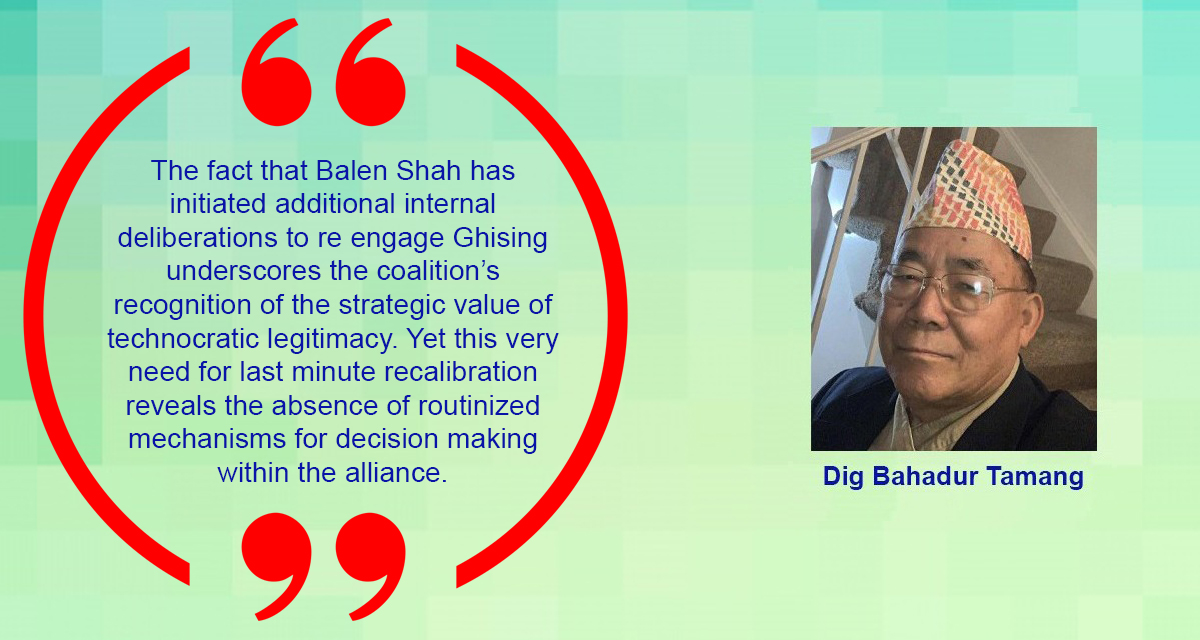
The fact that Balen Shah has initiated additional internal deliberations to re engage Ghising underscores the coalition’s recognition of the strategic value of technocratic legitimacy. Yet this very need for last minute recalibration reveals the absence of routinized mechanisms for decision making within the alliance. In organizational theory terms, the coalition appears to be operating through ad hoc coordination rather than institutionalized procedures, making it vulnerable to disruptions whenever key actors express dissatisfaction or ambiguity regarding their prospective roles.
The temporal context further heightens the stakes. The impending deadline for submitting the proportional representation list to the Election Commission functions as an institutional constraint that compresses negotiation time and amplifies internal pressures. The list itself is not merely a procedural requirement; it constitutes a formal articulation of representational hierarchy, internal power distribution, and the coalition’s strategic orientation. Any unresolved dissent—particularly from a high visibility figure like Ghising—signals potential fissures that may manifest in future governance challenges, policy incoherence, or intra coalition contestation.
The broader political landscape compounds these dynamics. Both Lamichhane and Shah represent emergent anti establishment currents that lack the organizational routinization characteristic of traditional parties. Their cooperation is therefore not anchored in long standing ideological alignment or institutionalized coordination but in shared populist momentum and mutual strategic convenience. Introducing a third influential actor such as Ghising into this configuration introduces additional layers of complexity, particularly if his role is not clearly institutionalized. Without explicit delineation of authority, responsibilities, and decision making rights, the coalition risks what political theorists describe as coordination failure—a breakdown in collective action due to ambiguous expectations and insufficiently formalized structures.
Public perception constitutes another critical dimension. Ghising’s reputation as a non partisan, results oriented figure is central to his public legitimacy. Aligning with a political coalition exposes him to reputational risk, especially if the coalition later experiences internal fragmentation or governance failures. His current reluctance may therefore reflect a strategic calculation grounded in reputational risk management, a concept widely discussed in governance and public administration literature. By withholding immediate commitment, he preserves optionality and avoids premature entanglement in a political project whose long term stability remains uncertain.
In sum, the question of Ghising’s inclusion transcends the immediate tactical considerations of electoral list formation. It serves as a diagnostic lens through which to examine the institutional maturity of emerging political formations in Nepal. The episode highlights the challenges of integrating technocratic legitimacy into populist coalitions, the fragility of alliances formed without robust organizational structures, and the broader tension between charismatic leadership and institutionalized governance. Whether Ghising ultimately joins the coalition is less significant than what his hesitation reveals: the unresolved structural dilemmas that confront new political actors attempting to construct durable, credible, and institutionally coherent alternatives within Nepal’s rapidly shifting political landscape.
Facebook Comment
Related News
latest Video
Trending News
- This Week
- This Month