
“Geopolitical Pressures and Democratic Agency: Rethinking External Influence in Nepal’s Political Trajectory”

Nepal’s political evolution has been profoundly shaped by its geopolitical location, internal structural fragilities, and the persistent presence of external actors. Positioned between two major regional powers—India and China—Nepal has historically navigated a complex political landscape in which external influence has been both inevitable and consequential. Among these influences, India’s role has been particularly prominent due to deep historical, cultural, and economic linkages. From my perspective, the early proximity between Nepal’s political parties—especially the Nepali Congress—and India must be understood not as a product of dependency alone, but as an outcome of historical contingencies and geopolitical imperatives.
The founding of the Nepali Congress in India, the organization of anti Rana political activities from Indian territory, and India’s diplomatic involvement in the 1950 Delhi Agreement collectively contributed to a perception of Congress–India closeness. However, interpreting this relationship merely as Indian “patronage” oversimplifies the historical context. At the time, Nepal’s domestic political environment was repressive, political mobilization within the country was nearly impossible, and exile became a structural necessity for political actors. India’s provision of political refuge thus reflected a convergence of strategic interests and circumstantial necessity rather than unilateral nurturing. Understanding this nuance is essential for a balanced assessment of early Nepal–India political relations.
During the Panchayat era, state driven narratives portrayed the Nepali Congress as an instrument of Indian influence, reinforcing public suspicion regarding external interference. Yet historical evidence also suggests that the Panchayat regime strategically employed the rhetoric of foreign intervention to legitimize its own authority and suppress dissent. Although India is believed to have facilitated dialogue during the 1990 People’s Movement, the decisive force behind political transformation was the collective agency of the Nepali people. This underscores a broader principle: while external support may shape political opportunities, the substantive drivers of political change in Nepal have consistently emerged from internal social and political dynamics.
The persistence of external influence narratives in contemporary Nepal can be attributed to several structural factors: chronic political instability, limited transparency in state decision making, ambiguous public communication by political leaders, and widespread public distrust. When political actors invoke foreign agencies without evidence—particularly in sensitive contexts—it deepens societal confusion and erodes democratic confidence. From my perspective, such tendencies weaken political literacy and risk alienating younger generations from political engagement.
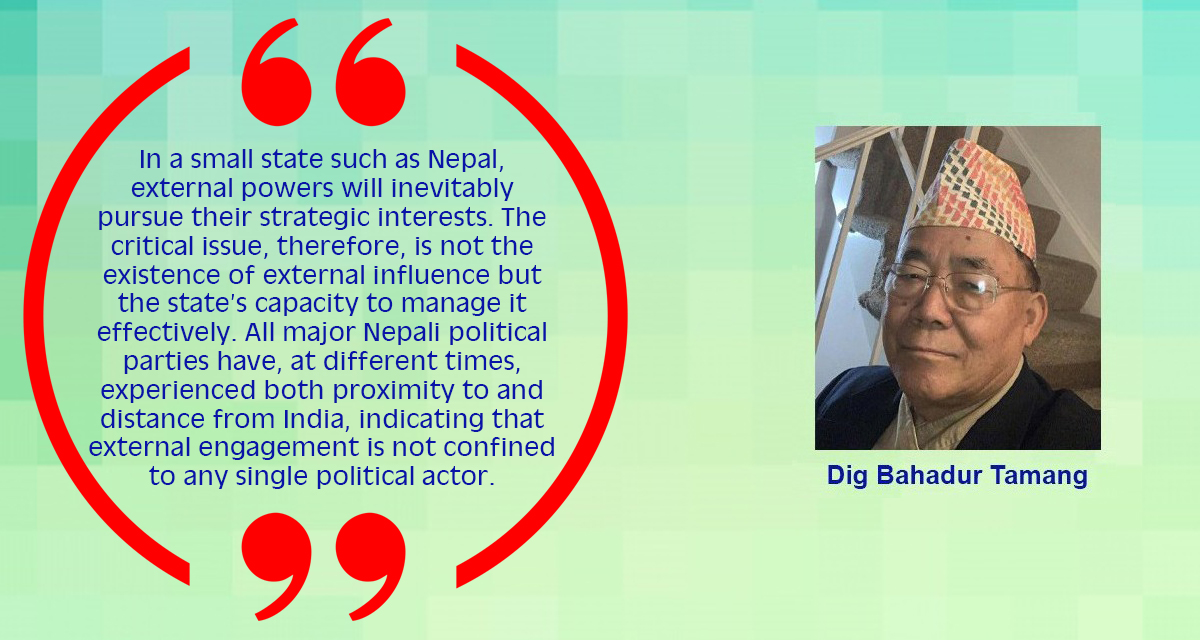
In a small state such as Nepal, external powers will inevitably pursue their strategic interests. The critical issue, therefore, is not the existence of external influence but the state’s capacity to manage it effectively. All major Nepali political parties have, at different times, experienced both proximity to and distance from India, indicating that external engagement is not confined to any single political actor. Sustainable political stability requires decision making grounded in national interest, institutional transparency, and accountable leadership.
Recent discussions surrounding India’s offer as gifts of 61 vehicles for Nepal’s upcoming special elections further illuminate the complexities of external engagement. Although opinions vary, my view is that accepting large scale external assistance during an electoral period is inappropriate for a sovereign democratic state.
First, elections represent the core mechanism of democratic legitimacy, and the state must demonstrate its administrative capacity independently. Reliance on external resources risks generating public perceptions that electoral management is influenced by foreign actors.
Second, Nepal’s geopolitical sensitivity necessitates careful calibration between cooperation and dependency. Accepting such assistance during an election could carry long term diplomatic implications and may symbolically weaken Nepal’s decision making autonomy.
Third, from a long term institutional perspective, Nepal must prioritize strengthening its own administrative and logistical capacities. Repeated dependence on external support undermines both national self reliance and political dignity.
For these reasons, from my perspective, Nepal would have been better served by declining the offer of 61 vehicles, thereby safeguarding national sovereignty, electoral neutrality, and the credibility of its democratic institutions.
Facebook Comment
Related News
latest Video
Trending News
- This Week
- This Month