
The Turning of Seasons: One Man’s Journey Through Change

Life often begins at a bend in the road where a person clearly understands what has been taken from them, yet remains unaware of what the future quietly prepares. The boy at the center of this story stood at such a crossroads. He had lost his mother far too early, and his father—exhausted but determined—held his hand as they left their ancestral village. Their journey to the eastern plains was not simply a change of place; it marked the first profound rupture in his young life. The familiar walls of home, the courtyard where he once played, and every memory of childhood faded behind him as they stepped into a world where no one knew their names.
In the new district, survival became their only priority. His father worked long days plowing other people’s fields, his back bent under the weight of labor and uncertainty. The boy, still too young to understand the full measure of their hardship, was placed as a cattle herder in a wealthy household. The calls of livestock, the smell of hay and dung, and the rhythm of morning and evening tea became the boundaries of his world. Yet even in this narrow life, there flickered in his eyes a quiet brilliance—one that neither privilege nor poverty could fully comprehend.
He carried within him a longing that was subtle but persistent. When the children of the household left for school, he watched from the doorway, absorbing every detail. Occasionally, he found discarded notebooks and tried to decipher the letters. For him, the alphabet was not merely a set of symbols; it was a gateway to a world he had never been allowed to enter. Though he lacked formal schooling, his mind absorbed knowledge with remarkable ease. When the village priest recited sacred verses, the boy listened from afar, memorizing the words until he could recite them himself. Villagers marveled at his ability, unaware that hardship often teaches lessons more profound than any classroom.
As he grew older, the nation around him entered a period of unrest. Secret meetings in the jungle, unexplained disappearances, and murmurs of ideological movements stirred the air. Drawn by a sense of injustice and the fervor of youth, he found himself pulled toward the turbulence. One day, a violent incident in the village led to widespread rumors, and he became the convenient suspect. Despite his innocence, he was arrested, thrust into a world he barely understood.
Prison became the next turning point in his life. Behind the iron gates, he encountered individuals who understood political philosophy, who had witnessed movements firsthand, and who carried the weight of history. Listening to their stories, he matured in ways he had never imagined. The prison walls, meant to confine him, instead expanded his mind. Fourteen years passed in confinement, shaping him into someone more resilient, thoughtful, and disciplined. A general amnesty eventually secured his release.
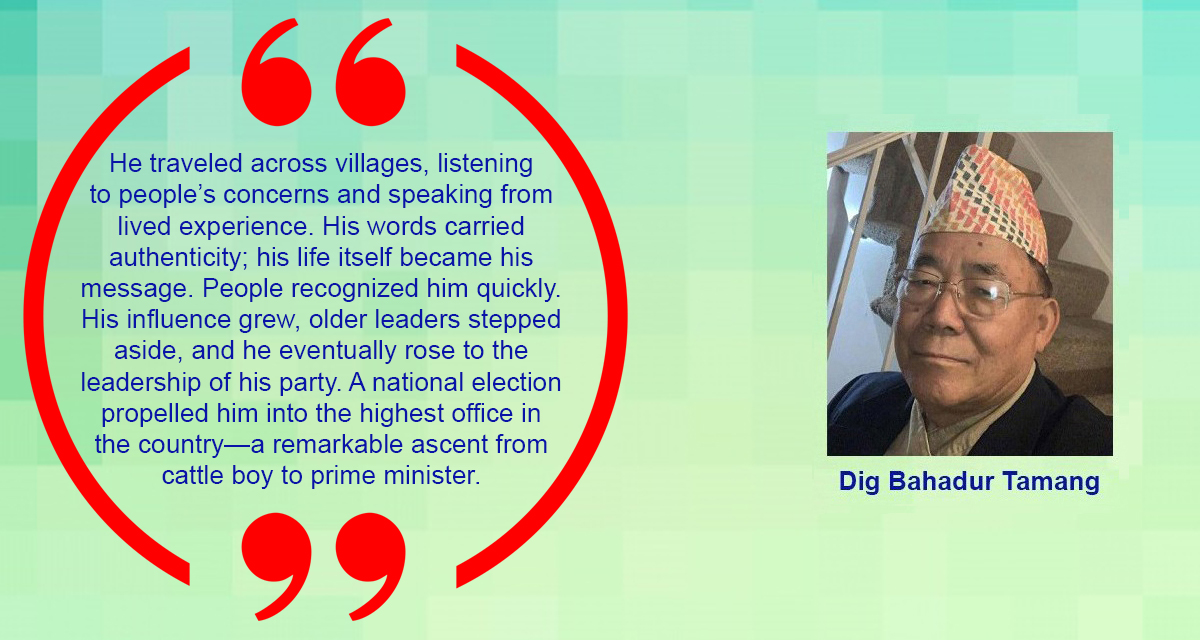
The world outside had changed, and so had he. Encouraged by former inmates and local supporters, he entered public life. He traveled across villages, listening to people’s concerns and speaking from lived experience. His words carried authenticity; his life itself became his message. People recognized him quickly. His influence grew, older leaders stepped aside, and he eventually rose to the leadership of his party. A national election propelled him into the highest office in the country—a remarkable ascent from cattle boy to prime minister.
Yet leadership brought its own complexities. Those close to him sought influence and opportunity. He entrusted significant responsibilities to individuals he believed he could rely on, but some decisions proved costly. Allegations surfaced—claims of foreign property, questions about documentation, and uncertainties regarding financial transactions. Public trust began to erode, and internal party tensions intensified.
Then came the youth driven movement of the previous year—a nationwide call for transparency, reform, and generational change. Led largely by young citizens, the demonstrations were peaceful yet powerful. Under mounting pressure, he stepped down from office. For a period, he remained within a military facility for his safety as the political climate shifted rapidly. Fresh elections brought a landslide victory for young leaders, and his party suffered a historic defeat. A new, reform minded prime minister took office. Soon after, legal proceedings were initiated, and he was arrested.
He returned to prison—the place he once believed he had left behind forever. Sitting on the cold floor of his cell, he reflected on the extraordinary arc of his life: from orphaned boy to herder, from prisoner to national leader, and back to prisoner again. Outside, supporters called his name while critics demanded accountability. His story, marked by resilience and contradiction, became a reminder that destiny often moves in circles, and that the measure of a life is not found in triumph or failure alone, but in the journey between them.
Facebook Comment
Related News




latest Video
Trending News
- This Week
- This Month