
Kathmandu’s Roads Are a Public Safety Emergency. How Many More Lives Must Be Lost ?

Kathmandu did not need another tragedy to understand the scale of its road safety crisis. Yet the death of Traffic Police Inspector Abhay Lama on April 12 has forced the city to confront a truth it has long tried to sidestep: the Valley’s roads are not merely inadequate — they are dangerous by design.
Inspector Lama, 33, was struck by a truck while riding home after his shift. He died later that day. His funeral, held on April 17, drew national attention when Home Minister Sudan Gurung joined senior police officials in carrying the officer’s body. The gesture was solemn and sincere. But gestures, however moving, do not fix broken systems. Kathmandu cannot honor its fallen officers with symbolism alone while the conditions that endanger them remain unchanged.
The Valley now holds more than two million registered motorcycles, along with a rapidly expanding fleet of cars, buses, and trucks. Yet the infrastructure supporting this explosion of vehicles is stuck in another era. Traffic lights fail with predictable regularity. Crosswalks are treated as optional. Sidewalks — where they exist — are blocked, crumbling, or simply unsafe. The city’s roads are a patchwork of narrow lanes, blind turns, and unmanaged intersections. For millions of residents, commuting has become an act of faith.
This is not a matter of inconvenience. It is a matter of life and death. Experts have been sounding the alarm for years. They have offered clear, actionable solutions: reliable traffic signals, enforceable pedestrian crossings, protected sidewalks, lane discipline, and modern traffic management systems. These are not radical ideas. They are the bare minimum for a functioning urban environment. Yet year after year, Kathmandu has chosen to look the other way.
The result is a city where preventable accidents are treated as routine, where pedestrians navigate roads with no safe passage, and where even trained officers — individuals tasked with protecting the public — are not safe on their way home. When a city’s roads become a hazard in themselves, the problem is not fate. It is policy.
Inspector Lama’s death should be the moment Kathmandu draws a line in the sand. It should be the point at which leaders acknowledge that piecemeal fixes and temporary patches are no longer enough. The Valley needs a comprehensive, enforceable, and sustained road safety strategy — one that prioritizes human life over convenience, political hesitation, or bureaucratic inertia.
A city that honors its security personnel must also protect the conditions in which they live and work. That responsibility extends to every resident who steps onto a road that has become a gamble. Kathmandu cannot continue to “make do” with infrastructure that was never designed for its current population or traffic load.
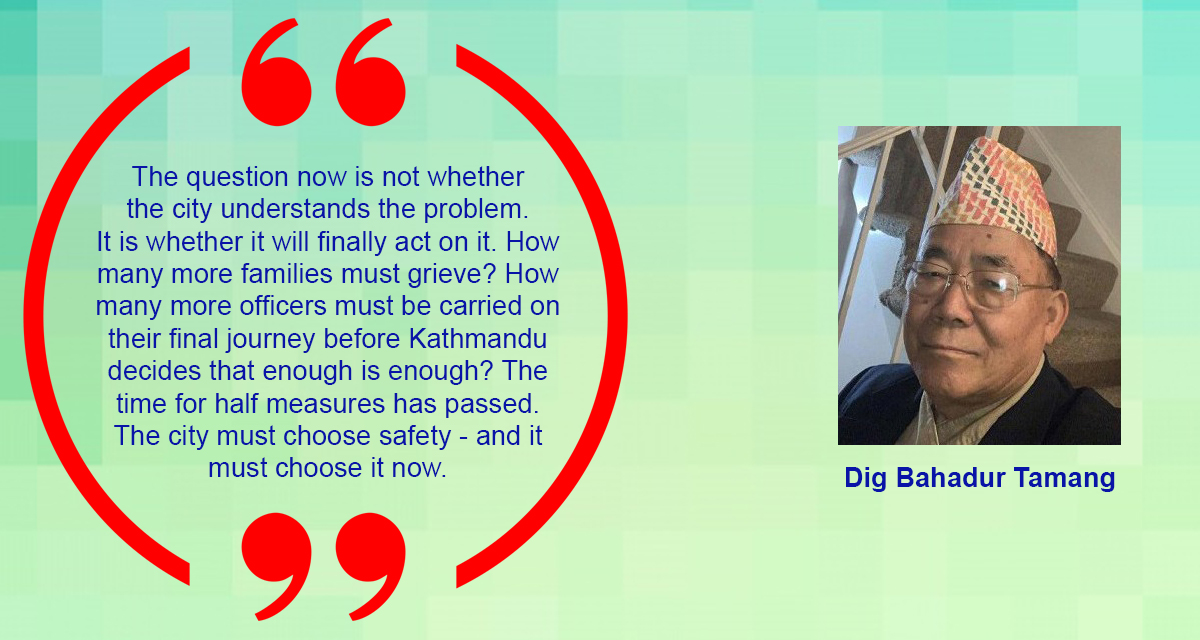
The question now is not whether the city understands the problem. It is whether it will finally act on it. How many more families must grieve? How many more officers must be carried on their final journey before Kathmandu decides that enough is enough?
The time for half measures has passed. The city must choose safety — and it must choose it now.
The writer’s prayers and heartfelt thoughts are with Traffic Inspector Abhaya Lama’s family as they navigate this unimaginable loss. No words can fully ease the pain of losing a son, a husband, a brother, or a colleague whose life was dedicated to public service. Yet it is my sincere hope that the outpouring of respect shown across the Valley offers them even a small measure of comfort in this dark hour. Inspector Lama served his community with courage and integrity, and his passing leaves a void felt far beyond his home. May his family find strength in the love that surrounds them, solace in the honor with which he served, and peace in knowing that his sacrifice has stirred a renewed call for safer roads and a more accountable system.
Facebook Comment
Related News
latest Video
Trending News
- This Week
- This Month