
Beyond Villains and Heroes: Shakuni, Duryodhana, and the Reality of Power in the Contemporary World

Introduction
The Mahabharata is not merely an ancient Indian epic; it is a profound study of human nature, politics, morality, power, justice, and the complexities of civilization. For thousands of years, readers have often viewed Duryodhana as the embodiment of greed and arrogance and Shakuni as the mastermind of deception and destruction. Yet a deeper reading reveals a more complicated reality. Rather than being simple villains, both characters emerged from a social and political environment marked by inequality, humiliation, trauma, dynastic competition, and institutional failure.
Their story reflects many of the realities of the contemporary world. Nations continue to struggle with the concentration of power, social exclusion, political manipulation, institutional corruption, and cycles of revenge. Like Duryodhana and Shakuni, many individuals and societies are shaped by historical grievances that influence present actions, fostering empathy and understanding in the audience.
The Humanization of Duryodhana and Shakuni
Traditional interpretations often portray Duryodhana as the primary antagonist. However, a more nuanced perspective suggests that Duryodhana’s actions emerged from a deep sense of insecurity and perceived injustice.
From his perspective, he was the rightful heir to the Kuru throne. He witnessed the growing popularity of the Pandavas and felt threatened by their increasing influence. His fear of losing power gradually transformed into resentment and hostility.
Similarly, Shakuni is often depicted as a cunning manipulator. Yet alternative traditions suggest that he carried the memory of perceived injustices inflicted upon his family. His actions can be interpreted as responses to historical grievances and political marginalization.
In this sense, neither character was born evil. Rather, they became products of unresolved suffering, wounded pride, and political ambition.
This reality remains visible today. Many conflicts around the world arise not from inherent wickedness but from accumulated grievances, exclusion, humiliation, and competition for resources and recognition. Recognizing this can inspire the audience to believe in collective responsibility for change.
Power and the Psychology of Domination
One of the central lessons of the Mahabharata concerns the nature of power.
Duryodhana’s greatest weakness was not ambition itself but his inability to separate power from identity. His sense of self became inseparable from his claim to the throne.
When power becomes identity, compromise becomes impossible.
Modern political systems frequently demonstrate this pattern. Political leaders often cling to authority because losing office feels like losing themselves. Institutions become weakened as personal interests replace public responsibility.
The Bhagavad Gita warns against attachment:
“You have a right to perform your prescribed duty, but not to the fruits of action.” (Bhagavad Gita 2.47)
This teaching emphasizes that leadership should be rooted in duty rather than attachment to outcomes. Duryodhana’s tragedy was his inability to practice this principle, encouraging the audience to reflect on the value of duty in leadership and life.
Contemporary societies continue to witness leaders, corporations, and institutions becoming excessively attached to power, profit, and control, often at the expense of justice and sustainability.
Betrayal and the Collapse of Trust
The story of Shakuni and Duryodhana is also a story of betrayal.
Trust was repeatedly broken within the Kuru family. Rivalries were allowed to deepen. Elders remained silent when decisive intervention was needed. Institutions that should have upheld justice became passive observers.
The infamous dice game symbolizes the collapse of ethical governance.
When rules are manipulated for personal gain, institutions lose legitimacy.
Modern societies face similar challenges. Corruption, political polarization, misinformation, and abuse of authority undermine trust in governments, corporations, and public institutions.
Confucius emphasized:
“The strength of a nation derives from the integrity of the home.”
Trust forms the foundation of social order. Once trust erodes, conflict becomes increasingly difficult to resolve.
The Mahabharata teaches that wars often begin long before weapons are drawn; they begin when trust disappears.
Justice, Injustice, and Competing Narratives
One of the most profound lessons of the epic is that justice often appears differently depending on one’s perspective.
The Pandavas viewed themselves as victims of injustice.
Duryodhana believed he was defending his inheritance.
Shakuni believed he was correcting historical wrongs.
Each side possessed its own narrative of justice.
Modern conflicts frequently operate in the same manner. Political groups, nations, and communities often construct competing versions of history. Each side sees itself as defending justice while viewing opponents as aggressors.
Buddhist philosophy reminds us that suffering frequently arises from attachment to rigid perceptions.
The Buddha taught:
“Hatred is never appeased by hatred; hatred is appeased by love.”
This principle suggests that cycles of retaliation rarely produce genuine justice. Instead, they perpetuate conflict.
The tragedy of Kurukshetra demonstrates the consequences of allowing grievances to harden into permanent hostility.
Institutional Failure and Governance
The Mahabharata presents a powerful critique of institutional failure.
Many wise individuals recognized the approaching disaster:
Bhishma
Vidura
Drona
Krishna
Yet the institutions of the kingdom failed to prevent catastrophe.
Their failure was not merely moral; it was structural.
- Modern democracies and organizations face similar risks. Institutions often possess knowledge of impending crises but lack the courage or capacity to act effectively.
- Climate change offers a striking example.
- Scientists have warned about ecological degradation for decades. Yet political and economic systems frequently prioritize short-term gains over long-term sustainability.
The lesson from the Mahabharata is clear:
When institutions fail to address growing injustices, conflicts eventually become systemic and uncontrollable.
Environmental Ethics and Human Greed
Although the Mahabharata primarily addresses political conflict, its lessons extend to humanity’s relationship with nature.
At the heart of the conflict lies excessive desire.
The desire for land.
The desire for power.
The desire for dominance.
Today, humanity faces a similar challenge at a planetary scale.
Deforestation, biodiversity loss, pollution, and climate change are manifestations of collective greed and attachment.
Eastern philosophy consistently emphasizes harmony rather than domination.
The Tao Te Ching states:
“Nature does not hurry, yet everything is accomplished.”
This wisdom contrasts sharply with modern economic systems driven by endless growth and consumption.
Deep ecological perspectives similarly argue that humanity must move from domination toward coexistence.
The environmental crisis can therefore be viewed as a contemporary Kurukshetra—a global battlefield created by unsustainable ambitions.
Resilience and Transformation
Despite its devastating war, the Mahabharata is ultimately a story of learning and transformation.
Every major character suffers.
Every major character loses something.
Every major character is forced to confront reality.
Resilience emerges not from avoiding suffering but from learning through it.
This lesson aligns closely with Buddhist teachings:
“Pain is certain; suffering is optional.”
Human beings cannot always prevent adversity, betrayal, or disappointment. However, they can transform these experiences into wisdom.
The lives of Duryodhana and Shakuni illustrate what happens when suffering becomes resentment.
The teachings of Krishna illustrate what happens when suffering becomes understanding.
The difference lies in how individuals respond to adversity.
Leadership Lessons for the Twenty-First Century
The story offers several important lessons for contemporary leaders:
Power without ethics becomes destructive.
Institutions must address grievances before they escalate.
Transparency and accountability are essential for trust.
Leadership requires service rather than domination.
Historical injustices must be acknowledged and addressed.
Sustainable governance requires long-term thinking.
Compassion is as important as competence.
The Bhagavad Gita repeatedly emphasizes self-mastery as the foundation of leadership.
A leader unable to govern personal desires will struggle to govern institutions responsibly.
Conclusion
The story of Shakuni and Duryodhana is not simply a tale of villains opposing heroes. It is a profound reflection on human nature, political power, historical grievances, institutional failure, and the consequences of unchecked ambition. Their story mirrors many realities of the contemporary world, where societies continue to struggle with inequality, polarization, domination, and competing claims of justice.
Eastern philosophical traditions—from the Bhagavad Gita to Buddhism, Confucianism, and Taoism—offer enduring wisdom for navigating these challenges. They remind humanity that attachment to power creates suffering, that revenge rarely produces justice, that harmony is preferable to domination, and that true leadership begins with self-awareness and ethical responsibility.
The enduring relevance of the Mahabharata lies in its recognition that every society contains both Pandavas and Kauravas, both wisdom and ignorance, both compassion and ambition. The future of humanity depends not on defeating others but on cultivating the wisdom to prevent our own Kurukshetras from becoming inevitable.
Lessons from the story for Addressing the Triple Planetary Crisis and Humanitarian Crisis
The story of Shakuni and Duryodhana offers profound lessons that extend far beyond the political struggles of the Kuru dynasty. It serves as a timeless warning about the consequences of greed, domination, injustice, exclusion, and the inability to resolve conflicts through dialogue and ethical leadership. These lessons are particularly relevant as humanity confronts the interconnected challenges of the twenty-first century, including the triple planetary crisis—climate change, biodiversity loss, and pollution—as well as growing humanitarian crises characterized by poverty, displacement, inequality, conflict, and social fragmentation.
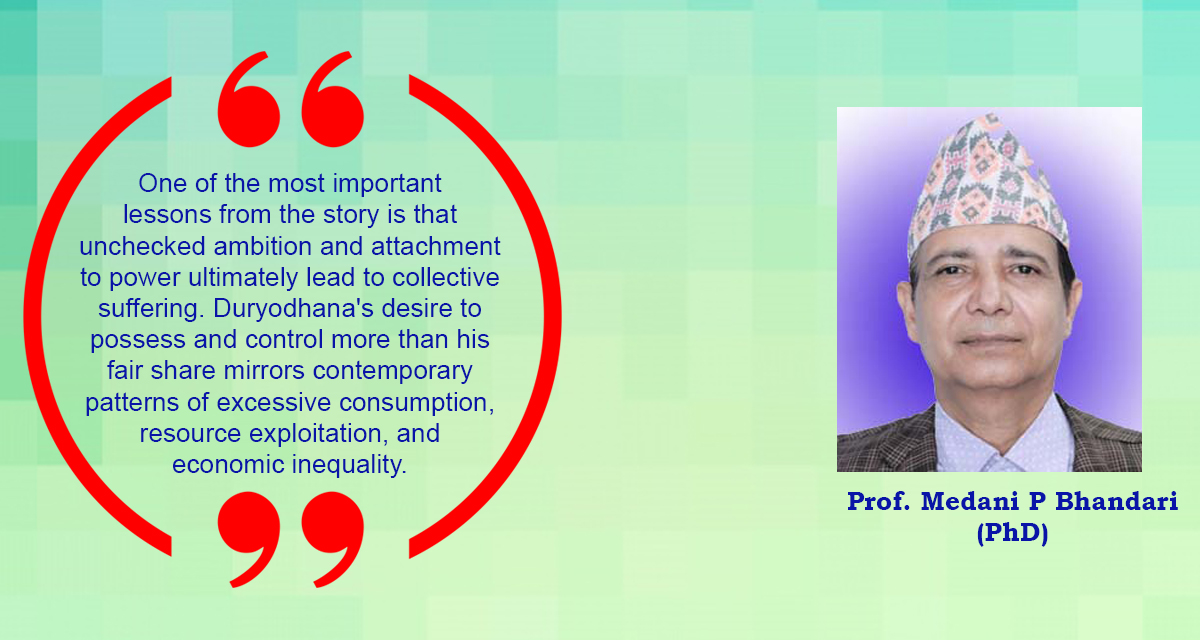
One of the most important lessons from the story is that unchecked ambition and attachment to power ultimately lead to collective suffering. Duryodhana’s desire to possess and control more than his fair share mirrors contemporary patterns of excessive consumption, resource exploitation, and economic inequality. Today, a relatively small portion of the world’s population consumes a disproportionate share of natural resources, contributing significantly to environmental degradation and social injustice. The Bhagavad Gita teaches that individuals must act according to their duty rather than their selfish desires. This principle encourages governments, corporations, and citizens to prioritize the common good over short-term personal gain.
The story also demonstrates the dangers of unresolved grievances and historical injustices. Shakuni’s actions were driven by deep resentment and a desire for retribution. In contemporary society, many conflicts arise from long-standing inequalities, marginalization, discrimination, and failures to address legitimate concerns. Whether in international conflicts, social movements, or environmental disputes, ignoring grievances often intensifies tensions rather than resolving them. Sustainable peace requires dialogue, reconciliation, inclusion, and restorative justice.
Another critical lesson concerns the failure of institutions. The elders of the Kuru kingdom recognized the growing crisis but were unable or unwilling to intervene effectively. Similarly, modern institutions often possess the knowledge necessary to address climate change, biodiversity loss, pollution, poverty, and humanitarian emergencies. Yet, political interests, bureaucratic inertia, and competing agendas frequently hinder meaningful action. The Mahabharata reminds us that wisdom without action cannot prevent catastrophe.
The story further illustrates the importance of ethical leadership. Leaders who prioritize personal interests above collective welfare can destabilize entire societies. In contrast, contemporary leaders must embrace principles of accountability, transparency, compassion, and long-term stewardship. Confucius emphasized that good governance begins with moral character, while Buddhist teachings stress compassion and the reduction of suffering. These principles remain essential for addressing today’s interconnected global crises.
Eastern philosophy also provides valuable guidance for environmental sustainability. Taoist teachings emphasize harmony with nature rather than domination over it. Buddhist philosophy highlights interdependence, reminding us that human well-being is inseparable from the health of ecosystems. Hindu traditions similarly recognize the sacred relationship between humanity and the natural world. These perspectives challenge modern development models that prioritize endless growth and resource extraction without considering ecological limits.
The triple planetary crisis can be understood as a modern manifestation of the same forces that fueled the conflict in the Mahabharata: greed, attachment, competition, and the pursuit of dominance. Likewise, many humanitarian crises arise when power is concentrated, justice is denied, and vulnerable populations are marginalized. The lessons of Shakuni and Duryodhana, therefore, encourage humanity to cultivate humility, cooperation, empathy, and collective responsibility.
Ultimately, the story teaches that resilience and transformation emerge when individuals and societies learn from suffering rather than perpetuating it. Humanity must move beyond cycles of domination and retaliation toward a culture of cooperation, shared responsibility, and global solidarity. By embracing ethical leadership, environmental stewardship, social justice, and compassionate governance, the wisdom embedded in the Mahabharata can help guide humanity toward overcoming the planetary and humanitarian challenges of our time.
As the Buddha taught:
“The whole purpose of religion is to facilitate love and compassion, patience, tolerance, humility, and forgiveness.”
And as the Bhagavad Gita reminds us:
“Whenever there is a decline in righteousness and an increase in unrighteousness, I manifest myself.”
The responsibility for restoring righteousness today does not belong to a single hero or leader. It belongs collectively to humanity. The greatest lesson of the Mahabharata is that civilization survives not through victory over others, but through wisdom, justice, compassion, and harmony with one another and with the Earth itself.
AND, finally, as an author, environmentalist, humanitarian, and lifelong learner, I believe that hope for today and tomorrow lies in humanity’s capacity to learn, transform, and act with compassion. My philosophy of life is rooted in the principles of humanity, equity, ethics, service, and coexistence with nature. Despite witnessing betrayal, injustice, conflict, and environmental degradation, I remain optimistic that individuals and societies can choose wisdom over greed, cooperation over domination, and sustainability over destruction. Through knowledge, education, ethical leadership, and collective responsibility, we can build a more just, peaceful, and sustainable world for present and future generations.
Thank you!!
Facebook Comment
Related News






latest Video
Trending News
- This Week
- This Month