
Unlocking Nepal’s Global Potential Through Continuation of Citizenship by Birth

Non-Resident Nepalis (NRNs) are Nepalis who live outside Nepal but remain deeply connected to their homeland through family, culture, investment, language, and identity. Over the past several decades, millions of Nepalis have migrated abroad in pursuit of education, employment, business opportunities, and improved living conditions. Many have subsequently acquired foreign citizenship for practical reasons related to work, mobility, family, and long-term settlement.
Under Nepal’s current framework, acquiring foreign citizenship generally results in the loss of Nepali citizenship, with the option of obtaining a separate Non-Resident Nepali (NRN) citizenship that provides limited rights.
A growing number of NRNs believe that this approach fails to recognize a fundamental reality: individuals who were born Nepali citizens remain Nepali by origin, ancestry, culture, and identity, regardless of where they reside or what passport they hold.
The question is therefore not whether NRNs deserve special treatment. Rather, it is whether Nepal should discontinue citizenship acquired by birth and replace it with a limited alternative, or whether it should allow continuation of original citizenship while appropriately regulating political rights and responsibilities.
This discussion is not only about citizenship. It is about Nepal’s future relationship with millions of Nepalis living around the world and how the nation can best harness one of its greatest global assets.
Citizenship by Birth Is Not a Privilege—It Is an Inherent Status
Citizenship acquired by birth or descent is fundamentally different from citizenship acquired through naturalization.
A Nepali citizen by birth did not obtain citizenship through investment, residency, or administrative approval. Citizenship was acquired through birth, family lineage, and an enduring connection to Nepal. While an individual may acquire a foreign passport later in life, they cannot change their birthplace, ancestry, language, culture, or historical ties to Nepal.
Migration may change where a person lives, but it does not erase who they are.
The continuation of original citizenship therefore recognizes an existing reality rather than creating a new privilege. It acknowledges that millions of Nepalis abroad remain Nepali in every meaningful historical, cultural, and familial sense.
For this reason, the discussion should focus on managing rights and responsibilities associated with citizenship rather than terminating citizenship acquired by birth.
Sentiment, Identity, and Lifelong Connection
For many NRNs, citizenship is more than a legal document. It represents identity, belonging, heritage, and emotional attachment to Nepal.
Despite living abroad, NRNs continue to celebrate Nepali festivals, speak Nepali languages, preserve cultural traditions, and pass these values to future generations. Across the United States, Europe, Australia, Asia, and the Middle East, Nepali communities have established temples, cultural centers, educational programs, and community organizations dedicated to preserving Nepali identity.
Examples include Nepali-led initiatives to establish Pashupati and Buddha temples in cities such as Washington DC, Baltimore, New York, Boston, Texas, California, and many others. Community organizations continue to promote Nepali language, literature, culture, and traditions among younger generations born outside Nepal.
The continuation of original citizenship would strengthen these lifelong connections and reaffirm Nepal’s relationship with its global population.
Nepal Already Benefits Enormously from Its Diaspora
The contribution of NRNs extends far beyond remittances.
Throughout the years, NRNs have invested in schools, colleges, hospitals, banks, insurance companies, hydropower projects, technology ventures, tourism enterprises, and charitable organizations across Nepal.
NRNs played a significant role during the aftermath of the 2015 earthquake and the COVID-19 pandemic by mobilizing donations, medical supplies, technical expertise, and international support. They have consistently supported families, communities, and development initiatives throughout the country.
Many NRNs have become successful entrepreneurs, scientists, engineers, academics, healthcare professionals, and business leaders abroad. Their knowledge, expertise, and international networks represent valuable resources that Nepal can leverage for national development.
The Nepali diaspora should therefore be viewed not as a group seeking privileges, but as one of Nepal’s greatest strategic assets.
The challenge is not whether NRNs should remain connected to Nepal. The challenge is how Nepal can strengthen and maximize that connection for the benefit of the nation.
Economic Benefits, Investment, and Knowledge Transfer
Allowing continuation of original citizenship would create a stronger environment for investment, entrepreneurship, and long-term engagement.
NRNs are often willing to invest in Nepal but face uncertainty regarding citizenship status, property rights, administrative procedures, and long-term legal security. Continuation of original citizenship would reduce these barriers and encourage greater participation in economic development.
In addition to financial investment, NRNs facilitate technology transfer, management expertise, research collaboration, professional training, and global business partnerships. These contributions help strengthen Nepal’s competitiveness in an increasingly interconnected world.
A stronger relationship with NRNs would encourage not only capital inflows but also innovation, entrepreneurship, and job creation.
Global Competition for Diaspora Engagement
The twenty-first century has transformed how nations engage with their citizens abroad.
Countries increasingly recognize that their diaspora communities represent valuable sources of investment, expertise, innovation, entrepreneurship, and international influence. As a result, many countries have adopted dual citizenship or equivalent arrangements to maintain strong ties with their overseas populations.
Countries such as the United States, Canada, the United Kingdom, Australia, New Zealand, Germany, South Korea, Switzerland, and many others have developed frameworks that recognize the value of maintaining relationships with citizens living abroad.
In today’s world, countries compete not only for foreign investment but also for the engagement of their diaspora networks.
Nepal should position itself to benefit from this global reality rather than create unnecessary barriers between the country and millions of Nepalis living overseas.
Demographic Reality and Nepal’s Future
Migration is not a temporary phenomenon. It has become a structural reality of modern Nepal.
For generations, Nepalis have migrated from villages to cities, from the hills to the Terai, and increasingly to destinations around the world. Migration has been driven by education, employment, economic opportunity, and global mobility.
The policy question is therefore not whether migration should occur. Migration is already occurring and will continue.
The real question is whether Nepal wishes to maintain meaningful and productive relationships with those citizens after they leave.
As Nepal faces demographic challenges, workforce shortages in certain sectors, and continued outward migration of young professionals, maintaining strong connections with its global population becomes increasingly important.
A modern citizenship policy should recognize this reality and create pathways for engagement rather than permanent separation.
Citizenship Continuation Encourages Return Migration
Many NRNs do not view migration as a permanent departure from Nepal.
A significant number hope to return later in life, establish businesses, invest in communities, retire in Nepal, support family members, or contribute their international experience to national development.
Continuation of original citizenship lowers barriers to return migration and long-term reinvestment. It provides confidence and legal certainty to individuals considering future engagement with Nepal.
Rather than encouraging detachment, citizenship continuation increases the likelihood that successful Nepalis abroad will bring their skills, capital, professional networks, and expertise back to Nepal.
Unpaid Ambassadors of Nepal
Non-Resident Nepalis (NRNs) function as informal ambassadors of Nepal across the world.
They actively promote Nepali culture, traditions, tourism, education, and business opportunities within their host countries. Through everyday community engagement and organized initiatives, they introduce Nepal to foreign societies, advocate for Nepal’s interests, and help build meaningful bridges between Nepal and the international community.
Their contribution extends beyond formal representation. Across continents, Nepali communities regularly organize cultural and social activities that preserve and showcase Nepal’s identity. These include traditional ceremonies such as weddings, Bratabandha, and Pasni, as well as public celebrations of festivals, Nepali Day events, literary programs, cultural performances, picnics, and community gatherings.
Through these activities, Nepalis abroad continuously project Nepal’s cultural richness, values, and social traditions to wider audiences. They also help younger generations born outside Nepal remain connected to their heritage.
Despite these sustained and voluntary contributions, their role in enhancing Nepal’s international visibility and reputation is often underrecognized. In reality, this global cultural presence generates long-term soft power benefits for Nepal, strengthening its identity and global image in ways that are both organic and enduring.
A New Political Context: Gen Z Movement, RSP, and Modern Leadership
The context of this discussion has evolved significantly in recent years.
The rise of the Gen Z civic movement and growing public demand for transparency, accountability, institutional reform, and merit-based governance have challenged many traditional assumptions about Nepal’s future.
The emergence of leaders such as Prime Minister Balen Shah and the rise of the Rastriya Swatantra Party (RSP) reflect a broader shift toward practical solutions, innovation, expertise, and results-oriented leadership.
Rabi Lamichhane’s journey is particularly relevant to the citizenship debate. Having previously lived abroad and held foreign citizenship status, he represents the experience of many Nepalis who left Nepal, gained international exposure, and later returned to contribute to national development.
His experience demonstrates that migration does not diminish one’s commitment to Nepal. On the contrary, international exposure often strengthens an individual’s capacity to contribute knowledge, skills, professional networks, and innovative ideas.
This evolving political environment presents an opportunity to rethink outdated assumptions regarding migration and citizenship and to view the global Nepali community as a strategic national asset.
Citizenship and Political Power Are Separate Issues
One of the most common concerns regarding continuation of citizenship is the possibility that individuals holding foreign citizenship could exercise undue political influence within Nepal.
This concern deserves serious consideration.
However, citizenship and political authority are separate issues.
Citizenship reflects identity, ancestry, family connections, cultural belonging, property rights, and national affiliation. Political authority involves voting, contesting elections, holding public office, and exercising direct governmental power.
A balanced policy would therefore:
- Allow continuation of original citizenship by birth or descent.
- Permit full participation in economic, social, cultural, and developmental activities.
- Require declaration of foreign citizenship status.
- Restrict voting rights, candidacy, and public office while foreign citizenship is retained.
- Impose strict penalties for violations.
Such an approach protects Nepal’s sovereignty while maximizing the contributions of its global diaspora.
Responding to Anti-Migration Narratives
The citizenship debate has often been influenced by political narratives that portray migration as a sign of diminished loyalty to Nepal.
Over the years, some politicians and public figures have expressed concerns regarding migration, dual citizenship, and the role of Non-Resident Nepalis (NRNs) in Nepal’s future. These concerns are often rooted in the traditional view that citizens who leave the country become less committed to its interests. While such concerns may have been understandable in the past, they reflect a limited understanding of today’s highly interconnected world and a lack of foresight regarding the direction of globalization and international mobility.
The reality of the twenty-first century is very different from that of previous generations. People now routinely live, study, work, invest, and build families across multiple countries while maintaining strong cultural, economic, and emotional ties to their country of origin.
Concerns regarding political participation, national sovereignty, and conflicts of interest deserve serious discussion. However, broader criticism of migrants often overlooks the immense contributions made by Nepalis living abroad and the opportunities they create for Nepal.
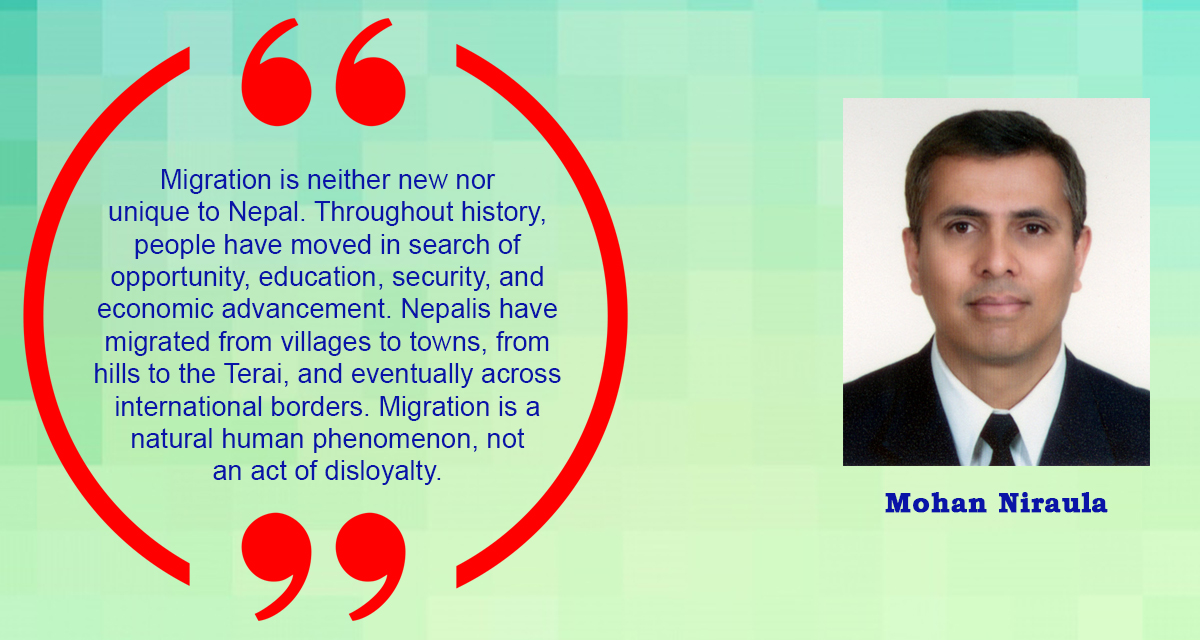
Migration is neither new nor unique to Nepal. Throughout history, people have moved in search of opportunity, education, security, and economic advancement. Nepalis have migrated from villages to towns, from hills to the Terai, and eventually across international borders. Migration is a natural human phenomenon, not an act of disloyalty.
The decision to migrate should not be interpreted as a rejection of Nepal. In many cases, migration occurred because domestic opportunities were insufficient to meet the aspirations, talents, and potential of citizens. Many Nepalis abroad continue to support family members, invest in businesses, promote Nepali culture, and contribute to national development.
The success of Nepalis abroad should therefore be viewed as a national achievement rather than a national loss. Their accomplishments reflect the resilience, hard work, and capabilities of the Nepali people.
A confident nation does not fear the global success of its citizens. Instead, it seeks ways to engage them, learn from them, and encourage them to contribute to national development.
The question is not whether Nepalis living abroad remain Nepali. The more important question is whether Nepal possesses the vision and confidence to embrace its global Nepali community as a source of strength rather than viewing it through the lens of outdated assumptions.
The countries that have benefited most from their overseas populations are those that recognized this reality early and adapted their laws accordingly. Nepal should do the same.
Conclusion
Nepal stands at an important moment in its history. The current government has expressed a clear commitment to engaging with Non-Resident Nepalis (NRNs) as strategic partners in national development, recognizing their skills, knowledge, global exposure, and access to technology, capital, and international networks. This forward-looking approach reflects a growing understanding that nation-building in the twenty-first century is not limited by geography but strengthened through global connectivity.
The country is increasingly linked to a global Nepali community that holds significant financial resources, professional expertise, entrepreneurial experience, and a deep emotional attachment to Nepal. In this context, strengthening legal and institutional ties with Nepalis abroad is both timely and necessary.
Allowing the continuation of original citizenship is not merely an emotional matter. It is a constitutional, economic, demographic, and strategic issue. It recognizes that citizenship acquired by birth is an inherent and enduring status, not a temporary privilege granted by the state. It also acknowledges that migration does not diminish identity, ancestry, or belonging.
With appropriate safeguards to protect political sovereignty and national security, Nepal can strengthen its engagement with millions of Nepalis living abroad while maintaining the integrity of its democratic system. Such a framework would support increased investment, innovation, technology transfer, return migration, cultural preservation, and stronger global representation of Nepal.
Ultimately, the continuation of citizenship by birth is not about granting special treatment, but about aligning national law with contemporary realities and the country’s development priorities. It complements the government’s own vision of working in partnership with NRNs and transforming their global experience into a source of national strength.
A forward-looking Nepal does not see distance as disconnection. Instead, it recognizes opportunity in its global citizens and builds systems that allow every Nepali—wherever they live—to contribute meaningfully to the nation’s progress.
Facebook Comment
Related News
latest Video
Trending News
- This Week
- This Month