
When Dharma Becomes a Mask: The Hidden Untrust That Breaks Families from Within
The greatest violence is not always physical. Sometimes it is inflicted through words, silence, manipulation, and the hypocrisy of pretending to be righteous.

Every society teaches the importance of dharma—righteousness, morality, compassion, truthfulness, and responsibility. From the Vedas to the Upanishads, from the Ramayana to the Mahabharata, from the teachings of the Buddha to the words of Christ, Confucius, Socrates, and modern psychologists, humanity has repeatedly been reminded that the true measure of a person is not what they proclaim publicly but how they treat those who depend upon them privately.
Yet one of the most painful contradictions of human civilization is that some individuals appear extraordinarily virtuous in public while becoming the source of relentless emotional suffering in their own homes. They pray loudly, speak eloquently about morality, quote sacred scriptures, attend religious ceremonies, donate generously, and project an image of kindness. Behind closed doors, however, they manipulate, humiliate, intimidate, and systematically diminish the confidence and dignity of those closest to them.
Such people rarely raise their hands.
Instead, they slowly break hearts.
Their weapons are words, silence, ridicule, comparison, emotional neglect, humiliation, guilt, and psychological domination.
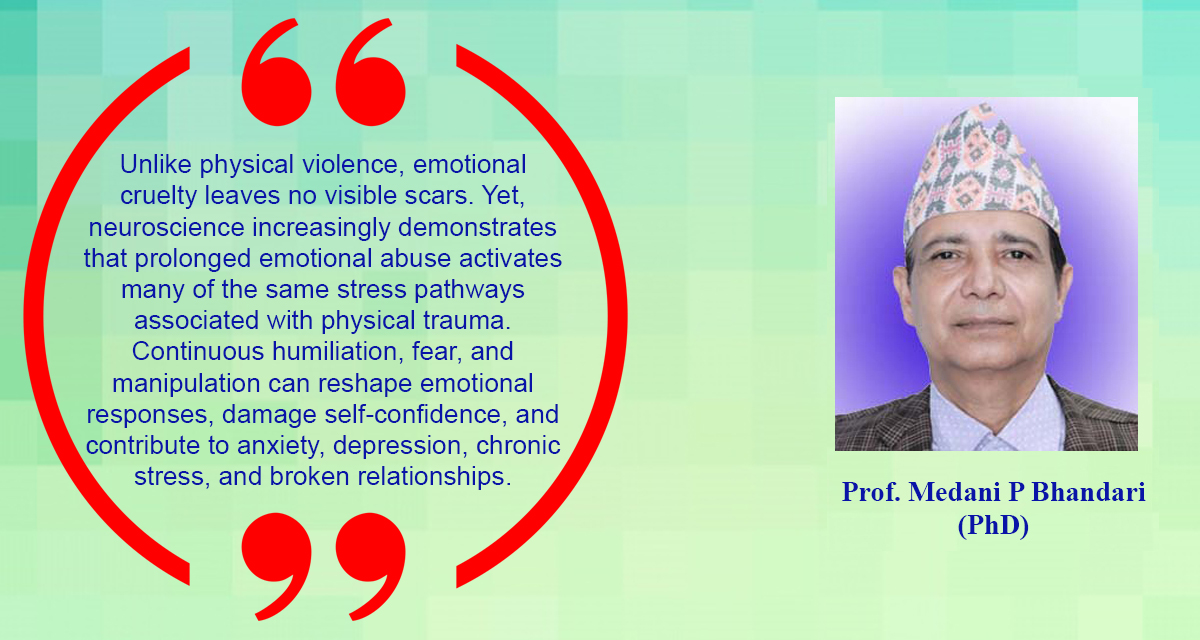
Unlike physical violence, emotional cruelty leaves no visible scars. Yet, neuroscience increasingly demonstrates that prolonged emotional abuse activates many of the same stress pathways associated with physical trauma. Continuous humiliation, fear, and manipulation can reshape emotional responses, damage self-confidence, and contribute to anxiety, depression, chronic stress, and broken relationships.
Ancient wisdom understood this long before modern psychology.
The Ramayana presents one of history’s most profound lessons about appearances. Ravana was no ordinary villain. He was an extraordinary scholar, a master of the Vedas, a gifted musician, a capable administrator, and a devoted worshipper of Lord Shiva. His knowledge was immense.
Yet knowledge without humility became arrogance.
Power without compassion became tyranny.
Devotion without self-control became destruction.
Ravana did not fall because he lacked intelligence.
He fell because his ego conquered his wisdom.
The lesson remains timeless: religious rituals alone cannot transform a person whose heart refuses compassion.
The Mahabharata offers equally powerful examples.
Shakuni rarely fought directly.
His battlefield was the human mind.
He planted suspicion where trust existed.
He encouraged jealousy where affection flourished.
He transformed minor disagreements into catastrophic conflicts.
His greatest weapon was psychological manipulation.
Even more revealing is the story of Duryodhana. Despite receiving guidance from Bhishma, Vidura, Krishna, and countless wise teachers, he remained imprisoned by envy and resentment. He publicly defended what he called justice while privately nurturing hatred.
The Mahabharata repeatedly reminds us that the greatest wars begin not on battlefields but inside human minds.
Lord Krishna never defined dharma merely by external rituals. Instead, the Bhagavad Gita describes the qualities of a truly wise person: humility, self-control, compassion, truthfulness, forgiveness, absence of hatred, steadiness, and equanimity.
These qualities cannot be performed.
They must be lived.
The Buddha expressed the same truth with remarkable simplicity:
“Hatred does not cease by hatred, but only by love.”
Modern psychology calls this emotional regulation.
Buddhism called it wisdom twenty-five centuries ago.
World literature repeatedly explores this hidden darkness within human nature.
William Shakespeare’s Iago in Othello is perhaps one of literature’s greatest masters of concealed cruelty. He smiles while destroying lives. He never attacks openly. Instead, he whispers doubts, manipulates perceptions, and slowly poisons trust until relationships collapse under the weight of suspicion.
Similarly, in King Lear, betrayal comes not from declared enemies but from those who feign loyalty while pursuing their own interests. Shakespeare understood that deception often hides beneath pleasant appearances.
The Russian novelist Fyodor Dostoevsky explored another dimension of inner cruelty. His characters reveal that the deepest human conflicts originate not from external enemies but from unresolved pride, fear, guilt, insecurity, and wounded ego.
Modern psychology reaches similar conclusions.
Individuals who constantly demoralize others often seek psychological control rather than mutual understanding. Every other person’s success feels threatening. Every independent opinion becomes rebellion. Every joyful moment becomes an opportunity for criticism.
Family members gradually begin walking on emotional eggshells.
Children stop expressing themselves.
Spouses lose confidence.
Parents grow silent.
Even celebrations become sources of anxiety because criticism inevitably follows.
This pattern exists in every culture.
Nepal is no exception.
In our society, preserving family harmony is deeply valued. Respect for elders, collective living, and maintaining relationships are among our greatest cultural strengths. Yet these same values can sometimes discourage people from speaking openly about emotional suffering within families. Many silently endure years of manipulation because they fear social judgment, family dishonor, or being misunderstood.
Silence, however, should never become a sanctuary for emotional cruelty.
Compassion does not require surrendering one’s dignity.
Forgiveness does not mean accepting repeated abuse.
Respect should never become submission to injustice.
This is where true dharma differs fundamentally from blind obedience.
Authentic spirituality never asks us to tolerate cruelty.
Rather, it encourages courage, wisdom, compassion, and justice.
How should families respond when emotional cruelty dominates the household?
The first responsibility is to recognize reality without hatred. Denial only prolongs suffering.
Second, establish healthy emotional boundaries. Protecting one’s mental well-being is neither selfish nor disrespectful.
Third, avoid responding with equal hostility. Cruelty often feeds upon emotional reactions. Calmness preserves clarity.
Fourth, seek trusted support. Wise relatives, friends, counselors, respected community leaders, or mental health professionals can provide perspective that victims often lose after years of manipulation.
Finally, remember that some individuals who behave cruelly may themselves struggle with severe depression, unresolved trauma, personality difficulties, or profound emotional pain. Understanding these possibilities can foster compassion—but compassion should never excuse continued emotional abuse. Healing requires both empathy and accountability.
Perhaps the greatest lesson from our sacred texts is remarkably simple.
No scripture teaches that performing rituals while humiliating one’s family is righteousness.
No religion praises cruelty hidden beneath sacred clothing.
No philosophy celebrates hypocrisy.
Real spirituality begins at home.
If prayer does not make us kinder, we have misunderstood prayer.
If meditation does not reduce our anger, we have misunderstood meditation.
If religion increases our ego instead of our compassion, we have misunderstood religion itself.
The measure of character is not how loudly we speak about virtue but how gently we speak to those who cannot escape our words.
History remembers Ravana not for his scholarship but for his arrogance.
History remembers Shakuni not for his intelligence but for his manipulation.
History remembers Iago not for his loyalty but for his deception.
Conversely, humanity remembers Lord Rama, Lord Buddha, Mahatma Gandhi, and many other moral exemplars because compassion consistently guided their actions.
Our homes should become places where kindness is stronger than criticism, where encouragement replaces humiliation, where truth overcomes manipulation, and where love is measured not by public appearances but by everyday conduct.
A peaceful nation begins with peaceful families.
A peaceful family begins with emotionally responsible individuals.
And true dharma begins not in temples, monasteries, churches, or mosques—but in the human heart.
Living with someone who habitually humiliates, criticizes, or undermines others is emotionally exhausting. Whether these behaviors arise from insecurity, a desire for control, unresolved emotional struggles, or other causes, they should never be accepted as normal. The wisest response is neither retaliation nor silent surrender. Maintain your dignity, establish healthy boundaries, refuse to internalize unfair criticism, and seek support from trusted family members, friends, or professionals when necessary. Do not allow another person’s negativity to define your worth or your future. Ultimately, those who consistently diminish others reveal more about their own inner conflicts than about the character, abilities, or value of the people they seek to discourage.
Thank you!!
Facebook Comment
Related News


latest Video
Trending News
- This Week
- This Month