
The Doctor of the Unspoken: Why the World Needs Veterinarians More Than Ever

There are professions the world celebrates loudly, and there are professions the world depends on silently. Veterinary medicine belongs to the second kind. It rarely appears on the front page, rarely becomes a subject of public pride, and rarely receives the respect it quietly earns every day. Yet without veterinarians, the very foundations of society i.e. safe food, healthy communities, resilient farming, and protection from deadly outbreaks would begin to shake. World Veterinary Day should be a day of honest reflection, because the veterinary profession is no longer limited to the treatment of animals. Today, veterinarians stand at the heart of global survival. They are the guardians of food systems, the first line of defense against zoonotic diseases, and the overlooked protectors of public health. Their work is not glamorous, but it is indispensable.
The simplest way to understand the importance of veterinarians is to look at a village household. In Nepal, an animal is not just an animal. A buffalo means daily income. A goat means emergency money. A cow means nutrition for children. Poultry means quick cash when a family needs to buy books, pay rent, or cover medical expenses. Livestock is the most accessible form of wealth for rural communities, especially where banking systems and formal savings are limited. When disease enters a farm, it does not only affect an animal’s body. It affects the household’s economy, the family’s stability, and sometimes the dignity of people who have worked for years to build a small but meaningful source of security. A veterinarian walking into a farm is not a clinician, they are a protector of someone’s future. When they treat mastitis in a dairy buffalo, they are saving the milk supply that supports a family. When they manage a difficult calving, they are saving not only two lives, but also the hope attached to those lives. When they control parasites, improve feeding advice, or recommend vaccination schedules, they are building resilience. Their work does not end when the animal stands up and eats again. The impact stays for months, sometimes years. But what makes veterinary medicine unique is that it is a profession of prevention more than treatment. And prevention, by nature, is invisible. Nobody celebrates a disease that did not occur. Nobody writes headlines about an outbreak that was stopped early. Nobody claps for a vaccination program that quietly saved thousands of animals from dying. Success in veterinary medicine often looks like “nothing happened,” and that is exactly why the profession is misunderstood. Society tends to admire dramatic rescue rather than silent protection. Yet it is silent protection that keeps communities stable.
The life of a veterinarian is not an easy one. It demands a kind of strength that people rarely notice. Veterinary professionals work where roads are broken, where farms are scattered, where resources are limited, and where emergencies do not follow office hours. They travel long distances to treat animals in harsh weather, often carrying only basic tools and essential medicines. They work in barns filled with dust, in sheds filled with ammonia smell, in muddy fields, and in the middle of nights when a farmer calls in panic. They handle cases that are physically demanding, emotionally exhausting, and financially undervalued. They are expected to be fast, accurate, and confident, even when the situation is uncertain and diagnostic support is absent. Yet, even beyond the physical hardship, veterinarians carry another burden, they often face society’s impatience. People want instant solutions. They want quick cures. They want miracles. But animal health is complex. The veterinarian is required to balance science, ethics, practicality, and the financial limitations of farmers. They must treat animals while also respecting the reality that many farmers cannot afford expensive diagnostics or prolonged treatment. This balance requires not only medical knowledge, but also empathy, communication, and judgment. A veterinarian is often forced to make difficult decisions under pressure, and those decisions can shape livelihoods.
The world, however, is now demanding more from veterinarians than ever before. The 21st century has transformed the veterinary profession into a frontline public health career. This is because the greatest health threats of our time do not come only from within human society. They emerge from the interactions between humans, animals, and the environment. The majority of emerging infectious diseases in humans have animal origins. Rabies, avian influenza, swine influenza, brucellosis, leptospirosis, anthrax, and many other zoonotic diseases continue to remind us that human health cannot be separated from animal health. When a veterinarian vaccinates a dog against rabies, they are not simply protecting an animal. They are protecting a child playing in a street. They are protecting a mother walking home. They are protecting an entire community from a disease that kills brutally and leaves no chance once symptoms begin. In many regions, a strong veterinary system is the only realistic way to prevent rabies deaths. Hospitals can treat bites, but only veterinary vaccination can break the chain of transmission. Similarly, poultry diseases are not merely poultry problems. An outbreak of avian influenza is not a farm issue; it is a national emergency waiting to happen. The collapse of a poultry sector affects food supply, employment, and market stability. The fear of zoonotic spillover affects human health systems. Veterinary surveillance and rapid response become national defense strategies. The world has seen what happens when disease surveillance fails. It becomes a crisis not only of health, but of economy, politics, and trust.
One of the most dangerous threats silently growing today is antimicrobial resistance. Antibiotics once changed the history of medicine. They made infections treatable and surgeries safer. But now, misuse of antibiotics is pushing the world toward a future where simple infections may become deadly again. This problem is not limited to human hospitals. It is deeply connected to livestock systems, where antibiotics may be used incorrectly, too frequently, or without professional guidance. Resistant bacteria do not stay inside animals. They travel through milk, meat, manure, soil, and water. They spread through contact, markets, and communities. In this fight, veterinarians are not just doctors, they are protectors of future generations. When veterinarians promote responsible antibiotic use, insist on correct dosages, educate farmers about withdrawal periods, and discourage unnecessary treatments, they are defending the power of medicine itself. They are preserving the effectiveness of antibiotics not only for animals, but also for human children who may one day need those same drugs to survive. Antimicrobial resistance is often described as a “slow pandemic,” and veterinarians are among the few professionals positioned to slow it down at its source.
Veterinary medicine also stands at the center of food safety. Food is not only about quantity; it is about quality and safety. The public often consumes meat, milk, and eggs without realizing how many risks exist within those products if animal health systems are weak. Diseases like bovine tuberculosis, brucellosis, salmonellosis, parasitic infections, and chemical residues can silently enter food chains. Unsafe slaughtering practices, poor milk hygiene, and improper drug use can turn daily meals into health threats. In this context, veterinarians become invisible protectors of consumers. Their work ensures that the food supply is not a hidden source of disease.
World Veterinary Day is also deeply relevant today because of climate change. Climate change is not only an environmental issue; it is a disease accelerator. Rising temperatures and shifting rainfall patterns affect the survival and spread of parasites, bacteria, and viruses. Vector-borne diseases are expanding into new altitudes and new regions. Heat stress is lowering fertility, reducing milk yield, weakening immunity, and increasing the vulnerability of animals to infections. Droughts reduce fodder availability and force animals into nutritional stress. Floods increase contamination and spread of pathogens. Climate change is reshaping disease ecology, and veterinarians are among the first professionals to witness these shifts on the ground. In Nepal, where geography ranges from lowland plains to high Himalayas within short distances, the impact of climate change on livestock systems can be dramatic. Diseases that were once uncommon in certain areas are beginning to appear. Farmers are noticing changes in seasonal disease patterns. Veterinary advice is no longer limited to treatment. It now includes climate-smart practices: improved housing, heat stress management, better feeding systems, and sustainable grazing. In many ways, veterinarians are becoming climate resilience advisors for rural communities.
Another dimension of veterinary medicine that deserves recognition is animal welfare. As societies modernize, there is a growing understanding that animals are not machines. They feel pain, stress, fear, and suffering. A veterinarian is often the only voice standing between animals and cruelty, whether intentional or unintentional. Proper handling, humane slaughter, pain management during procedures, and prevention of neglect are not secondary responsibilities. They reflect the moral progress of society. Animal welfare is not against productivity; in fact, better welfare often improves productivity. Healthier animals produce more, grow better, and resist disease more effectively. Veterinarians play a central role in teaching that compassion and development are not enemies.
Despite carrying these responsibilities, veterinarians often remain under-supported. Veterinary systems in many developing countries still struggle with weak laboratory networks, limited diagnostic capacity, insufficient disease surveillance, and inadequate emergency preparedness. Preventive services are frequently undervalued, even though prevention saves far more money than treatment. Field veterinarians may work with minimal resources, yet they are expected to protect entire regions from outbreaks. This imbalance is dangerous. A country cannot strengthen livestock production without strengthening veterinary infrastructure. A nation cannot speak about dairy revolution while ignoring animal health systems. Economic development plans cannot succeed if disease outbreaks continue to drain farmers’ progress.
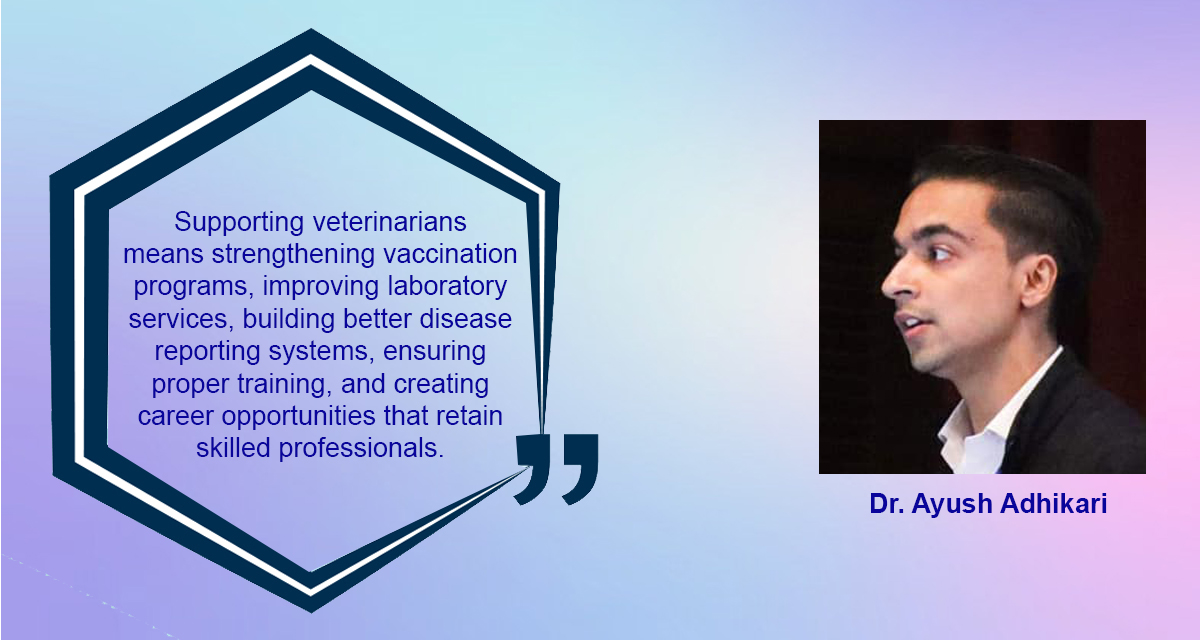
World Veterinary Day should therefore be a reminder to policymakers, institutions, and the public that veterinary investment is national investment. Supporting veterinarians means strengthening vaccination programs, improving laboratory services, building better disease reporting systems, ensuring proper training, and creating career opportunities that retain skilled professionals. It means recognizing that animal health is not a side sector, it is a core part of national health security.
Veterinary medicine is a profession that deals with life in its rawest form: birth and death, survival and suffering, recovery and loss. It requires scientific intelligence, but also emotional discipline. Veterinarians are expected to care deeply, yet remain calm. They must carry empathy, yet make tough decisions. They often witness the struggle of farmers, the pain of animals, and the reality of limited resources. Still, they continue. Not because it is easy, but because it matters. World Veterinary Day 2026 should remind us that veterinarians are not only animal doctors. They are defenders of livelihoods. They are protectors of food safety. They are warriors against zoonotic threats. They are educators in rural development. They are guardians in the fight against antimicrobial resistance. They are essential partners in climate resilience. They are advocates for animal welfare. Their work is not limited to farms and clinics; it extends to the health and stability of society itself.
And perhaps the greatest truth is this: when veterinarians do their work properly, the world stays normal. People drink milk without fear. Farmers sleep without panic. Markets remain stable. Outbreaks do not explode into disasters. Children grow up safer. Communities remain healthier. The world continues smoothly, unaware of how close it often stands to crisis. That is the power of veterinary medicine. It keeps life moving, quietly and faithfully. It protects the unspoken, heals the voiceless, and holds together the delicate connection between animals, humans, and the environment.
Facebook Comment
Related News
latest Video
Trending News
- This Week
- This Month