

Ecological Buffering and the Future of Monkey Management in Nepal

A farmer in Nepal can legally lose an entire season’s harvest to monkeys and receive little more than sympathy in return.
Imagine any other sector of the economy functioning this way. If a factory lost half of its production due to repeated external damage, the government would intervene. If a road project was destroyed year after year, emergency funds would be allocated. Yet when farmers lose maize, wheat, vegetables, fruits, and even their willingness to continue farming because of monkey attacks, the response is often limited to temporary solutions and political promises.
This is not just a wildlife issue. It is an agricultural crisis, a rural development crisis, and ultimately a policy crisis. For years, Nepal has approached monkey conflict as though the monkeys themselves were the problem. Consequently, discussions have revolved around sterilization, relocation, capture, and population control. These measures may satisfy public anger, but they do little to address the underlying drivers of conflict. In fact, after decades of similar interventions in different parts of South Asia, monkey-human conflicts continue to increase. This should force policymakers to ask a simple question: if controlling monkeys was the solution, why does the problem keep getting worse?
The answer lies not in monkey biology but in human decisions. Nepal’s hills are changing rapidly. Villages that once were filled with agricultural activity are becoming quieter each year as young people migrate abroad. Terraces that produced maize and millet now lie abandoned. Shrubs and secondary forests have reclaimed large areas of farmland. Forest cover has increased nationally, a development often celebrated as an environmental success. Yet beneath the positive statistics lies a neglected reality: much of this forest recovery has occurred without strategic land-use planning.
The result is a fragmented landscape where forests, abandoned fields, settlements, and crop lands are intertwined. Ecologists call such areas “edge habitats”, zones where wildlife and humans interact most intensely. Unfortunately, edge habitats are exactly where rhesus macaques grow.
From the monkey’s perspective, modern Nepal is a land of opportunity. Natural predators are virtually absent. Forest patches provide shelter. Nearby farms provide abundant food. Abandoned lands serve as safe movement corridors. In ecological terms, Nepal has unintentionally engineered ideal conditions for monkey populations to expand. We have spent years asking how monkeys became so bold. A more honest question is: how did we make it so easy for them?
This distinction is crucial because it determines whether policies succeed or fail. When governments focus solely on reducing monkey numbers, they are treating symptoms. When governments address the landscape conditions encouraging conflict, they are treating causes.
The most overlooked policy tool in Nepal today may therefore be ecological buffering. Unlike sterilization or relocation, ecological buffering does not seek to fight wildlife. Instead, it seeks to redesign the interface between wildlife habitat and human activity. The concept is based on a simple principle: conflict becomes inevitable when attractive crops begin exactly where forests end.
Across much of Nepal, there is no transition zone between monkey habitat and human food production. A troop emerging from a forest can move directly into a maize field within minutes. For an intelligent, opportunistic primate, this is the equivalent of finding a supermarket at the forest gate. Ecological buffering seeks to remove that invitation. Strategically planted belts of bamboo, medicinal plants, aromatic crops, fodder species, or other vegetation that monkeys find less attractive can be established between forests and agricultural land. Such buffers do not function as physical barriers. Rather, they function as ecological filters. They alter movement patterns, reduce crop visibility, and increase the energetic cost of reaching cultivated areas.
The science behind this approach is supported by decades of wildlife management experience. Around the world, successful conflict mitigation increasingly relies on habitat management rather than population eradication. Whether the challenge involves elephants in Africa, wild boars in Europe, or deer in North America, experts have learned a common lesson: wildlife populations are shaped by landscapes. If landscapes encourage conflict, conflict will occur regardless of how many animals are removed.
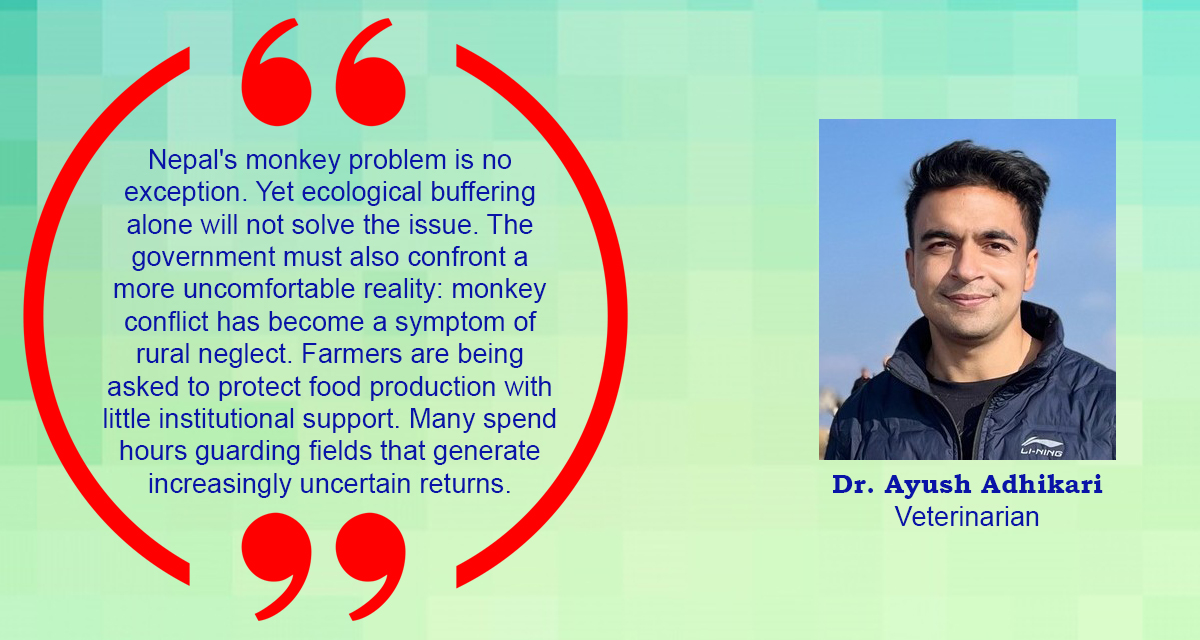
Nepal’s monkey problem is no exception. Yet ecological buffering alone will not solve the issue. The government must also confront a more uncomfortable reality: monkey conflict has become a symptom of rural neglect. Farmers are being asked to protect food production with little institutional support. Many spend hours guarding fields that generate increasingly uncertain returns. Some have already abandoned cultivation altogether. Every abandoned field represents not only an agricultural loss but also an invitation for further wildlife encroachment.
Therefore, monkey management must be integrated into national agricultural policy. Farmers in high-conflict zones should receive incentives to establish buffer crops. Local governments should incorporate wildlife-conflict mapping into land-use plans. Agricultural extension programs should identify crops that are economically viable yet less attractive to monkeys. Compensation mechanisms must become faster, more transparent, and more realistic.
Most importantly, responsibility for monkey conflict should not rest solely with forestry agencies. This is where Nepal’s current approach falls short. Monkey conflict sits at the intersection of forestry, veterinary, agriculture, local governance, biodiversity conservation, and rural livelihoods. It requires a cross-sectoral response rather than isolated interventions.
There is also a broader lesson here. Nepal’s monkey conflict illustrates a growing challenge of the twenty-first century, the collision between ecological success and policy failure. Forest recovery without land-use planning can create new conflicts. Wildlife conservation without agricultural protection can undermine rural livelihoods. Environmental policies cannot be judged solely by the number of trees planted or hectares reforested. They must also be judged by how well people and wildlife coexist within those landscapes.
The temptation will be to search for quick solutions. Sterilize more monkeys. Capture more monkeys. Move them elsewhere. Such measures generate headlines and create the appearance of action. However, the evidence from around the world suggests that lasting solutions rarely emerge from reacting to animals. They emerge from understanding systems.
The monkey raiding a farmer’s maize field is not the root of Nepal’s problem. It is the visible outcome of years of fragmented planning, unmanaged land-use change, and policy blind spots. In that sense, the monkey is not the villain of the story. It is the messenger. And unless policymakers listen to the message, Nepal may discover that controlling monkeys is far easier than controlling the consequences of ignoring the landscapes that created the conflict in the first place.
Facebook Comment
Related News






latest Video
Trending News
- This Week
- This Month