
Time Beyond Measurement: Science, Philosophy, and Human Consciousness

Introduction
Time is often described as the fourth dimension, the silent companion of space, matter, and energy. It is the invisible thread connecting the birth of the universe with the present moment and extending toward an unknowable future. Every living organism, every ecosystem, every civilization, every star, and every atom exists within its continuous flow. Yet despite its universality, time remains one of the greatest unresolved questions in science and one of the deepest subjects of philosophical contemplation. Humanity has measured time with remarkable precision—from ancient sundials and water clocks to atomic clocks that lose less than a second over millions of years. However, the ability to measure time has never equated to understanding its essence.
The distinction between measuring time and understanding time is fundamental. Clocks quantify duration; they do not explain meaning. Calendars organize events; they do not reveal purpose. Scientific instruments calculate intervals with extraordinary accuracy, yet they cannot measure love, sacrifice, hope, compassion, suffering, wisdom, or the transformative significance of a single moment. Consequently, time must be understood not merely as a measurable quantity but as a complex, multidimensional reality that integrates physical processes, biological evolution, psychological experience, philosophical inquiry, cultural interpretation, ethical responsibility, and human consciousness.
This essay explores time from an interdisciplinary perspective by integrating classical and modern physics, biological and geological sciences, psychology, Eastern and Western philosophy, Indigenous knowledge systems, and my own conceptual framework of interconnectedness. Rather than treating these perspectives as competing explanations, I argue that each illuminates a different dimension of the same profound reality. This collaborative approach invites curiosity and encourages us to see time as a shared human endeavor that unites diverse ways of understanding and experiencing the world.
Time in Classical Physics: Newton’s Absolute Universe
For more than two centuries, the scientific understanding of time was dominated by the ideas of Sir Isaac Newton. Newton conceived time as absolute, universal, and independent of the observer. According to classical mechanics, time flows uniformly throughout the universe like an invisible river whose movement is unaffected by matter, energy, or human perception. Whether on Earth or among distant stars, every event was believed to occur within the same universal temporal framework.
This conception provided extraordinary explanatory power. Newtonian mechanics enabled scientists to describe planetary motion, predict eclipses, understand gravity, and establish the mathematical foundations of engineering and astronomy. Within this framework, time became a universal coordinate against which all physical phenomena could be measured with remarkable precision.
Although later scientific discoveries revealed limitations in Newton’s model, its conceptual importance remains profound. Absolute time introduced humanity to the possibility that nature operates according to discoverable principles rather than arbitrary events. It encouraged systematic observation, experimentation, and mathematical reasoning, laying the foundation for modern scientific inquiry. In this sense, Newton’s conception of time transformed not only physics but also the epistemology of science by demonstrating that the universe possesses an intelligible order accessible through human investigation.
Nevertheless, Newton’s universe portrayed time as an external container within which events occurred. Human consciousness played no role in shaping temporal reality. The observer merely recorded an objective flow that existed independently of experience. This perspective, while scientifically powerful, left unanswered questions concerning consciousness, meaning, and the subjective experience of time.
Einstein and the Relativity of Time
The twentieth century fundamentally transformed humanity’s understanding of time through Albert Einstein’s theories of relativity. Einstein demonstrated that time is not absolute but relative to the observer’s motion and gravitational environment. Space and time are inseparable components of a unified continuum known as space-time, in which the passage of time varies with velocity and gravity.
One of the most remarkable implications of relativity is that two observers moving at different speeds or experiencing different gravitational fields may measure different durations for the same event. Time, therefore, becomes dynamic rather than fixed. Near massive celestial bodies, time slows. At velocities approaching the speed of light, time dilates significantly. These phenomena are not philosophical speculation but experimentally confirmed realities that are essential to technologies such as satellite navigation systems.
Einstein’s revolution extends beyond physics. It fundamentally altered humanity’s philosophical understanding of reality. If time depends upon relationships rather than existing independently, then reality itself becomes relational rather than isolated. Events derive meaning through interaction rather than separation. This insight resonates remarkably with numerous philosophical traditions emphasizing interconnectedness rather than independent existence.
Relativity also encourages intellectual humility. Human perception is not an absolute reference point but one perspective among many. Reality often transcends immediate observation. Consequently, scientific knowledge evolves through continual refinement rather than final certainty, inspiring confidence in the ongoing pursuit of understanding and the collective progress of human inquiry.
Quantum Perspectives: Time and the Uncertainty of Reality
If relativity transformed our understanding of the large-scale universe, quantum physics revolutionized our understanding of the microscopic world. At quantum scales, matter behaves in ways that challenge classical intuition. Probability replaces certainty, observation influences measurable outcomes, and fundamental questions arise concerning the relationship between reality and measurement.
Although physicists continue to debate the precise role of time in quantum mechanics, quantum theory demonstrates that the universe possesses levels of complexity beyond ordinary experience. Time may emerge differently at quantum scales than within everyday reality. Some contemporary approaches even suggest that time itself may emerge from deeper relationships rather than existing as a fundamental property of nature.
These perspectives invite philosophical reflection. Knowledge is not merely accumulated through observation but continually reconstructed through interaction between observer and reality. Scientific understanding, therefore, becomes an evolving dialogue rather than a completed description of the universe.
Biological Time: The Living Rhythm of Existence
While physics examines cosmic time, biology reveals living time. Every organism possesses biological clocks regulating sleep, metabolism, reproduction, growth, healing, and aging. Circadian rhythms synchronize countless physiological processes with Earth’s rotation, while seasonal cycles influence migration, flowering, reproduction, and ecological interactions across entire ecosystems.
Evolution itself represents biological time operating across millions of years. Species emerge, adapt, diversify, and sometimes disappear through continuous interaction with changing environments. Every living organism, therefore, embodies an evolutionary history extending far beyond individual existence.
Human aging further illustrates the complexity of biological time. Chronological age records the number of years since birth, yet biological age reflects the cumulative effects of genetics, environment, nutrition, stress, disease, lifestyle, and resilience. Two individuals born on the same day may experience profoundly different biological trajectories. Time, therefore, acts not merely as a chronological measure but as an ongoing biological dialogue between organism and environment.
This understanding reinforces an important ethical insight: health is not achieved by resisting time but by living harmoniously with its biological rhythms.
Geological and Evolutionary Time: Earth’s Deep Memory
Human civilization often measures history in centuries or millennia, yet Earth’s history extends across approximately 4.5 billion years. Mountains rise and erode. Continents drift across oceans. Ice ages advance and retreat. Oceans expand and disappear. Entire ecosystems emerge, flourish, and vanish long before human societies appear.
Geological time teaches patience and humility. Human lifetimes represent only brief moments within Earth’s extraordinary history. Nevertheless, modern humanity has acquired unprecedented capacity to influence geological processes through climate change, biodiversity loss, pollution, and landscape transformation. Human activity increasingly shapes what many scientists describe as a new geological epoch.
Evolutionary time similarly reminds us that every species alive today carries an inherited history spanning millions of years. Humanity is therefore not separate from nature but an expression of nature’s continuous evolutionary creativity.
Psychological Time: The Inner Experience of Duration
Scientific clocks measure objective duration, but human consciousness experiences subjective time. Moments of joy often appear brief, while suffering may seem endless. Childhood summers feel expansive, whereas adult years often feel like they accelerate. Memory reconstructs the past, anticipation imagines the future, and attention shapes the perceived pace of the present.
Psychological time reveals that human experience cannot be reduced to chronological measurement. Emotional states, cultural expectations, personal aspirations, trauma, and hope all influence temporal perception.
Mindfulness traditions emphasize fully inhabiting the present moment rather than being imprisoned by regrets about the past or anxieties about the future. Contemporary neuroscience increasingly supports these insights by demonstrating how attention and awareness influence cognitive processing and emotional well-being.
Thus, the quality of time often depends less upon duration than upon consciousness.
Eastern and Western Philosophical Perspectives on Time
Throughout history, philosophers have sought to understand time not merely as physical reality but as the foundation of existence itself.
Many Western traditions, particularly those influenced by Greek philosophy and later Enlightenment thought, frequently conceptualized time as linear—a progression from beginning to end characterized by historical development, causality, and progress. This perspective profoundly influenced scientific inquiry, historical interpretation, and technological advancement.
Eastern philosophical traditions often emphasize cyclical understandings of time. Hindu, Buddhist, and Jain philosophies describe recurring cycles of creation, preservation, transformation, dissolution, rebirth, and renewal. Impermanence becomes not a source of despair but a fundamental characteristic of existence. Everything changes; therefore, attachment to permanence inevitably produces suffering.
Rather than contradicting one another, these perspectives may be complementary. Linear time emphasizes progress and responsibility, while cyclical time emphasizes continuity, renewal, resilience, and ecological balance.
Together, they provide a richer understanding of human existence than either perspective alone.
Indigenous Knowledge and Cyclical Time
Many Indigenous knowledge systems throughout the world understand time as relational rather than merely chronological. Past, present, and future remain interconnected through ancestral memory, cultural continuity, ecological stewardship, and responsibilities toward future generations.
Within numerous Indigenous traditions, humans do not own land; rather, they belong to the land. Time is experienced through seasonal cycles, ceremonies, ecological rhythms, storytelling, and reciprocal relationships among humans, animals, plants, rivers, mountains, and spiritual realities.
Such perspectives challenge contemporary societies to reconsider development not solely in terms of immediate economic gain but also in terms of long-term ecological and cultural sustainability. Indigenous temporal consciousness reminds humanity that today’s actions become tomorrow’s inheritance.
Time, Interconnectedness, and the Human Journey
My own philosophy of life views time as the universal medium connecting every dimension of existence. I believe that all living and non-living entities participate in an interconnected web extending beyond individual lifetimes. Every action generates consequences that ripple across families, communities, ecosystems, and future generations.
Knowledge itself evolves through this interconnected process. Individual discoveries become collective understanding. Personal experiences become social learning. Local wisdom contributes to global knowledge. Scientific inquiry, ethical reflection, Indigenous wisdom, artistic creativity, and lived experience collectively enrich humanity’s understanding of reality.
From this perspective, time is not simply a sequence of moments but the living fabric through which interconnectedness becomes visible.
Toward a Theory of Transformation and a Theory of Knowledge
Building upon these interdisciplinary perspectives, I propose that time should be understood as the foundational dimension underlying both transformation and knowledge production.
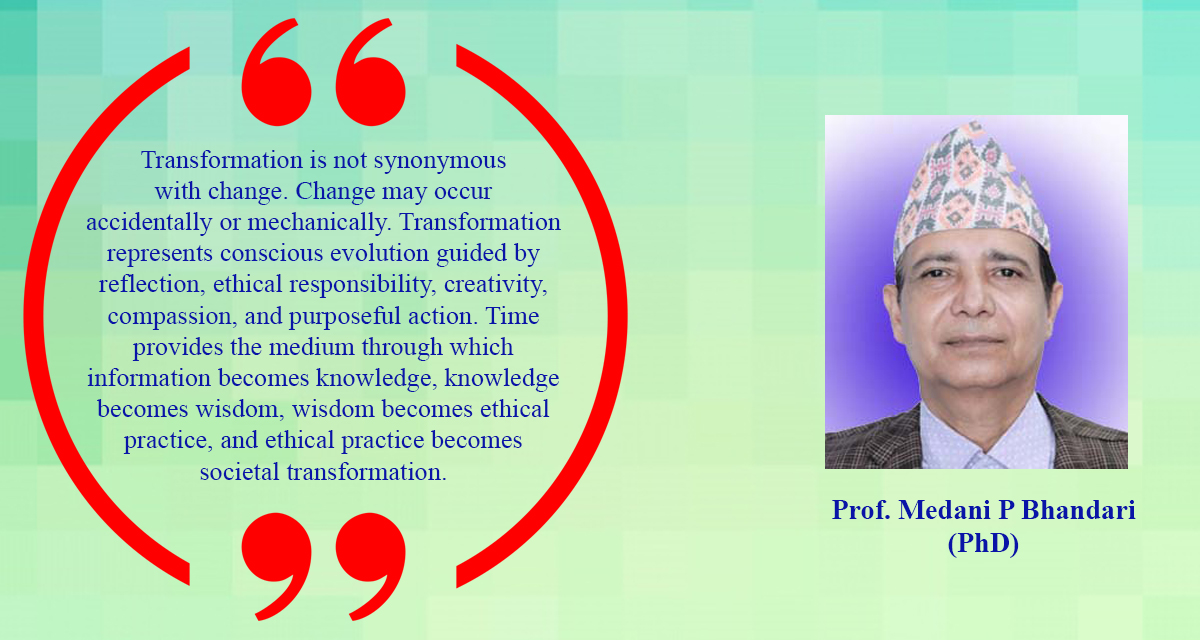
Transformation is not synonymous with change. Change may occur accidentally or mechanically. Transformation represents conscious evolution guided by reflection, ethical responsibility, creativity, compassion, and purposeful action. Time provides the medium through which information becomes knowledge, knowledge becomes wisdom, wisdom becomes ethical practice, and ethical practice becomes societal transformation.
Similarly, knowledge should not be regarded as static accumulation. Knowledge emerges through continuous interaction among observation, experience, dialogue, experimentation, imagination, culture, and reflection across time. Epistemology, therefore, becomes dynamic rather than fixed, while ontology remains open to continual reinterpretation as human understanding evolves.
Accordingly, my Theory of Transformation views time as the dynamic process through which individuals, societies, institutions, and civilizations consciously evolve toward greater justice, sustainability, resilience, and human flourishing. My Theory of Knowledge views time as the cumulative dimension within which multiple ways of knowing—scientific, philosophical, Indigenous, experiential, ethical, artistic, and spiritual—interact to produce increasingly comprehensive understandings of reality.
Neither theory regards knowledge as complete nor transformation as final. Both are continuous, adaptive, and relational processes shaped by humanity’s ongoing dialogue with nature, society, and the universe.
Conclusion
Time extends far beyond measurement. Physics reveals its cosmic structure; biology demonstrates its living rhythms; geology records its planetary history; psychology experiences its subjective flow; philosophy questions its meaning; Indigenous knowledge embodies its relational continuity; and human consciousness transforms it into memory, responsibility, hope, and purpose.
Perhaps the deepest lesson is that time is not something humanity possesses but something humanity participates in. Every generation inherits unfinished questions, unresolved injustices, evolving knowledge, and fragile ecosystems. Every individual receives the same finite opportunity to contribute to this continuing story.
The ultimate value of time is therefore not determined by its duration, but by the quality of transformation it enables. A meaningful life is not measured solely by years lived but by wisdom shared, compassion expressed, knowledge created, lives improved, and hope extended to future generations. In this sense, time is not merely the background against which life unfolds—it is the very foundation upon which humanity constructs knowledge, cultivates transformation, and discovers the enduring meaning of existence.
Facebook Comment
Related News

latest Video
Trending News
- This Week
- This Month