
Nepal’s Ballot Revolution: A Mandate for Justice, Accountability, and Service

Nepal stands at a historic crossroads. The election held on March 5, 2026 (Falgun 23, 2082 BS) represents far more than a political transition — it is the culmination of years of civic struggle, youth activism, and public demand for accountability. Citizens across the nation have used their votes to deliver a decisive message: politics must serve the people, not personal or party interests.
This election is deeply connected to the Gen Z protests of September 2025, which began as a response to the government’s ban on 26 social media platforms. The restrictions were widely seen as an attack on free speech, democratic engagement, and citizens’ ability to communicate their grievances. The protests quickly expanded beyond digital freedom to demand accountability, transparency, and justice, revealing widespread frustration with entrenched political privilege and systemic corruption.
What makes this moment remarkable is that the energy of street protests and youth activism was transformed into a peaceful democratic mandate. Through the ballot, citizens have created a ballot-box revolution, choosing reform over violence and democratic process over armed insurgency.
At the center of this historic mandate stands Balendra “Balen” Shah and the Rastriya Swatantra Party (RSP). The people have entrusted them to lead Nepal toward justice, economic renewal, and governance that truly responds to citizen needs. No matter where citizens stood before or during the election, the public has now spoken: Nepal succeeds when RSP succeeds. The nation must unite behind this mandate.
We do not lack knowledge; we lack integrity. Reform must begin at the top and within ourselves. Stay disciplined and remain vigilant, even toward those closest to you. Those who appear overly loyal from within can become the most dangerous invisible enemies. Never stop examining the inner circle—the so-called kitchen cabinet. History shows that many leaders were ultimately undermined by their closest associates, driven by greed for themselves, their families, and their party cadres—whether under Koirala, Dahal, Bhattarai, or Oli. Nepotism, favoritism, nepo-babies, kitchen cabinets, brokers (bichauliya), personal secretariats—you name it.
Lessons from History: Why Change Was Needed
Nepal’s modern political history offers both inspiration and caution. Decades of political struggle have shown that opportunities for reform can be wasted when leaders prioritize personal power over public interest.
The Maoist Insurgency: Violence Without Lasting Reform
From 1996 to 2006, the Maoist insurgency, led by Pushpa Kamal Dahal and Baburam Bhattarai, waged a violent campaign against the state. The conflict claimed over 17,000 lives, displaced thousands, and disrupted development across Nepal. While framed as a fight for social justice, in practice the insurgency failed to deliver sustainable reform. After entering mainstream politics, some leaders adopted the privileges they had once opposed, leaving many promises unfulfilled.
The human cost — lives lost, families traumatized, and communities destabilized — highlights why violence was not justified. It also underscores the contrast with the current democratic shift, where citizens have expressed their demands peacefully and collectively through voting.
Political Party Failures
Subsequent democratic governments, including Girija Prasad Koirala, Pushpa Kamal Dahal, Baburam Bhattarai, and Khadga Prasad Sharma Oli, each received historic mandates to lead Nepal toward stability, development, and inclusion. Yet:
- Narrow advisory circles and vested interests limited their vision
- Corruption remained widespread
- The public’s calls for accountability and reform were largely ignored
Nepal’s citizens witnessed repeated cycles of frustration: leaders failed to hear the people, and political processes often reinforced privilege rather than service.
Constitutional Monarchy and the Public Voice
Another dimension of Nepal’s political discourse that has gradually resurfaced is the question of constitutional monarchy. The Shah dynasty, which played a central role in the founding and unification of modern Nepal, remains historically connected to the country’s identity. Even after the abolition of the monarchy in 2008, a segment of the population has continued to express respect for the idea of a monarch serving as a neutral national symbol—an institution that could stand above partisan politics and help unify the country during periods of political fragmentation.
At the same time, interest in Nepal’s historical foundations has been re-emerging among younger generations. Public awareness of King Prithvi Narayan Shah, the unifier of Nepal, and his guiding philosophy articulated in Divyopadesh, is increasingly being revisited as a source of strategic and cultural reflection. Similarly, the late King Mahendra is often remembered for initiating early national development policies and laying the groundwork for infrastructure and modernization during a formative period of the country’s growth. And Balen heard the public sentiment during his campaign nationwide.
The repeated failure of past leaders to respect public opinion highlights why Nepal required a new, citizen-driven mandate — a mandate now embodied in the RSP and Balen.
From Gen Z Protests to a Ballot Revolution
The Gen Z movement ignited public consciousness nationwide. Citizens demanded:
- Accountability for corruption, including the lavish lifestyles of politicians’ children (“nepo kids”)
- Transparent governance and ethical public administration
- Greater citizen influence in policymaking and decision-making
Clashes with security forces during these protests resulted in over 70 deaths and more than 2,000 injuries, underscoring the sacrifices citizens made for democratic reform. Families, volunteers, and activists risked life and safety to push for a better Nepal.
Unlike the violent insurgencies of the past, this movement channeled its energy through democratic means, culminating in the March 5, 2026 election. The election discredited the Maoist insurgency, which failed to deliver on its promises or justify the violence carried out in its name, while also serving as a lesson against such motives in the future. The people chose ballots over bullets, proving that lasting change can emerge through peaceful participation.
A Clear Mandate: RSP and Balen
The election results reflect a decisive public demand for leadership that:
- Acts decisively against corruption and holds all citizens and leaders accountable
- Strengthens the rule of law and ensures transparency in governance
- Promotes economic self-sufficiency with jobs at home, revived industries, and a focus on exports
- Transforms politics from careerism to service, emphasizing merit-based appointments and inclusive decision-making
- Uses technology to connect with citizens, ensuring policy reflects real needs rather than party priorities
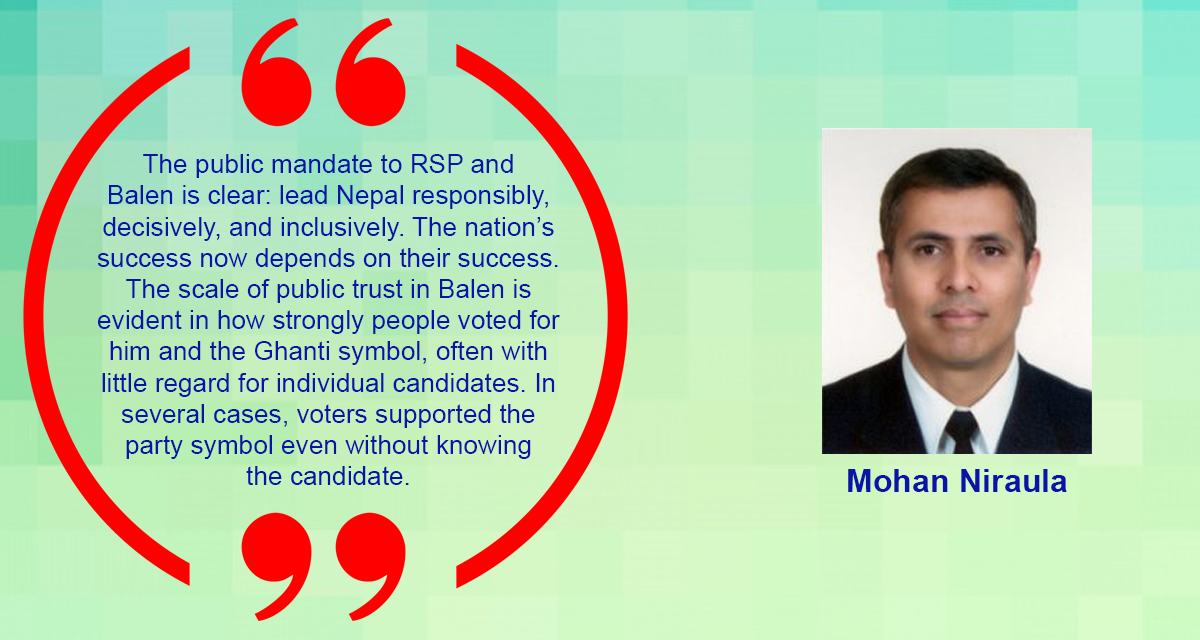
The public mandate to RSP and Balen is clear: lead Nepal responsibly, decisively, and inclusively. The nation’s success now depends on their success. The scale of public trust in Balen is evident in how strongly people voted for him and the Ghanti symbol, often with little regard for individual candidates. In several cases, voters supported the party symbol even without knowing the candidate. A notable example is Dhanusha-1, where the RSP candidacy had been canceled, yet the Ghanti symbol continued to receive the highest number of votes, as widely reported in the media. The situation became so unusual that the Election Commission directed officials not to announce the result until the court decided the fate of the RSP candidate. Such incidents illustrate the depth of public frustration and the powerful mandate for change.
Inclusive Leadership: United for Change
Regardless of prior political affiliation, every citizen is called to support this mandate. The time is now to unite as a nation, honoring those who lost their lives, were injured, or invested their time and energy for reform.
The people demand:
- Justice without discrimination: Bring corrupt individuals to account, regardless of political protection. Start from self-discipline, within the party and for all.
- Accountable governance: Ensure transparency and efficiency at every level of government. Be aware of party insiders, relatives, close friends and opportunists.
- Lean, effective structures: Reduce unnecessary political posts, re-examine provincial government roles, and streamline the legislature. Think some drastic cut in numbers such as house of representative members and cabinet members, advisors, secretaries. A lean and technology driven system can capture the grassroot, not the numbers. It will be difficulties and will face challenges.
- Citizen-centered decision-making: Use technology and direct engagement to prioritize public needs over party agendas. Work on priorities not on personal touch and some in power or connection.
Nepal’s future cannot be realized through division or narrow interests. Only a united, principled approach can ensure justice, economic development, and lasting reforms.
A Direct Message to Balen
Balen, the people have entrusted you with their hopes, their frustrations, and their sacrifices. The mandate is clear:
- Stand strong and accountable: Let the rule of law guide every decision, without shielding anyone—including allies.
- Confront corruption boldly: Target nepotism, favoritism, and the misuse of public resources.
- Serve the people first: Transform politics into public service, streamline governance, and focus on outcomes rather than privilege.
- Watch internal enemies: Great objectives can easily be ruined or derailed by members of your own inner circle, who may appear in different forms. Set clear boundaries and remain vigilant beyond them.
- Unite the nation: Bridge past divides, honor those who sacrificed for reform, and encourage broad participation in shaping Nepal’s future.
Serve justice, not the revenge: Hold all culprits accountable—including those long shielded by political protection—for financial crimes and policy-level corruption, while maintaining independence and ensuring that justice is never mistaken for political retaliation..
The trust people have placed in you reflects the strength of charismatic leadership, but no leader can rebuild a nation alone. Fighting corruption rooted at every level, restoring the rule of law, and renewing public hope while balancing limited resources against unlimited expectations will require strong teamwork and institutional support. Visionary leadership must be backed by capable colleagues, accountable institutions, and citizens who remain engaged in the reform process. Such collective effort can lay the foundation for lasting change and a stronger Nepal.
Nepal succeeds when RSP succeeds. You now hold the power and responsibility to deliver on the public’s mandate.
The Moment of Responsibility
Nepal has reached a defining moment in its history. The people have spoken — decisively and peacefully — through the March 5, 2026 election (Falgun 23, 2082 BS). The message is clear: the era of politics serving personal or narrow interests is over. Now is the time for leadership that is accountable, inclusive, and focused on the welfare of the nation.
Balen and the Rastriya Swatantra Party (RSP) carry the mandate to lead Nepal. But this is not only a responsibility for the leaders themselves; it is a call to the entire nation. Citizens, communities, and all political actors must unite to support reform, leaving behind past differences, rivalries, and partisan divides. Only through collective effort, shared commitment, and trust in principled governance can Nepal achieve the stability, growth, and justice it so urgently needs.
We all have responsibilities If you truly want the country to succeed, forget the past, put political differences aside and help Balen and his team to succeed, we should not approach him with any personal demands or favors—whether for political appointments, job postings, personal promotions, contracts, policy changes, or special projects outside the system. Let him work freely and fairly for the country, not for family, friends, or vested interest groups. And yes, that responsibility is ours. This is very important for the new leadership to see beyond his or her inner circle and fight internal enemies or opportunists. Listen the people and self-reevaluate.
The people demand that the new leadership:
- Guarantee justice for all past and future issues independently, without bias or political interference. No individual, party, or network should be above scrutiny. This includes addressing past corruption, financial crimes, misuse of public resources, and violations of public trust.
- Honor the sacrifices of citizens who lost their lives, were injured, or invested their time and energy in the pursuit of reform, democracy, and accountability. Their courage must translate into concrete action and lasting institutional change.
- Focus on nation-building over personal or party gain. The lessons of history are clear: when leaders prioritize narrow circles, vested interests, or political privilege, the people and the nation suffer. Now, governance must be guided by the principles of service, transparency, and meritocracy.
- Unite citizens around a shared vision for Nepal’s future, bridging regional, generational, and political divides. The success of the RSP under Balen’s leadership is inseparable from the success of the nation.
Nepal’s future depends on the courage of its leaders and the unity of its citizens. It is time to move beyond past grievances, ideological divides, and political loyalty, and to focus on collective national benefit. A lean, transparent, and effective government, guided by public accountability and justice, will be the foundation for prosperity, security, and sustainable development.
This is a historic opportunity: the chance to demonstrate that democracy, integrity, and citizen-centered governance can deliver more than violence, corruption, or privilege ever have. The nation is watching, the citizens are invested, and history will remember those who rise to meet this responsibility.
Now is the time to unite for Nepal — to build justice, fight corruption, empower citizens, honor the sacrifices of the past, and create a future where the nation thrives under principled and accountable leadership. Nepal succeeds when the Balen-led RSP succeeds, and when citizens stand together to make that success possible.
Facebook Comment
Related News
latest Video
Trending News
- This Week
- This Month