
Online Booking in Nepal’s Transport Sector: Prospects and Challenges Amidst the Entry of “eyaatri”

Introduction
The digital revolution in Nepal’s transport sector has transformed how travelers plan their journeys. From mobile app-based bus reservations to ride-sharing services, online booking systems promise unprecedented convenience and transparency. However, this technological advancement has encountered significant implementation challenges, making seamless travel an elusive goal. This article examines the current state of online booking in Nepal’s transport sector, identifies major problems, proposes solutions, and evaluates the market entry of “eyaatri” as a new platform in this evolving landscape.
Current Status of Online Booking
With expanding internet access and growing smartphone penetration across Nepal, online booking has gained notable momentum. The private sector’s active participation has accelerated this digital transformation, with multiple platforms creating a competitive market environment. The new Gongabu Bus Park, operating under public-private partnership, has connected all 47 ticket counters to online systems, expanding service comprehensiveness.
These platforms offer features including real-time seat availability viewing, seat selection, fare comparison across bus companies, and instant e-ticket generation. Travelers are increasingly freed from standing in long queues for tickets. However, as of September 2024, while over 42,000 tickets are available daily through online platforms serving 600 routes across 75 districts with nearly 500 transport entrepreneurs affiliated, digital payments constitute only 15% of transactions, meaning approximately 97% of bookings remain offline.
The Government of Nepal announced the ‘Online Ticketing Monitoring System (OTMS)’ in 2020 to integrate long-distance public bus transport into a digital system for transparency, organization, and effectiveness. The government believed this would ensure fare transparency, ease monitoring, enhance passenger safety, maintain accurate data records, and mitigate offline ticketing risks. However, unlike Nepal’s fully digitized air transport, long-distance bus services lack publicly published passenger data and remain incompletely digitized.
Recently, the Ministry of Infrastructure Development approved the “Standards on Safe and Technology-Friendly Vehicle Operation, 2083” to implement the 98th item of the government’s 100-point “Governance Reform Agenda.” This standard mandates various electronic devices in all vehicles operating throughout Nepal, including front and rear dash cams, vehicle location tracking devices, cabin surveillance cameras, SOS buttons, and driver monitoring systems for long-route buses. It establishes legal consequences for non-
compliance and monitoring mechanisms for adherence. This standard represents a significant milestone toward safe, reliable, and paperless travel.
Problems and Challenges
Despite policy, technical, administrative, and structural reforms, Nepal’s online booking system has failed to overcome its persistent issues. These challenges require coordinated private sector and government intervention to revive declining user trust.
Digital Infrastructure and Payment System Weaknesses
The mere 15% digital payment rate reveals serious deficiencies in banking access, internet quality, and cybersecurity. Remote areas lack network coverage, QR payments experience technical glitches, and unreliable banking systems force travelers back to cash transactions, undermining online booking’s core purpose of convenience and transparency.
Regulatory Ambiguity and Bus Company Arbitrariness
Despite the 2020 OTMS announcement, full implementation remains elusive. Regular public buses are not yet mandatory on online systems. During festivals like Dashain, bus companies impose one-way round-trip obligations, arbitrarily hike fares, and provide incorrect boarding points—practices platforms cannot curb. Even when platforms deny involvement, such behavior by affiliated companies erodes passenger trust. Promised facilities like ‘free Wi-Fi and water’ often prove unavailable, premium ticket holders get downgraded to ordinary buses, and service uncertainty following accidents raises reliability questions.
Weak Physical Infrastructure and Safety Standards
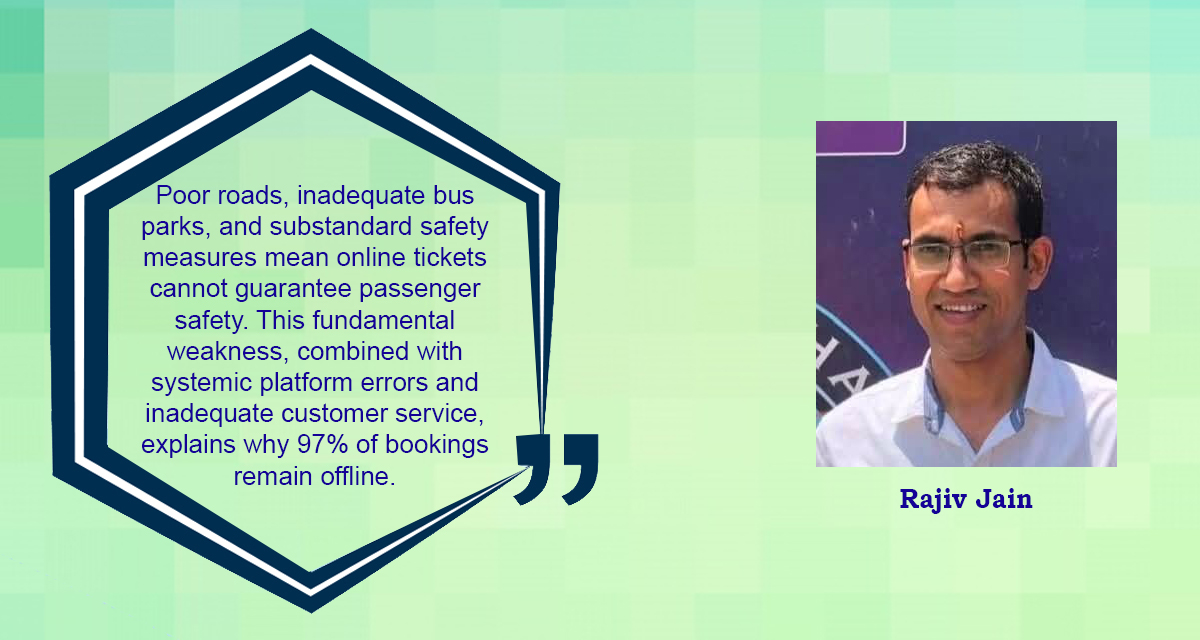
Poor roads, inadequate bus parks, and substandard safety measures mean online tickets cannot guarantee passenger safety. This fundamental weakness, combined with systemic platform errors and inadequate customer service, explains why 97% of bookings remain offline. Users widely report money deducted without ticket confirmation, or tickets not found when attempting to print. As one user described, showing “No ticket found” after purchase creates a sense of fraud. The lack of effective customer support compounds passenger frustration.
Lack of Standards and Service Consistency
Inconsistent pricing across services, poor service quality, and passenger safety concerns present major obstacles. Festival passenger surges create management difficulties, while uncertain road conditions cause ticketing delays. Bus companies downgrading passengers by selling premium tickets but assigning ordinary buses undermine service quality and online booking effectiveness.
Remedial Measures
Addressing these multifaceted problems requires integrated efforts across technology, regulation, and infrastructure.
Infrastructure and Payment System Enhancement
The government and private sector must increase investment to extend internet access to remote areas and secure digital payment systems. Strengthening customer service, often overlooked, needs prioritization. Booking platforms must fix bugs and develop effective helpdesks and feedback mechanisms to resolve user issues.
Transparent Regulation and Pricing
The Department of Transport Management must establish common standards for all online services to monitor fares and service quality. Clear regulations must address arbitrary bus company practices that exploit passengers during peak seasons.
Mandatory Implementation
The government must fully implement OTMS and make all long-distance buses compulsory for online systems, ensuring fare transparency and accurate passenger data records. An automatic ceiling on fare hikes during festivals must be established to prevent exploitation.
Digital Payment Integration
Similar to the SET4NPL project’s vision for electric bus and digital ticketing ecosystems, all online booking platforms must integrate with secure, fast digital payment systems.
Public-Private Partnership
Paperless travel is impossible without private sector-government partnership. Attention to infrastructure development, digital literacy, cybersecurity, and effective regulation is crucial for sustainable digital transport.
Safety Integration
The Ministry of Physical Infrastructure Development’s recent standard mandating GPS, CCTV, dash cams, and AI-based facial recognition systems marks positive progress.
However, without purposeful implementation, effective monitoring, and compulsory online booking integration, these provisions remain paper-based aspirations.
“eyaatri” Amidst Problems and Challenges
As internet access and smartphone usage grow in Nepal, the online travel booking market expands significantly. Urban ride-hailing platforms like Tootle, Indrive, and Pathao have
gained immense popularity. For intercity travel, platforms such as BusSewa, GoMygo, Tourist Bus Nepal, and Sajilo Yatra enable real-time seat availability checking and ticket booking, introducing competition and innovation through fare transparency, driver ratings, and accessibility.
In this context, Digital Travel Pvt. Ltd., registered with Nepal’s Company Registrar’s Office, is entering the market with “eyaatri,” a multi-featured online booking platform. Operated by experienced entrepreneurs and IT experts, “eyaatri” is Nepal’s first comprehensive online booking service provider. Its primary focus is long-distance vehicle and flight ticket bookings, offering convenient, fast, and reliable service accessible 24/7 via mobile app and website. Features include ticket reservations, e-tickets, and plans to integrate tourism-related services including destination promotion, hotel and homestay bookings, visa assistance, tour packages, and international operator partnerships.
Key Differentiators
“eyaatri” distinguishes itself through several unique features. It offers bus and flight online ticketing through a convenient, secure, and fast system accessible via mobile app, website, and e-tickets. Every bus is equipped with GPS and dash cameras/CCTV, enabling passengers to track real-time location and speed directly from their devices. Payment security is ensured through transactions made directly to bus owners or companies.
The platform serves both passengers and transport operators. Operators gain dashboards, booking management tools, revenue reports, occupancy insights, and vehicle performance analytics to improve efficiency. Rather than displacing existing physical ticket counters, the platform integrates them, offering cash-back incentives to encourage participation.
Through this approach, counters become digitally empowered, enabling adaptation to the digital ecosystem while benefiting from new business opportunities.
The platform is data-driven, offering valuable travel data and analytics that help transport operators and government agencies understand passenger demand, optimize routes, improve schedules, and formulate evidence-based transport planning.
Future-Ready Design
The platform is designed to easily adapt to future government digital initiatives, evolving transport technologies, and additional services accompanying Nepal’s transportation modernization. Its long-term vision brings together transportation, tourism, accommodation, activities, and other travel-related services under a single integrated platform, creating a comprehensive travel ecosystem that delivers a seamless end-to-end experience.
This vision aligns with establishing Nepal as a digital travel hub, ensuring paperless, safe, and globally connected travel through technology and tourism integration—all centered on customer satisfaction.
Conclusion
The digital transformation of Nepal’s transport sector through online booking systems represents a pivotal shift with immense potential to revolutionize travel. While platforms like BusSewa, GoMygo, and the emerging “eyaatri” introduce unprecedented convenience, transparency, and technological integration, the journey toward a fully digitalized transport ecosystem faces significant hurdles.
The stark reality—97% of bookings still occurring offline despite growing digital infrastructure—underscores a critical disconnect between policy ambition and ground- level implementation. Challenges are multidimensional: unreliable payment systems, weak infrastructure, regulatory ambiguity, arbitrary pricing, and service failures erode passenger trust. The government’s “Standards on Safe and Technology-Friendly Vehicle Operation, 2083” marks a commendable milestone mandating GPS, CCTV, dash cams, and AI-based facial recognition. However, without purposeful implementation, rigorous monitoring, and compulsory online booking integration, these provisions risk remaining paper-based aspirations.
The entry of “eyaatri” brings renewed hope. Its multi-featured platform—offering 24/7 access, real-time tracking, secure payments, data-driven analytics, and tourism integration—demonstrates technology’s potential to bridge existing gaps. By empowering traditional ticket counters rather than displacing them, and prioritizing customer satisfaction alongside operational efficiency, “eyaatri” exemplifies the collaborative approach necessary for sustainable transformation. Its vision of creating a comprehensive travel ecosystem encompassing transportation, tourism, accommodation, and activities aligns with Nepal’s aspirations to become a digital travel hub.
However, technology alone cannot solve deeply rooted structural issues. The way forward demands synchronized action from all stakeholders. The government must fully implement OTMS, enforce transparent fare regulations, and invest in digital infrastructure and cybersecurity. The private sector must strengthen customer service, ensure pricing transparency, and maintain service quality commitments. Most critically, both parties must collaborate to bridge policy-practice gaps, ensuring safety technologies are actively monitored and linked to online booking systems for real-time passenger safety.
Ultimately, online booking success hinges on one fundamental principle: trust—trust in digital payments, service quality, safety measures, and system promises. Only when passengers experience consistent reliability, transparency, and accountability will they transition from offline to online booking, fulfilling the digital revolution’s promise for Nepal’s transport sector.
(Mr. Jain is the first winner of Nepal’s “ Ko Banchha Crorepati ” hosted by actor Rajesh Hamal 2019. )
Facebook Comment
Related News

latest Video
Trending News
- This Week
- This Month