
Nepal’s Prime Minister Warns U.N. That Climate Disasters Are Becoming a Development Crisis

UNITED NATIONS — Nepal’s prime minister used an address to the United Nations General Assembly to deliver a stark warning about the consequences of climate change in the Himalayas, calling for greater international support for disaster recovery, stronger regional cooperation and a fairer global system for countries facing mounting risks despite contributing little to global warming.
Speaking four weeks after catastrophic flash floods devastated mountain communities in Nepal, the prime minister described the disaster as a warning to the international community that climate risks can no longer be treated as a distant or abstract threat.
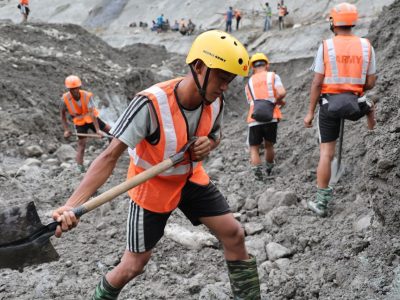
The floods, which the prime minister referred to as the Bhotekoshi-Trishuli disaster, killed at least 1,400 people and left more than 6,000 missing, according to figures cited in the speech. Roads, bridges, schools, homes and livelihoods were swept away, while Nepal’s progress toward achieving the United Nations Sustainable Development Goals was disrupted.
The disaster has been described by some as a “Himalayan Tsunami,” the prime minister said. “This was not just a local tragedy, it was a warning to the world,” the prime minister said. The address was framed as a call for action rather than an effort to assign blame. The prime minister recalled warnings made nearly three years earlier by the United Nations secretary-general from the Himalayas about the dangers of a worsening climate crisis.
Nepal, the prime minister said, heard that warning, as did local communities and scientists around the world. But political leaders, the prime minister argued, have not translated those warnings into action at the speed and scale required by vulnerable populations.
A warming Himalayas
The prime minister pointed to changes in the Himalayan environment as a growing source of danger. A warming climate, the prime minister said, is destabilizing the fragile Himalayan ecology. Melting permafrost is weakening mountain slopes beneath glaciers and increasing the risk of ice-rock avalanches, floods, landslides and other cascading hazards. The consequences are not confined to one country.
The disaster caused devastation on both sides of the Nepal-China border, while floodwaters continued downstream toward India. The prime minister used the geography of the disaster to underscore the international nature of climate risks.“Climate change does not recognize borders,” the prime minister said. “Glaciers and floods do not travel with a visa stamped on passports.”
The Hindu Kush Himalaya is home to nearly two billion people, according to the speech, and provides water, ecosystems, agricultural resources and livelihoods to populations across a large part of Asia. “The Himalayas are not peripheral to the planet,” the prime minister said. “They are part of the planet’s life-support system.”
Nepal seeks international support
Nepal now faces a major recovery and reconstruction effort. The prime minister expressed gratitude to neighboring India and China for their prompt assistance following the floods, as well as to other countries, the United Nations system, humanitarian agencies, philanthropic organizations and people around the world who supported Nepal.
According to figures presented in the speech, Nepal’s rapid assessment estimates that physical recovery needs will amount to approximately 10 percent of the country’s gross domestic product.
The prime minister compared the challenge with Nepal’s reconstruction following the 2015 Gorkha earthquake, saying the country once again needs international solidarity and support.
But the speech also made a broader argument: repeated reconstruction cannot be a substitute for building long-term resilience.
Nepal contributes less than 0.1 percent of global greenhouse-gas emissions, the prime minister said, yet the country is experiencing retreating glaciers, increasingly unstable mountain slopes and less predictable rivers. Every major disaster, the prime minister said, threatens to erase years of development. Roads, bridges, schools, homes, farms, livelihoods and clean-energy infrastructure can all be destroyed, leaving a poor country to borrow money to repair damage it did not cause.
For Nepal, the prime minister said, climate change is therefore not merely a humanitarian or environmental issue. It is a development emergency.
A proposal for Himalayan cooperation
The prime minister proposed the creation of a Himalayan Climate Resilience Mechanism, led by Nepal, India and China. The proposed mechanism would promote the sharing of satellite data and technical expertise, monitoring of dangerous glacial lakes, stronger joint early-warning systems and coordinated assistance when disasters strike across borders. The proposal would seek to turn the Himalayas into a center of practical international cooperation rather than a region where critical information remains divided among countries.
Nepal, the prime minister said, is already undertaking measures to strengthen its own climate resilience. The country has restored forests to cover nearly half its territory, is expanding hydropower capacity and promoting electric mobility, while also strengthening climate adaptation at the local level. The prime minister said Nepal intends to do more to withstand the increasing intensity and frequency of climate-related disasters. But Nepal cannot build resilience alone, the prime minister argued.
The case for climate justice
A central theme of the speech was climate justice. The prime minister said Nepal is not seeking to blame particular countries or continents or to turn climate change into another geopolitical confrontation. Instead, Nepal is calling for shared responsibility and solidarity. The prime minister invoked the international principle of common but differentiated responsibilities and respective capabilities, under which countries’ responsibilities for addressing climate change take into account their differing contributions and capacities.
Those that have historically contributed more to the problem and those with greater capacity to respond, the prime minister said, should do more. “Climate justice cannot remain a beautiful phrase in a United Nations document,” the prime minister said. For poorer countries, the prime minister argued, climate justice should mean having the opportunity to build a future rather than repeatedly rebuilding what disasters have destroyed.
Six words for the climate response
The prime minister summarized Nepal’s priorities in six words: “Relief. Rehabilitation. Reconstruction. And also: Responsibility. Reparation. Resilience.” The first three describe the immediate requirements following a disaster. The latter three, the prime minister said, are necessary to prevent climate disasters from becoming a permanent condition. Nepal is seeking greater grant-based international assistance rather than simply taking on additional debt.
The prime minister said the Loss and Damage Fund, the Global Environment Facility and other climate-financing mechanisms remain inadequate for the needs of vulnerable countries. The process for obtaining climate finance, the prime minister added, can also be too complicated and slow. “Climate finance must not become a bureaucratic maze through which vulnerable countries spend years proving that they need help,” the prime minister said. “When the house is burning, we do not ask the family to complete fifty forms. We act.”
A broader challenge to the international system
The speech then moved beyond climate change to questions about the global economic and political order. The prime minister said the United Nations was created after the devastation of the world wars with the promise that sovereignty, international law and human dignity would matter, and that weaker countries would not simply have to accept decisions made by more powerful states. Today, the prime minister said, that international system is under strain.
Military and economic power, the prime minister argued, too often determines whose voice receives attention. Nepal therefore supports what the prime minister described as a fairer global economic order. The speech cited the 1994 UNDP Human Development Report, which developed the concept of human insecurity and emphasized people rather than territories, as well as freedom from fear and want. The prime minister connected those principles to everyday economic problems in Nepal.
When a farmer needs fertilizer, the supply may not arrive on time. When Nepal wants to build a highway, there may be shortages of bitumen. Families may face shortages of cooking fuel. At the same time, communities are dealing with melting glaciers, failing harvests and floods arriving with little warning.
The prime minister contrasted these difficulties with the efficiency of global military logistics. “Inter-continental missiles arrive on time,” the prime minister said. “Rifles and ammunition cross borders, clear every bottleneck, meet every deadline. But a peasant in Nepal cannot procure his fertilizer or fuel at market price at a time of need.” The prime minister summarized the contrast more broadly: “We have built a world with flawless logistics for war and broken logistics for food.”
Climate change and conflict
The prime minister said Nepal’s experience is shared by other countries in the region. Bangladesh, Bhutan, India, the Maldives, Pakistan and Sri Lanka, the speech said, are also dealing with climate pressures and the effects of conflicts beyond their borders. The prime minister argued that these overlapping crises reveal weaknesses in the existing system of global cooperation.
The challenge, the speech suggested, is not only climate change but the distribution of power, resources and decision-making. Nepal therefore reaffirmed its support for multilateralism and called for a United Nations in which small and poor countries have a meaningful voice.
The prime minister said climate justice extends beyond financial assistance. It includes distributive justice — determining who bears the costs; procedural justice — determining who has a voice; and ensuring that mountain communities, small island states, landlocked countries, least-developed countries and future generations are given equal consideration.
A new generation in Nepal
The prime minister also linked the country’s international message to political and social changes at home. Nepal’s new majority government, the prime minister said, was elected in what he described as the country’s fairest and most peaceful elections in history. The government has since faced a series of international and domestic challenges. The prime minister described a younger generation demanding greater integrity and accountability from government and said the generational shift reflects a broader global reaction against conflict, inequality and a lack of opportunity.
The government’s domestic priorities include creating decent jobs, expanding social protection and ensuring that Nepalis have a fair opportunity to build their futures at home. The prime minister also emphasized that the challenges facing Nepal are not limited to climate change.
Global supply disruptions can affect the price and availability of basic goods, while climate-related disasters can destroy the infrastructure needed for economic development.
From response to preparedness
The prime minister called for Nepal and other vulnerable countries to move beyond ad-hoc responses to disasters. The country needs stronger infrastructure, better institutions, greater investment in insurance and innovation, and systems capable of warning communities before disasters strike. The prime minister also called for a reduction in dependence on fossil fuels. “The Nepal floods signal a future shaped by rising climate extremes,” the prime minister said. “Our baselines are no longer relevant.”
The message was that governments should prepare for conditions that may differ substantially from historical patterns rather than relying on past assumptions about climate risk. “Ready to hear it, and ready to act”
The prime minister said Nepal is prepared to help lead the international conversation on climate justice and Himalayan resilience. The “Sagarmatha to the Sea” side event at the United Nations was presented as one opportunity to advance that discussion.
The larger objective, the prime minister said, is to strengthen an international system capable of protecting vulnerable communities, financing resilience and giving smaller countries a meaningful role in decisions that affect their future. The speech ultimately returned to the warning that had brought Nepal’s experience to the center of the address: the Himalayas are already experiencing changes with consequences that reach far beyond the mountains.
The prime minister urged world leaders not to wait for another catastrophe before acting. “When the next warning comes from the rooftop of the world,” the prime minister said, “let us be ready to hear it, and ready to act.” The address ended with a traditional Nepali invocation for the welfare of the world and a wish that humanity would follow the path shown by the Buddha
Facebook Comment
Related News

latest Video
Trending News
- This Week
- This Month