
A New Voice for Nepal at the United Nations: An Independent Diplomatic Analysis of Prime Minister Balendra Shah’s Address

In my view, the real significance of Prime Minister Balendra Shah’s address to the United Nations on Sept.24,2026 lies not simply in its powerful language, but in the connection he sought to establish between Nepal’s challenges and broader global concerns. His effort to bring climate change, the Himalayas, food security, international finance, and multilateralism into a single diplomatic narrative was particularly noteworthy.
Prime Minister Balendra Shah’s address to the 81st United Nations General Assembly went well beyond a conventional speech focused on climate change. It presented a clear diplomatic vision of how Nepal seeks to position itself on the international stage. Shah presented Nepal not merely as a small developing country vulnerable to climate change, but as a country seeking an active role in the global debate on climate justice, Himalayan protection, food security, and multilateral cooperation.
The central message of the address was clear: although Nepal’s contribution to global greenhouse-gas emissions is extremely small, the country is experiencing serious consequences of climate change. Floods, landslides, melting glaciers, an increasingly fragile Himalayan environment, and other climate-related disasters are placing additional pressure on Nepal’s development. Shah used this imbalance to raise a fundamental question of climate justice: how fair is it for countries that have played a relatively minor role in creating the crisis to bear such a significant share of its consequences?
This argument is closely connected to the established principle of “common but differentiated responsibilities” in international climate diplomacy. What is notable is that Shah did not reduce his message to direct blame. Rather than singling out individual countries, he emphasized shared responsibility, international solidarity, and multilateral cooperation. From a diplomatic standpoint, this was a measured yet firm approach.
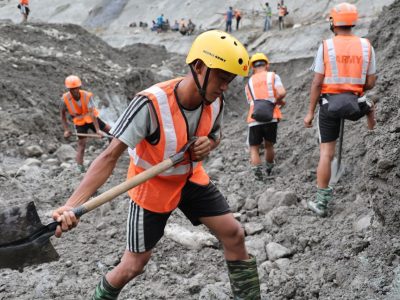
The opening of the address was also effective. Rather than beginning with statistics or policy formulas, Shah described people who had lost their lives, families searching for missing relatives, and communities that had seen roads, bridges, homes, and livelihoods disappear within moments. This gave a human face to what can otherwise become a highly technical discussion about climate change.
His description of the recent disaster as the “Tsunami of the Himalayas” was also rhetorically powerful. The phrase sought to draw international attention from the immediate disaster in Nepal toward the broader climate risks facing the Himalayan region. Shah’s underlying argument was that the changes taking place in the Himalayas cannot be viewed simply as an internal Nepalese problem.
Against this backdrop, one of the most significant policy proposals in the address was the establishment of a “Himalaya Climate Resilience Mechanism,” involving Nepal, India, and China. The basic rationale behind the proposal is compelling. The Himalayas are not an ecological system confined within the political boundaries of a single country. Glaciers, rivers, glacial lakes, landslides, and floods can have consequences across national borders. Shah therefore proposed the sharing of satellite data and technical expertise, monitoring of high-risk glacial lakes, effective early-warning systems, and coordinated cross-border disaster response.
Diplomatically, the proposal is particularly significant. Although Nepal, India, and China have complex strategic and political relationships, climate and disaster management could provide an area of shared interest. Environmental cooperation will not resolve every geopolitical difference, but common risks can create a practical pathway for cooperation.
At the same time, proposing such a mechanism and implementing it are two different things. It would require political commitment from all three countries, confidence in information sharing, clear institutional arrangements, technical standards, and reliable long-term financing. Shah has put the concept on the table; the central diplomatic challenge now is how to turn it into a workable institutional framework.
Another important element of Shah’s address was climate finance. He argued that relief, rehabilitation, and reconstruction after disasters are not enough. Vulnerable countries need adequate resources to invest in preparedness, resilient infrastructure, insurance, early-warning systems, and long-term resilience before disasters occur.
His formulation—“relief, rehabilitation, reconstruction, responsibility, compensation, and resilience”—attempts to move the debate beyond post-disaster response toward long-term preparedness. This is particularly relevant for a country such as Nepal. If roads, bridges, schools, and other infrastructure are repeatedly rebuilt after disasters without sufficient investment in resilience, an increasing share of national development resources could be consumed simply by reconstruction. Climate resilience, therefore, needs to become an integral part of development planning.
Shah’s criticism of the complexity of international climate finance should also be understood in this context. He questioned the situation in which vulnerable countries, even when facing urgent needs, can become entangled in lengthy and complicated administrative procedures. His message is straightforward: if a disaster is an immediate crisis, the international assistance system should be capable of responding with comparable speed and effectiveness.
Yet an important question remains: what specific reforms does Nepal seek within the existing international financial architecture? Political and moral appeals can help generate international support, but turning those appeals into practical policy requires clear financial structures, transparency, accountability, eligibility criteria, and mechanisms for measuring results. Nepal’s diplomacy will therefore need to translate the emotional urgency of its message into concrete and technically credible policy proposals.
One of the most memorable passages of the address was Shah’s comparison between war and food security. He pointed to the fact that weapons and military supplies can move rapidly across different parts of the world while farmers can struggle to obtain fertilizer and fuel on time. He presented this contrast as a question about international priorities.
The comparison was more than a rhetorical device. It also reflected an effort to broaden the traditional definition of security. From the perspective of ordinary citizens, security is not limited to borders, military power, or strategic deterrence. It also means access to food, employment, energy, infrastructure, economic opportunity, and protection from climate-related disasters.
This helps explain why Shah placed such emphasis on multilateralism. Countries such as Nepal have limited military and economic capacity to compete directly with major powers. International law, multilateral institutions, coalitions, and diplomatic engagement therefore remain among their most important instruments. From this perspective, Shah’s call for a more equitable international order is closely connected to Nepal’s long-term diplomatic interests.
The breadth of the address, however, is also one of its limitations. Climate change, food security, disaster management, climate finance, global inequality, war, youth, democratic change, and United Nations reform were all addressed within the same speech. These issues are interconnected, but covering so many subjects at once can make it more difficult to identify the central priorities.
There is also a clear distinction between an effective speech and effective diplomacy. Attracting international attention is one stage; turning that attention into long-term partnerships, financial commitments, and institutional cooperation is another—and considerably more difficult—stage.
In this respect, one of the important features of Shah’s address was his effort not to portray Nepal simply as a country seeking assistance. By highlighting forest conservation, hydropower, electric vehicles, local adaptation, and clean energy, he sought to demonstrate that Nepal is prepared to be part of the solution.
That is an important diplomatic message. A country’s negotiating position can be strengthened when it demonstrates that it is prepared to carry its own share of responsibility while seeking international cooperation. Shah’s message was essentially this: Nepal is prepared to do its part, but Nepal cannot solve a global problem on its own.
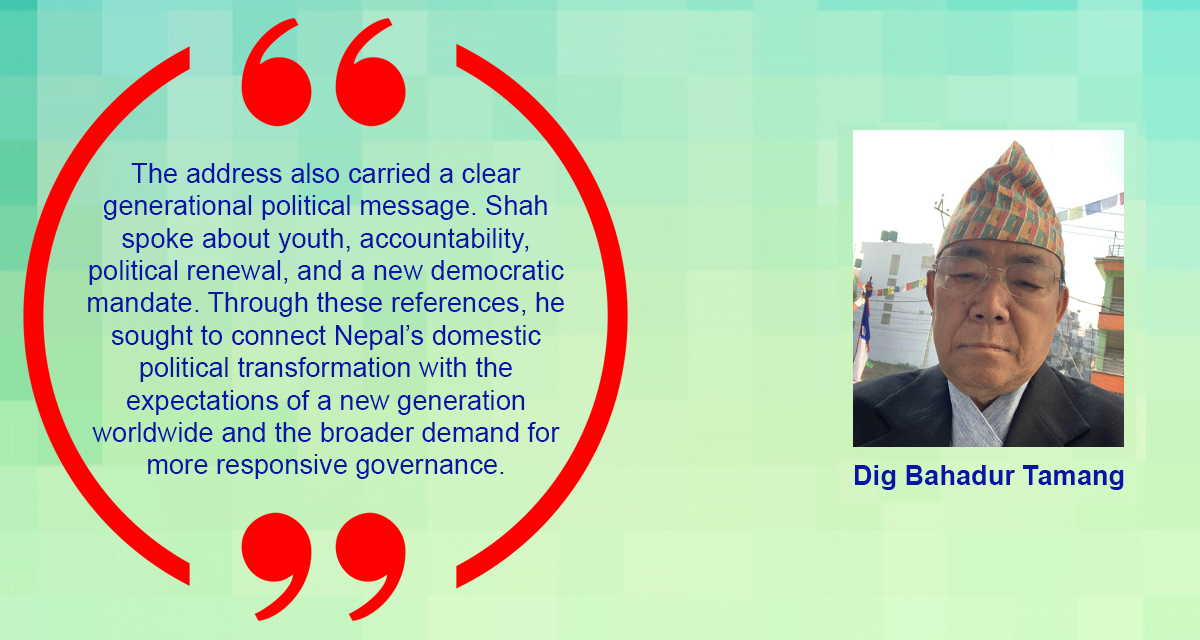
The address also carried a clear generational political message. Shah spoke about youth, accountability, political renewal, and a new democratic mandate. Through these references, he sought to connect Nepal’s domestic political transformation with the expectations of a new generation worldwide and the broader demand for more responsive governance.
Taken as a whole, Shah’s address to the United Nations is best understood not as a complete foreign-policy program, but as an initial diplomatic framework. Its most significant contribution is the international narrative it presents: Nepal is a Himalayan country that has contributed relatively little to climate change but is experiencing serious consequences; the Himalayas should be understood not merely as national territory but as a global ecological asset; and climate resilience requires cross-border cooperation and effective international institutions. The real test begins after the speech.
If Nepal can advance the proposed Himalaya Climate Resilience Mechanism through serious dialogue with India and China, expand cooperation with vulnerable countries on climate finance, and turn its proposals into concrete institutional initiatives, Shah’s address could come to represent more than a powerful moment at the United Nations. It could help move Nepal’s climate diplomacy toward a more active and results-oriented direction.
For now, however, Shah has placed a clear message before the international community. He has called not only for a stronger response to climate-related disasters, but for a broader reconsideration of how the international community defines responsibility, security, and development.
From a Washington policy perspective, the key question is therefore not simply how effective Shah’s speech was. The more consequential question is how Nepal will translate that diplomatic momentum into partnerships, institutions, financial resources, and measurable results.
At the conclusion of his address, Shah connected Nepal’s cultural and spiritual identity with his broader international message, saying, in essence: “May Lord Pashupatinath bless the world, and may the world follow the path shown by Lord Buddha.”
The closing message adds a distinctive cultural and spiritual dimension to the address. After speaking about climate justice, international responsibility, human security, and multilateral cooperation, Shah concluded with an appeal for peace, compassion, and the welfare of humanity. It linked Nepal’s diplomatic message with the country’s broader cultural identity and its historical association with Lord Buddha.
The speech opened the door. Now comes the difficult diplomatic work of walking through it.
Facebook Comment
Related News


latest Video
Trending News
- This Week
- This Month