
September 11, 2001: The Morning That Changed Everything

Twenty-five years ago today, I experienced a day that began like any ordinary morning but became one of the most devastating days in modern history. The attacks on the World Trade Center in New York, the Pentagon in Northern Virginia, and the crash of an aircraft in Pennsylvania changed the United States and the world forever.
There are moments in life when an ordinary day suddenly becomes extraordinary. Sometimes, an event is so unexpected and devastating that its memory remains with us for the rest of our lives. September 11, 2001, was such a day for me.
What began as a completely normal Tuesday morning—having breakfast with a friend, driving to Washington, D.C., and preparing for a regular workday—slowly turned into one of the most frightening and unforgettable experiences of my life.
At the time, Captain Raj Kumar Lama, a senior Boeing 757 instructor with RNAC, was staying with us. He had come to Denver, Colorado, for a simulator instructor assignment. Whenever he traveled between the United States and Nepal, he would often stop at our home and stay with us for a few days before continuing his journey to Kathmandu. His visit was therefore nothing unusual. We welcomed him into our home as we had done before, with no reason to believe that this particular visit would become connected in my memory with one of the most consequential days in modern history.
The morning of September 11 began peacefully. I prepared breakfast, and Captain Lama and I sat down and ate together. We talked and prepared ourselves for the day ahead. There was no warning of what was happening in New York, no indication of what was about to happen in Washington, and no reason for us to imagine that the ordinary rhythm of our lives would soon be interrupted.
After breakfast, I drove Captain Lama to Washington, D.C. At the time, I was working at the Embassy of Nepal, located at 2131 Leroy Place NW. The journey into the city was part of my normal routine, and that morning did not initially seem different from any other workday.
When we arrived at the Embassy, I made Captain Lama a cup of coffee and gave it to him. He sat nearby while I prepared to begin my work. By approximately nine o’clock, most of the staff had arrived. I looked over my schedule, turned on my computer, and prepared to start the day’s responsibilities. Nothing about the morning suggested that we were standing at the beginning of a historic tragedy.
Then the telephone rang. It was my wife calling from home. Her voice immediately caught my attention. She sounded concerned and told me that she had heard that an airplane had crashed into the World Trade Center in New York. She urged me to watch the news on television. At that moment, however, we did not have a television in our office, and the information reaching us was still incomplete. We did not yet understand the scale of what was happening or whether the incident was an accident. We turned to an FM radio for information.
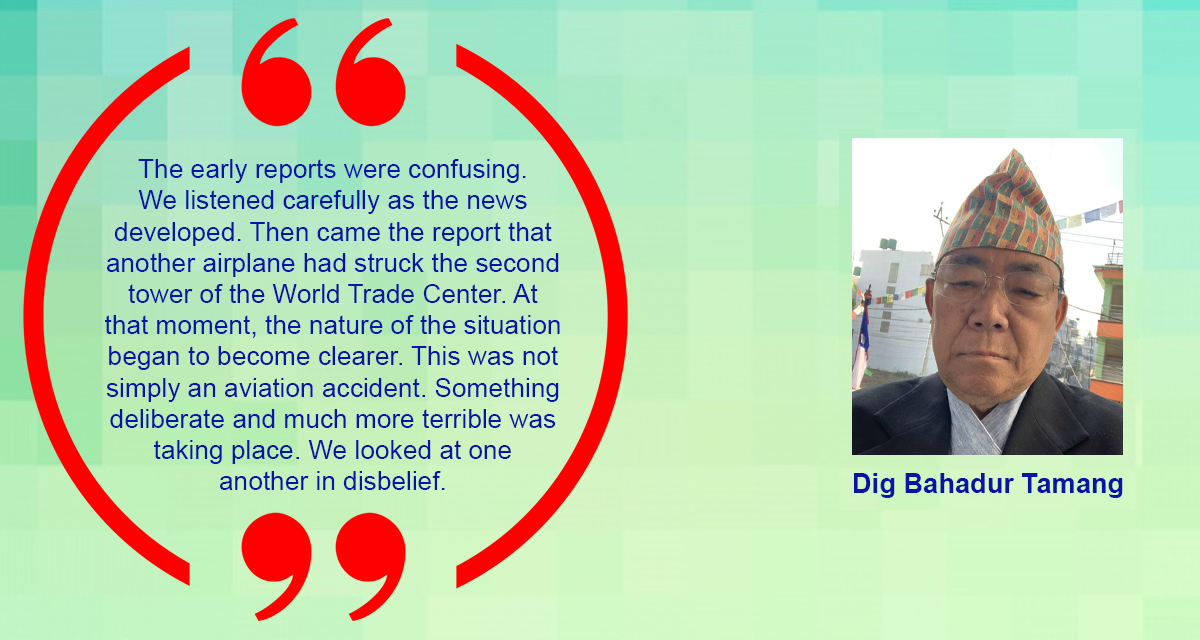
The early reports were confusing. We listened carefully as the news developed. Then came the report that another airplane had struck the second tower of the World Trade Center. At that moment, the nature of the situation began to become clearer. This was not simply an aviation accident. Something deliberate and much more terrible was taking place. We looked at one another in disbelief. Then another report came over the radio: the Pentagon had also been attacked.
That report was particularly disturbing because we were in Washington, D.C., only a short distance from the Pentagon. The tragedy was no longer something happening far away in New York. It had reached the very area where we were living and working. Soon afterward, we heard that another aircraft had crashed in Pennsylvania. One report followed another, each more disturbing than the last. We listened to the radio almost continuously, trying to understand what had happened and what might happen next.
We were all stunned.
The normal atmosphere inside the Embassy had disappeared. Computers were still turned on, schedules were still sitting on desks, and telephone lines were still operating, but the routine responsibilities of the day no longer seemed important. Everyone’s attention was directed toward the unfolding news. A UPS messenger arrived at the Embassy carrying several packages. I asked him whether he had heard about the attacks. He told me that he had also been listening to the radio and was aware that something extraordinary was happening. His arrival was a small reminder that ordinary life was still attempting to continue, even though the country around us had been transformed within a matter of hours.
Reports indicated that flights throughout the United States had been grounded. Washington was under an extraordinary level of uncertainty. As the situation developed, it became increasingly clear that this was not a temporary disruption to the normal workday. The entire country was facing an event whose consequences nobody could yet fully understand. After some time, Captain Lama and I decided that it would be best to return home.
The drive back was unlike any drive I had ever experienced in the Washington area. We traveled along Connecticut Avenue, then onto the 495 Beltway and north on I-270. Normally, these roads would have been crowded with commuters. The Washington metropolitan area is accustomed to heavy traffic, particularly during working hours. Cars fill the highways, people hurry to their destinations, and the roads reflect the constant movement of a large metropolitan region.
That day, however, the roads were eerily quiet. There were very few vehicles. The usual traffic and congestion seemed to have disappeared. The silence was unsettling. It was as though the entire region had paused, waiting for an explanation of what had happened and wondering what might happen next.
I remember that quiet drive very clearly.
Only a few hours earlier, the morning had seemed completely ordinary. People had been waking up, having breakfast, going to work, boarding airplanes, making telephone calls, and making plans for the day. Now, the ordinary movement of life had been interrupted. The empty roads seemed to reflect the fear and uncertainty that had spread across the country. When we finally arrived home, we immediately turned on the television.
The images we saw were almost impossible to comprehend. Smoke was rising from the World Trade Center. The enormous towers that had stood as symbols of New York, commerce, and modern American life had become scenes of destruction. Television images showed people running through the streets, emergency personnel responding to the disaster, and enormous clouds of smoke and dust covering parts of Lower Manhattan.
As we watched, the reality of the tragedy became increasingly difficult to deny. Some of the images were particularly painful. Among them were images of people who, trapped in the burning and damaged buildings, were forced into desperate situations. Some people jumped from the upper floors. Seeing those images was deeply disturbing. Even now, after so many years, they remain among the most painful memories associated with that day.
I often think about the families of those people. Where were their loved ones when the attacks occurred? What did their spouses, parents, children, brothers, sisters, and friends experience as they watched the events unfold? How could anyone possibly prepare themselves for such a sudden and devastating loss? There are some questions to which there can never be satisfactory answers.
According to the September 11 Memorial & Museum and other historical sources, 2,977 people were killed in the September 11 attacks. They included office workers, visitors, airline passengers and crew members, firefighters, police officers, paramedics, and other emergency responders. The victims came from many different backgrounds, nationalities, religions, professions, and walks of life. Behind that number were thousands of individual lives and thousands of families whose futures were permanently changed.
As I watched the events of that day, I found myself thinking about the nature of violence and the suffering it creates. What can ever be gained by taking innocent human lives? What can possibly be achieved by destroying buildings where ordinary people are working and by turning peaceful communities into scenes of terror?
People and nations will always have disagreements. Individuals have different beliefs, cultures, political views, religious traditions, and ideas about how societies should be governed. Countries may have competing interests and historical grievances. But none of these differences should diminish the value of human life.
For me, September 11 reinforced the belief that disagreements must ultimately be addressed through dialogue, diplomacy, understanding, tolerance, and peaceful engagement. Violence does not resolve suffering. Instead, it creates additional suffering, often affecting people who had no role in the original conflict.
The events of September 11 also taught me to distinguish between extremists who commit acts of terrorism and the millions of ordinary people who may share a religion, nationality, or cultural background with those extremists. Terrorism cannot represent an entire religion or an entire community. The actions of extremists should never become a reason to condemn innocent people.
The human cost of September 11 belonged to people of many different backgrounds. Their common bond was simply that they were human beings whose lives were taken from them without warning.
Later that afternoon, at approximately three o’clock, the Chargé d’Affaires, Mr. Dinesh Bhattarai, called the Embassy staff together. We reflected on the terrible events that had taken place in the United States and discussed the importance of standing together in solidarity during such a difficult moment.
For us as Nepalese citizens working at a diplomatic mission, the moment carried an additional significance. Nepal itself had recently experienced a devastating tragedy with the Royal Palace massacre. We understood, in our own way, the pain that comes when a society is confronted with sudden and unexpected loss.
We discussed organizing a candle-lighting ceremony in remembrance of those who had lost their lives on September 11 and in prayer for the repose of their souls. That discussion remains meaningful to me because it represented something larger than the formal responsibilities of a diplomatic office. It was an expression of compassion and solidarity.
Before September 11, I had understood diplomacy largely through the responsibilities of representing Nepal and maintaining relationships between governments and peoples. That day gave me another understanding of diplomacy. Diplomacy is also about humanity.
It is about expressing sympathy when others are suffering, showing compassion during times of tragedy, and recognizing that grief and loss can transcend national boundaries.
The tragedy also demonstrated how interconnected the modern world had become. An attack in the United States would have consequences far beyond American borders. International relations, aviation security, counterterrorism policy, military strategy, immigration procedures, and public perceptions of security would all be affected.
In the years that followed, the United States launched military operations in Afghanistan against the Taliban and al-Qaeda, and the invasion of Iraq in 2003 became another major chapter in the post-September 11 era. These events had far-reaching consequences for international relations and global security. Governments around the world strengthened counterterrorism efforts, while societies engaged in difficult debates over national security, civil liberties, war, peace, and individual freedom.
Nearly a decade after the attacks, Osama bin Laden, the al-Qaeda leader associated with planning the September 11 attacks, was killed during a U.S. operation in Pakistan in May 2011. Yet none of those later events can erase the memory of that morning. When I look back now, I often find myself returning not to the large historical events but to the small, ordinary details of that particular day.
I remember preparing breakfast. I remember sitting at the table with Captain Raj Kumar Lama. I remember our conversation. I remember driving him to Washington. I remember making him a cup of coffee at the Embassy. I remember turning on my computer and looking at my day’s schedule. I remember preparing to begin what I believed would be an ordinary workday. And I remember the telephone ringing. I remember my wife’s anxious voice. I remember the radio reports.
I remember the disbelief when we heard that the second World Trade Center tower had been struck. I remember the report that the Pentagon had been attacked. I remember hearing about the plane that crashed in Pennsylvania. I remember the silence on the roads during our journey home. And I remember turning on the television and seeing the images that would become permanently associated with September 11.
Those memories remain vivid because they represent the extraordinary contrast between ordinary life and unexpected catastrophe. That morning, none of us knew what the day would bring. People had plans. People had meetings. People had jobs to do. Families expected their loved ones to return home in the evening. Travelers boarded airplanes expecting to reach their destinations. Office workers entered buildings expecting to finish another day’s work.
But within a few hours, thousands of families were waiting for loved ones who would never return.
This is perhaps one of the deepest lessons I took from September 11: we often do not recognize the value of an ordinary day until that ordinary day is gone. A simple breakfast can become a cherished memory.
A cup of coffee can become part of a historic recollection. A familiar road can become a symbol of a moment when the world seemed to stop. A telephone call can divide life into two parts—the moments before the call and everything that came afterward.
Twenty-five years have now passed since September 11, 2001. Time has changed many things. People have grown older. Children who were not yet born that day have become adults. Buildings have been rebuilt. Security procedures have changed. New generations have grown up learning about September 11 through history rather than personal experience. But for those of us who lived through that day, memory remains.
For me, September 11 is not simply a date in a history book. It is a personal memory connected to a breakfast table, a friend staying in our home, a drive to Washington, a cup of coffee at the Embassy, an unexpected telephone call, an FM radio, an unusually quiet highway, and television images that were almost impossible to believe. It is history that entered my own life.
Looking back, I do not want the memory of September 11 to become only a memory of destruction and death. I want it also to serve as a reminder of the importance of humanity.
We should remember the victims and their families. We should honor the courage of the people who responded to the attacks and those who risked their own lives to help others. We should recognize the suffering caused by terrorism and violence. But we should also remember that hatred can create more hatred and that violence can produce consequences that continue long after the original act.
The most meaningful way to remember the victims, in my view, is to reaffirm the value of human life.
We should teach future generations that differences can be discussed without violence, that political disagreements can be addressed through peaceful means, and that people of different religions, cultures, nationalities, and backgrounds can live together with mutual respect.
We should reject the idea that violence is an acceptable solution to political or ideological disagreements.
We should also be careful not to blame innocent communities for the actions of extremists. The responsibility for terrorism belongs to those who commit, organize, or knowingly support such acts—not to people who happen to share a religion, nationality, ethnicity, or cultural background.
The memory of September 11 should therefore be accompanied by both remembrance and reflection. We must remember what happened. We must remember those who died. We must remember those who survived and carried the wounds of that day. We must remember the families whose lives were permanently changed. But we should also ask what kind of world we want to leave for future generations.
I hope it is a world in which dialogue is stronger than violence, understanding is stronger than hatred, and compassion is stronger than fear. I hope that future generations will understand that human beings can disagree without destroying one another. And I hope that the lessons of September 11 will remind us that peace should never be taken for granted.
For the families who lost loved ones on that terrible day, no words can adequately express the magnitude of their loss. Twenty-five years later, their memories remain part of the history of the United States and the world. I offer my deepest respect and heartfelt sympathy to all those who lost parents, spouses, children, relatives, friends, and colleagues.
May the memories of those who died remain a source of strength for their families. May those who continue to carry the pain of loss find comfort and peace. May we remember the courage of those who tried to save others. And may the souls of all those who perished rest in eternal peace. When I think back to the morning of September 11, 2001, I am struck by how ordinary everything seemed at the beginning. There was breakfast on the table. A friend was staying with us. A drive to Washington was ahead of us. A cup of coffee was waiting at the Embassy. A computer was ready for another day’s work.
Nothing seemed extraordinary. And yet, within hours, everything had changed. That is why September 11 remains so deeply etched in my memory. It reminds me that history does not always announce itself. Sometimes history enters our lives quietly, in the middle of an ordinary morning, and changes everything before we have time to understand what is happening. For me, September 11, 2001, will always be remembered as the morning that began normally and ended with the world transformed.
I remember the breakfast. I remember Captain Raj Kumar Lama. I remember the drive to Washington. I remember the coffee. I remember my wife’s telephone call. I remember the radio. I remember the silence on the roads. I remember the television images. And above all, I remember the human lives that were lost. Twenty-five years later, I still remember. May we never forget. May their families find strength and comfort. May their souls rest in eternal peace. And may the memory of September 11 inspire us to build a future in which human dignity, compassion, tolerance, dialogue, and peaceful coexistence are stronger than hatred and violence.
Facebook Comment
Related News
latest Video
Trending News
- This Week
- This Month