
Nepal at a Democratic Crossroads: Elections, Sovereignty, and a Changing Political Landscape

Abstract: The Reckoning Nepal’s 2026 election didn’t just change the government, it changed the rules. A generational rupture, not merely a transfer of power. The old guard didn’t lose; they were buried. Democratic mechanics are no longer the question.
The meaning and limits of a landslide
Nepal’s March 2026 election shattered the old political order. The Rastriya Swatantra Party (RSP), led by Balendra “Balen” Shah, won 182 of 275 parliamentary seats, 125 direct and 57 proportional, the first single-party majority since 1999. After 18 years marked by nine prime ministers and 14 unstable governments, voters decimated the Nepali Congress (38 seats) and CPN-UML (25 seats) on a historic 60% turnout.
Yet the mandate carries illusions. Two in five eligible voters abstained. Over a third of contesting parties emerged from the September 2025 protests. The numbers reflect exhaustion with the old order more than unified enthusiasm for the new one. Balen Shah embodies the outsider spirit Nepal’s youth craves, but whether the democratic transition is complete or has simply entered a more complicated phase will depend on what happens next. Election Commission of Nepal – Results Portal
Youth, digital networks, and the collapse of normative authority
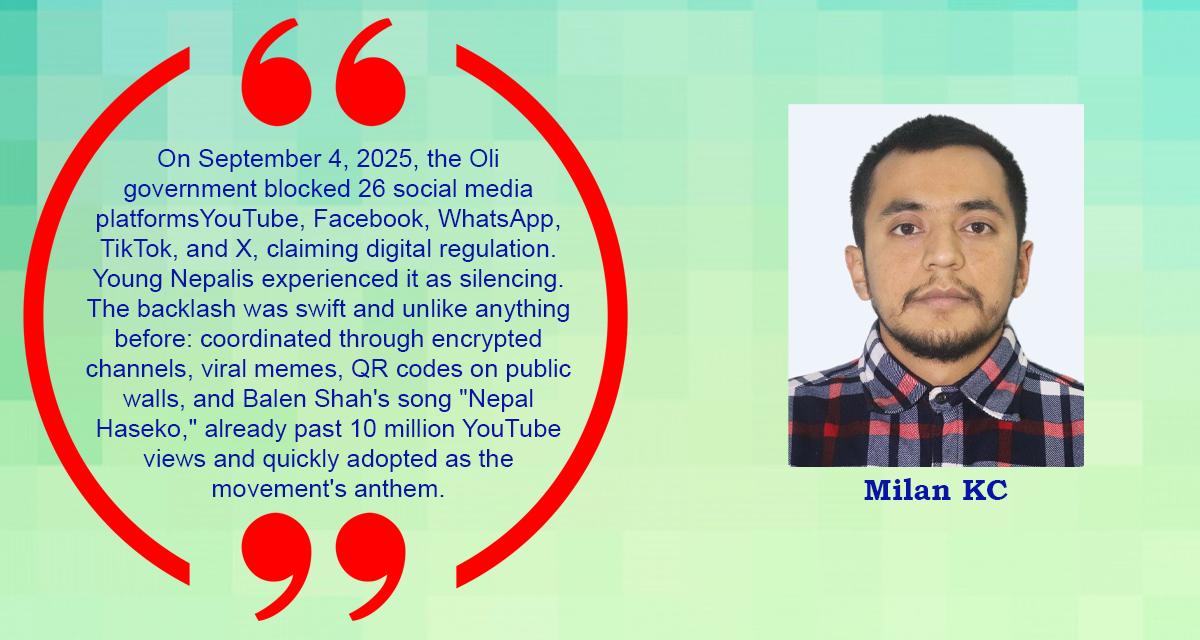
On September 4, 2025, the Oli government blocked 26 social media platforms YouTube, Facebook, WhatsApp, TikTok, and X, claiming digital regulation. Young Nepalis experienced it as silencing. The backlash was swift and unlike anything before: coordinated through encrypted channels, viral memes, QR codes on public walls, and Balen Shah’s song “Nepal Haseko,” already past 10 million YouTube views and quickly adopted as the movement’s anthem. At least 77 people died. Prime Minister Oli resigned. Nepal’s Gen Z had achieved what decades of traditional politics had not genuine accountability. The protests proved that digital network effects could survive state censorship, and they permanently delegitimised institutions that had long survived on assumed deference rather than actual performance. The traditional parties fell first in the streets, then at the ballot box. Amnesty International – Nepal 2025 Protest Report
Political economy: foundations and fault lines
The protests were political in form but economic in fuel. Youth unemployment stands officially at around 20% and is higher in practice. An estimated 1,500 Nepalis leave for foreign work daily, not by choice, but because the domestic economy cannot absorb them. Remittances account for roughly 25% of GDP, leaving Nepal exposed to any shock in the Gulf or Southeast Asian labour markets. Tourism has recovered slowly from COVID-19 agriculture struggles under irregular monsoons and climate stress. Against these fault lines stands Nepal’s greatest untapped asset, an estimated 83,000 megawatts of hydroelectric potential, less than 3% of which has been developed, the largest such reserve in South Asia. The RSP has placed hydropower at the centre of its economic vision. Delivering it, through a domain long captured by rent-seeking interests, will be the first real test of whether this mandate can produce meaningful change. Department of Foreign Employment, Nepal
State capacity, institutions, and democratic consolidation
Elections without strong institutions produce fragile democracies. Nepal’s 2015 constitution created seven federal provinces with elected assemblies and devolved budgets, but the civil service, judiciary, and anti-corruption bodies still operate within a centralised, patronage-driven logic. Federalism on paper has not become federalism in practice.
The brief caretaker tenure of interim PM Sushila Karki, the former Chief Justice, appointed after Oli’s fall, offered an instructive proof of concept. She restored social media access within a week, rigorously enforced the Election Commission’s Code of Conduct, and delivered a credible election that the IFES rated substantially better than 2022. She didn’t govern, she demonstrated that the Nepali state is capable of competence when it is genuinely demanded. The incoming RSP government now faces the harder work: reforming a patronage stuffed civil service, reinforcing judicial independence, and empowering an anti corruption commission long undermined by the politicians it was meant to restrain. Shah’s outsider status, often seen as a liability, may prove an asset precisely because he arrives without the debts that have always tied Nepali prime ministers to the networks they are supposed to reform. IFES Nepal Election Assessment 2026
Inclusion, representation, and the federal promise
Nepal’s 2015 constitution is among South Asia’s most progressive on paper, 33% of parliamentary seats reserved for women, proportional representation for Dalits, Janajatis, Madhesis, and other historically marginalised communities, and federal guarantees of provincial self governance. The gap between that text and lived reality has defined every government since promulgation.
Madhesi communities retained proportional representation in 2026, but their relationship with a Kathmandu centric RSP government will require careful navigation. Janajati communities watch with cautious hope and historical wariness. Karki’s brief tenure as Nepal’s first female PM at least recalibrated one ceiling, though genuine parity in elected, not appointed, roles remains unfinished. True federalism will also require fiscal autonomy, which the central bureaucracy has resisted since 2017. Ultimately, the federal promise is a promise about belonging: whether Nepal’s identity is broad enough to hold 125+ languages, dozens of ethnic communities, and three ecological zones together without enforced homogenisation. World Bank – Nepal Federalism Study
Foreign policy and strategic autonomy
Nepal has long been the yam between two boulders. India’s Modi called the 2026 election a “proud moment” and pledged cooperation, but past overreach has left a reservoir of resentment. China has steadily expanded its Belt and Road footprint as USAID assistance was curtailed, investing in roads and infrastructure to offer an alternative to Indian controlled transit routes.
The RSP carries an unusual freedom, unlike the Nepali Congress or the UML. Balen Shah has no inherited foreign policy positioning or embedded elite networks through which either neighbour has traditionally managed Nepali politics. That grants him room to chart a genuinely non aligned course but also exposes him to the familiar levers of pressure both neighbours have long mastered. Hydropower, the RSP’s flagship, is inherently geopolitical: cross border electricity trade with India demands complex bilateral frameworks, while Chinese investment in contested projects introduces dependencies that are never purely commercial. Extracting maximum value from Nepal’s water resources while preserving strategic autonomy will be the defining diplomatic test of the next five years. India-Nepal Power Trade Agreement
From electoral mandate to democratic depth
Nepal has mastered the mechanics of elections. Democratic depth, genuine accountability, effective institutional constraints, meaningful citizen recourse, and structural inclusion have consistently lagged. The RSP’s majority removes the oldest excuse: coalition paralysis. For the first time in a generation, a Nepali PM can be held directly accountable for results rather than shielded by coalition partners.
That majority is also a double-edged sword. Every failed project, every questionable appointment, every delayed reform falls squarely on Balen Shah. The Gen Z networks that toppled Oli have not stood down they remain organised, watchful, and emboldened by the knowledge that they already forced a government to fall. This is both an opportunity and a risk: an active citizenry capable of sustaining pressure for reform, but with expectations that the scale of the mandate has been set extraordinarily high.
What distinguishes 2026 from Nepal’s previous crossroads is not the size of the mandate or the youth of the leadership. It is the generation that forced this change that remains present and capable of imposing consequences. They did not wait to receive citizenship; they claimed it. Whether the government they installed honours that claim or gradually replicates the patterns of those it replaced is the question that will define Nepal’s next decade.
About the Author:
Milan KC (Tigris) is a social science researcher holding an MSc in Forestry. His work focuses on politics, environment, and socioeconomic issues across Nepal and South Asia, with special emphasis on governance, international relations, diplomacy, and the region’s evolving geopolitical dynamics.
Email: [email protected]
Contact: 9851091389
Facebook Comment
Related News


latest Video
Trending News
- This Week
- This Month