
A New Diplomatic Horizon: Rethinking Nepal’s Role in a Changing World

Nepal’s foreign policy has traditionally been understood through the lens of geography. Situated between India and China, the country has often been described as a small state navigating the competing interests of two major powers. This geopolitical reality cannot—and should not—be ignored. But in a rapidly changing international system, geography alone should no longer define Nepal’s diplomatic imagination.
The world is moving towards a more fragmented and competitive order. Strategic rivalry among major powers, shifting supply chains, technological transformation, climate change, economic insecurity and the growing importance of connectivity are reshaping international relations. Nepal therefore faces a fundamental question: Should it remain primarily a country that manages geopolitical pressures, or can it become a country that actively creates diplomatic opportunities?
The answer should be the latter.
Nepal needs a new diplomatic horizon—one that preserves the principles of sovereignty, non-alignment and sovereign equality while making foreign policy more closely connected to economic transformation, climate resilience, technological cooperation and global influence.
Nepal’s constitutional framework already provides a sound foundation. Article 51 directs the state to pursue an independent foreign policy based on the UN Charter, non-alignment, Panchsheel, international law and the norms of world peace. It also emphasizes sovereign equality and national interest. The Ministry of Foreign Affairs identifies safeguarding sovereignty, territorial integrity, independence and economic wellbeing as fundamental objectives.
The challenge, therefore, is not necessarily to reinvent the principles of Nepali foreign policy. It is to reinvent how those principles are translated into strategy.
From geopolitical balancing to strategic diversification
For decades, Nepal’s diplomatic discourse has revolved around India and China. This is understandable. India is Nepal’s immediate southern neighbor, while China is its northern neighbor and an increasingly important economic and strategic power. Academic research has repeatedly highlighted how Nepal’s location has shaped the choices available to its leaders. But reducing Nepal’s foreign policy to a choice between India and China creates a strategic limitation.
Nepal should not view its international relations as a zero-sum game. Its relationship with India need not weaken its relationship with China, and engagement with China need not come at the expense of India. Similarly, stronger relations with Australia, Japan, the United States, the European Union, South Korea and Southeast Asian countries should not be interpreted automatically through the prism of rivalry among major powers. This calls for a shift from “balancing” to “diversification.”
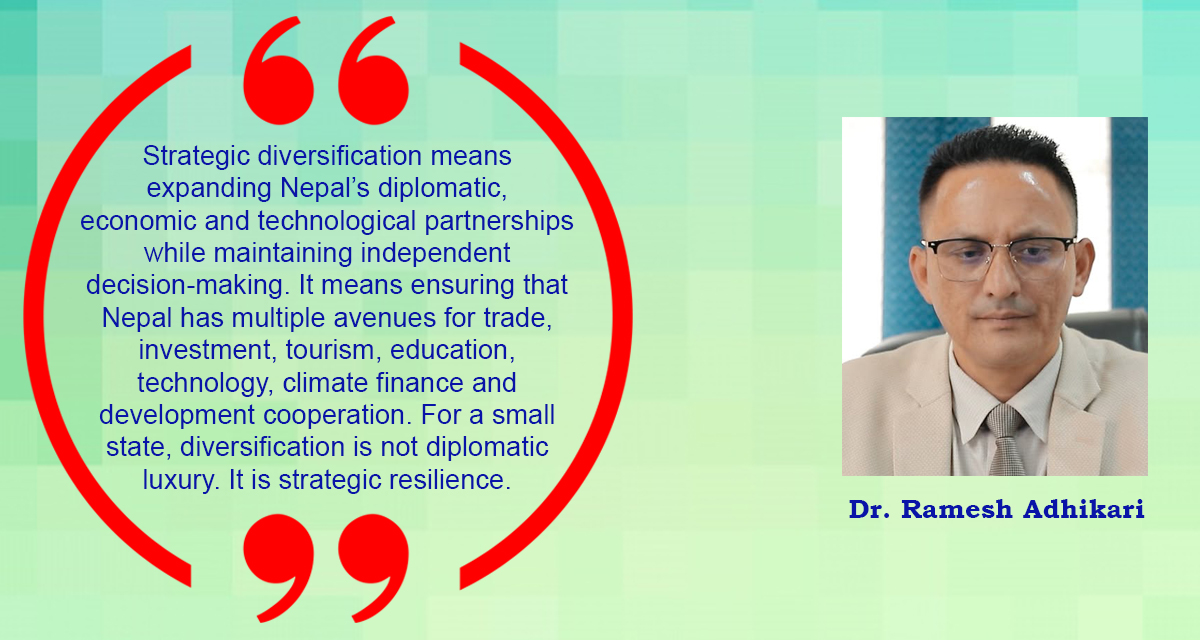
Strategic diversification means expanding Nepal’s diplomatic, economic and technological partnerships while maintaining independent decision-making. It means ensuring that Nepal has multiple avenues for trade, investment, tourism, education, technology, climate finance and development cooperation. For a small state, diversification is not diplomatic luxury. It is strategic resilience.
Non-alignment must become active, not passive
There is sometimes a misconception that non-alignment means remaining distant from international strategic developments. It does not.
For Nepal, non-alignment should mean the ability to assess international issues according to national interest rather than external pressure. The principle should provide Nepal with diplomatic space—not diplomatic silence.
The recent evolution of international politics makes this distinction increasingly important. Competition among major powers is extending beyond military affairs into infrastructure, technology, supply chains, finance and digital systems. Nepal’s own Foreign Ministry has recently emphasized that emerging technologies, economic instruments and critical infrastructure are reshaping international relations, while arguing that non-alignment should be understood as active engagement and independent judgement.
Nepal should therefore aspire to become an active non-aligned state: principled on sovereignty, flexible in cooperation, constructive in multilateral forums and pragmatic in pursuing national interests.
Diplomacy must deliver economic value
Nepal’s foreign policy can no longer be separated from its economic ambitions. Diplomacy should help Nepal sell more goods, attract more productive investment, expand tourism, develop hydropower markets, secure technology partnerships and create opportunities for Nepali workers and students abroad.
This is particularly urgent as Nepal approaches a major economic transition. The country is scheduled to graduate from the UN’s Least Developed Country category on November 24, 2026. However, the transition is not without risks. The United Nations has noted the importance of addressing the loss of LDC-specific support measures, strengthening competitiveness and expanding export opportunities. This should be treated not merely as a development-policy issue but as a diplomatic priority.
Nepal’s embassies should increasingly function as economic and knowledge gateways. Ambassadors and diplomats should be expected not only to represent the state but also to identify investment opportunities, facilitate business-to-business relationships, promote tourism and education, support Nepali enterprises abroad and communicate Nepal’s emerging economic priorities.
Economic diplomacy should become measurable.
Instead of asking simply how many diplomatic meetings were held, Nepal should increasingly ask: How much investment was facilitated? How many new markets were opened? How many students, tourists and businesses were connected? How many technology partnerships were established? Diplomatic success should ultimately be visible in national development.
Climate diplomacy: turning vulnerability into influence
Nepal possesses another potentially powerful diplomatic asset: the Himalayas. The country is highly vulnerable to the consequences of climate change, yet it also occupies a geographically and environmentally significant position in the Hindu Kush Himalaya region. Nepal can therefore transform climate vulnerability into diplomatic leadership.
Rather than speaking about the Himalayas primarily as victims of climate change, Nepal should position the Himalayas as a central component of the global climate conversation. Nepal could lead stronger international advocacy on mountain ecosystems, glacier and snowmelt monitoring, climate-induced disasters, adaptation finance, loss and damage, mountain biodiversity and sustainable tourism.
The logic is straightforward: countries with limited economic and military power can still exercise influence through ideas, institutions and moral authority. Nepal’s experience as a mountain country gives it credibility to speak for mountain communities globally.
Nepal’s peacekeeping legacy is a diplomatic asset
Nepal also possesses an important form of soft power that is sometimes underestimated: its contribution to international peacekeeping.
Nepali military and police personnel have served under the UN flag for more than six decades. In April 2026, the United Nations described Nepal as the fifth-largest contributor to UN peacekeeping, with more than 5,700 personnel serving in more than a dozen countries. This is more than a military contribution. It is diplomatic capital.
In a similar vein, Nepal should use its peacekeeping reputation to deepen its profile in conflict prevention, mediation, peacebuilding and post-conflict reconstruction. The country has its own historical experience of peacebuilding and political transition. Combining this experience with its UN peacekeeping record could allow Nepal to develop a distinctive niche in international diplomacy. Nepal need not aspire to become a great power. It can aspire to become a respected peace power.
From recipient to partner
Another important shift is psychological. For decades, Nepal has often approached international relations primarily as a recipient of aid and development assistance. Development cooperation remains important, but Nepal’s diplomatic narrative should increasingly emphasize partnership rather than dependency.
Specifically, Nepal has resources, human capital, culture, tourism potential, renewable energy, biodiversity and a globally connected diaspora. Its strategic location also gives it potential as a bridge between South Asia and the wider Asian region.
The objective should therefore be to move from:
aid diplomacy → investment diplomacy
recipient diplomacy → partnership diplomacy
reactive diplomacy → proactive diplomacy
protocol diplomacy → results-oriented diplomacy
This does not mean abandoning development assistance. It means using diplomacy to create relationships that generate sustainable economic and technological capacity.
A 21st-century diplomatic architecture
A new diplomatic horizon also requires institutional reform. Nepal needs a stronger ecosystem connecting the Ministry of Foreign Affairs with universities, think tanks, the private sector, provincial governments, municipalities, technology experts and the Nepali diaspora. Foreign policy cannot remain exclusively a Kathmandu-based government exercise.
Universities should contribute research and policy analysis. Think tanks should provide strategic foresight. The private sector should articulate international economic priorities. The diaspora should be treated as a source of knowledge, investment and global networks. Young professionals should be encouraged to enter diplomatic and international-policy careers.
Nepal should also invest more seriously in digital diplomacy and artificial intelligence. The next generation of diplomacy will increasingly involve data, digital communication, cyber security, artificial intelligence and real-time public engagement. A country that does not adapt its diplomatic institutions to these changes’ risks becoming strategically invisible. Nepal should establish stronger capacity in digital diplomacy, strategic communication, geopolitical analysis and technology policy.
The country must speak with greater coherence
Perhaps the greatest diplomatic asset Nepal needs is not another treaty or another institution. It is policy consistency. Foreign policy should rise above short-term partisan calculations. Changes in government are normal in a democracy, but fundamental national interests should not change dramatically with every political transition. The Ministry of Foreign Affairs itself has repeatedly emphasized the importance of national consensus and continuity in foreign policy.
Further, a small country becomes more influential when its partners know what it stands for. Nepal should therefore develop a broadly shared national foreign-policy framework covering sovereignty, neighborhood relations, economic diplomacy, climate diplomacy, development cooperation, diaspora engagement, digital diplomacy and multilateralism. Such a framework would provide continuity while allowing governments to adjust tactics according to changing circumstances.
From being located between powers to connecting them
Nepal’s geography is often described as a constraint. It can also be an opportunity. The country sits between two of Asia’s largest economies and within a rapidly transforming Asian region. Rather than seeing itself merely as a buffer or a geopolitical space contested by others, Nepal should seek to become a connector—of markets, cultures, knowledge, tourism, energy and people. This requires infrastructure, political stability, predictable policies and diplomatic imagination. The ultimate goal should not be to choose one side. Nor should it be to remain permanently trapped between sides. The goal should be to have enough strategic autonomy to work constructively with all sides while remaining firmly anchored in Nepal’s national interest.
A new diplomatic confidence
Nepal has already demonstrated that a small country can have a voice beyond its material capabilities. Its participation in the United Nations, longstanding peacekeeping contribution, role in regional diplomacy and commitment to multilateralism demonstrate that influence does not always depend on economic or military size. Nepal’s own diplomatic tradition has emphasized sovereign equality, mutual respect, peaceful coexistence and an independent foreign policy.
The next step is to convert these principles into a more ambitious strategy. Nepal should move from being primarily a rule-taker to a rule-shaper, from a recipient to a partner, and from a geopolitical object to a diplomatic actor. The changing world does not necessarily make Nepal less relevant. It may actually create new opportunities for a country that understands its limitations but is confident about its possibilities.
In Short, the new diplomatic horizon should therefore be clear: friendship with all, strategic autonomy, economic pragmatism, climate leadership, technological engagement and an unwavering commitment to national interest.
The author is an educationist, researcher & social contributor
Facebook Comment
Related News

latest Video
Trending News
- This Week
- This Month