
The Absence of Shri Krishna from the Dashain Blessing Mantra: A Study of Religious Tradition, Epic Characters, and Cultural Consciousness

This article examines the historical, religious, and cultural significance of the traditional Dashain blessing mantra, with particular attention to the absence of Shri Krishna’s name, the symbolic associations of epic characters, and the value of thoughtful inquiry in understanding Nepal’s cultural heritage.
1. Introduction
In Nepali society, Dashain is much more than a religious festival. It is a living expression of historical memory, social bonds, cultural identity, and traditions passed down from one generation to the next. Through the rituals of tika and jamara, blessings from elders, and family reunions, Dashain continues to play an important role in Nepal’s religious and cultural life.
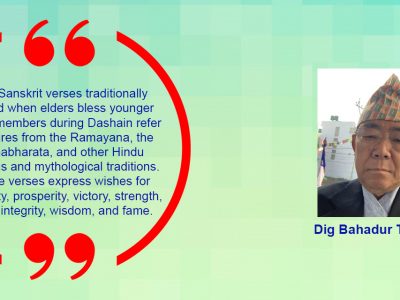
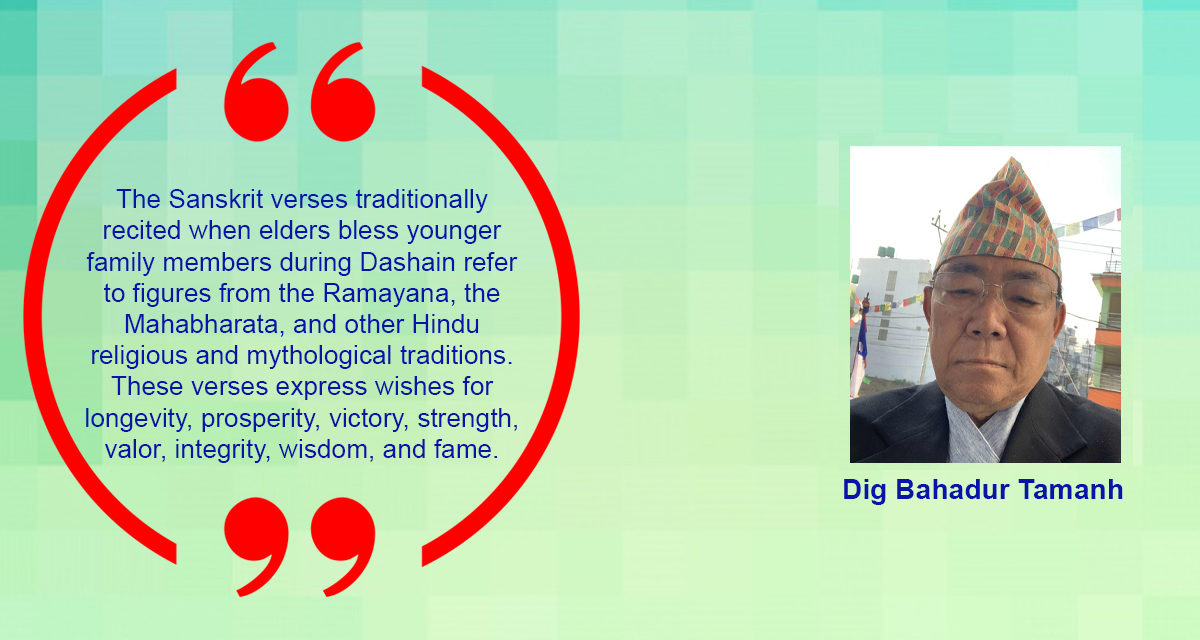
The Sanskrit verses traditionally recited when elders bless younger family members during Dashain refer to figures from the Ramayana, the Mahabharata, and other Hindu religious and mythological traditions. These verses express wishes for longevity, prosperity, victory, strength, valor, integrity, wisdom, and fame. Yet a question arises when we examine one commonly recited Dashain blessing mantra: Although it mentions several prominent figures associated with the Mahabharata, including Bhishma, Ashwatthama, Yudhishthira, Vidura, and Duryodhana, it does not explicitly mention Shri Krishna, one of the epic’s most influential figures.
This observation raises an intriguing question: Why does Shri Krishna’s name not appear explicitly in the Dashain blessing mantra, despite his pivotal role in the Mahabharata? Could this omission be related to the mantra’s purpose, the symbolic qualities associated with the figures it invokes, or the historical development of the tradition?
Exploring this question requires a careful examination of Dashain’s historical development, the structure and meaning of the blessing mantra, the symbolic significance of its characters, and the broader cultural consciousness of Nepali society.
The purpose of this discussion is not to challenge religious faith or assign motives to the tradition’s creators. Rather, it is to consider a meaningful cultural question through a balanced approach that respects religious traditions while recognizing the importance of historical evidence and critical inquiry.
2. The Historical Development of Dashain: From the Licchavi Period to the Malla Era
The Licchavi period in Nepal, generally dated from approximately the fourth through the eighth century CE, was an important era in the development of religious and cultural traditions. Inscriptions from this period provide evidence of deity worship, religious donations, and royal patronage. An inscription associated with King Manadeva, dated to 503 CE, mentions Bhagwati and offers a useful point of reference for studying the history of goddess worship in Nepal.
However, evidence of goddess worship should not automatically be taken as proof that Dashain was celebrated in the same form as it is today. Establishing such a connection requires additional historical evidence. Drawing on historical discussions by scholar Mahesh Raj Pant, references to Dashain in Nepal can be traced to the medieval period, including the fourteenth century.
During the Malla era, Navaratri, Durga worship, and the veneration of Shakti appear to have held important places in royal and urban religious life. Goddess worship was not simply a matter of personal devotion; it also served as an expression of royal prestige, political legitimacy, and collective religious identity. Later, during the Shah period, Dashain acquired broader significance at the state level alongside territorial expansion and political unification.
The festival’s development can therefore be understood as the product of a long and complex interaction among religious traditions, royal patronage, and political change. Nevertheless, establishing a direct connection between these historical developments and the composition of the Dashain blessing mantra requires further research into the mantra’s origins, earliest known textual sources, and history of transmission.
3. The Dashain Blessing Mantra and Its General Meaning
One commonly recited version of the Dashain blessing mantra reads as follows:
“आयुर्द्रोणसुते श्रियं दशरथे शत्रुक्षयं राघवे। ऐश्वर्यं नहुषे गतिश्च पवने मानं च दुर्योधने॥ शौर्यं शान्तनवे बलं हलधरे सत्यं च कुन्तीसुते। विज्ञानं विदुरे भवन्तु भवतां कीर्तिश्च नारायणे॥”
In general terms, the verse expresses a wish that the recipient may enjoy longevity like Ashwatthama, the son of Drona; prosperity like Dasharatha; victory over enemies like Rama; grandeur and authority like Nahusha; speed like the wind god Vayu; honor like Duryodhana; valor like Bhishma, the son of Shantanu; strength like Haladhara, or Balarama; truthfulness like Yudhishthira, the son of Kunti; wisdom like Vidura; and fame like Narayana.
A closer examination reveals that the mantra is not intended to provide a comprehensive list of epic characters or evaluate their entire lives and personalities. Instead, it associates particular figures with specific qualities and uses those associations to express blessings for the recipient.
The figures named in the verse come from several religious and literary traditions. Dasharatha and Rama are associated with the Ramayana, while Ashwatthama, Bhishma, Yudhishthira, Vidura, and Duryodhana are associated with the Mahabharata. Nahusha, Vayu, Balarama, and Narayana represent other strands of Hindu religious and mythological tradition.
This structure suggests that the mantra’s primary purpose is to invoke desirable qualities through familiar cultural and religious figures rather than to recount epic narratives or make an overall moral judgment about each character.
Understanding this distinction is important when considering why some figures appear in the mantra while others do not.
4. Why Is Shri Krishna’s Name Not Explicitly Mentioned ?
This is perhaps the most intriguing question raised by the mantra. Shri Krishna occupies a central position in the Mahabharata. He supports the Pandavas, serves as Arjuna’s charioteer, delivers the teachings of the Bhagavad Gita, and plays a decisive role in the epic’s political, philosophical, and moral conflicts.
Given his importance, the absence of his name from the mantra naturally invites further inquiry. However, a responsible historical analysis must begin by acknowledging the limits of the available evidence. Unless reliable sources establish who composed the mantra, when it was composed, and what considerations guided the selection of its characters, it would be premature to offer a definitive explanation. Several possibilities merit consideration.
First, the figures may have been selected primarily for their association with particular qualities rather than according to their overall religious or literary importance. Rama, for example, is associated with victory, Bhishma with valor, and Vidura with wisdom. From this perspective, Krishna’s absence may reflect the particular structure or purpose of the mantra rather than any judgment about his significance.
Second, some qualities associated with Shri Krishna may overlap with the religious or symbolic meanings attached to other figures mentioned in the verse. This is a possible interpretive approach, but it should not be presented as the composer’s original intention without supporting evidence.
Third, the mantra may have developed within a particular religious, literary, or regional tradition in which the selection of characters became established through repeated use and oral transmission. A comparison of older manuscripts, published Sanskrit texts, and related blessing verses from different regions could help clarify how the mantra evolved.
These possibilities offer starting points for further investigation, not definitive answers.
For this reason, the absence of Shri Krishna’s name should not, by itself, be interpreted as evidence of deliberate exclusion or opposition to a particular religious tradition. Such a conclusion would require independent historical evidence.
5. The Religious Relationship Between Narayana and Shri Krishna
The final line of the mantra contains the expression “कीर्तिश्च नारायणे” (kīrtiś ca nārāyaṇe), which conveys a wish for fame like that of Narayana. This raises another important question: If Shri Krishna is not named explicitly, might the reference to Narayana have a broader theological connection to Krishna?
In Vaishnava traditions, Narayana and Vishnu are revered as supreme divine figures. Shri Krishna is widely understood in many Hindu traditions as an incarnation of Vishnu. In other Vaishnava traditions, Krishna himself is understood as the Supreme Being. The theological relationship between Narayana and Krishna is therefore significant, although its interpretation varies across traditions.
From this perspective, the reference to Narayana may resonate with religious beliefs that also encompass Shri Krishna. Nevertheless, it is important to distinguish between a theological relationship and an explicit textual reference. The phrase “कीर्तिश्च नारायणे” expresses a wish that the recipient attain fame like Narayana. Although the religious relationship between Narayana and Krishna provides a meaningful context for interpretation, it does not establish that Narayana’s name was deliberately intended to serve as a substitute for Krishna’s name in this particular mantra.
Determining whether the reference was intended to include Krishna in this way would require further evidence concerning the mantra’s textual history, religious context, and original purpose.
The most cautious conclusion is that Narayana’s presence connects the mantra with broader Vaishnava religious concepts, while the precise significance of that reference within the mantra remains an open question for further study.
6. The Mention of Duryodhana but Not Shri Krishna: A Question for Comparative Study
Another noteworthy feature of the mantra is its association of Duryodhana with honor. In the Mahabharata, Duryodhana is a complex and controversial figure. His actions are frequently associated with ambition, arrogance, and hostility toward the Pandavas. At the same time, some episodes portray his determination, loyalty to his friends, and commitment to his understanding of Kshatriya honor.
The inclusion of Duryodhana’s name, alongside the absence of Shri Krishna’s name, creates an interesting question for comparative literary and cultural analysis. However, this contrast should not be taken as evidence that the composer considered Duryodhana more important than Krishna or intended to diminish Krishna’s significance.
Associating Duryodhana with honor does not necessarily endorse his entire character or conduct. Similarly, the absence of Krishna’s name does not establish that his religious or literary importance was rejected.
The broader issue concerns the way cultural traditions associate particular characters with specific qualities. Over time, a character may become closely linked to one attribute, even when the character’s larger narrative includes moral complexity and conflicting actions.
This process may help explain how epic figures function symbolically within the blessing mantra. However, the actual reasons for the selection of these figures cannot be established without further textual and historical research.
A comparative study of older versions of the mantra, regional variations, and related Sanskrit religious literature could help determine whether the selection of characters reflects a particular literary convention, a regional tradition, or another historical development.
7. The Blessing Mantra and Nepali Cultural Consciousness
The significance of the Dashain blessing mantra extends beyond the literal meaning of its words. It is a cultural practice passed down through generations. When elders apply tika and jamara to younger family members, they offer blessings for longevity, prosperity, strength, wisdom, and fame. These rituals help reinforce affection, mutual respect, family bonds, and continuity between generations.
The mantra can also be understood as an expression of oral cultural heritage. Within its verses, epic characters, religious beliefs, moral aspirations, and social values come together in a form that has remained meaningful in everyday family life.
At the same time, the mantra’s present-day cultural significance and its historical origins are distinct matters. Its widespread use during Dashain does not, by itself, establish when it was composed, which text it originally came from, or why particular characters were selected. Addressing these questions requires the examination of manuscripts, Sanskrit literary sources, religious commentaries, and regional traditions.
This distinction does not diminish the cultural value of the mantra. Instead, it recognizes that a tradition can be meaningful to a community while still offering important questions for historical and scholarly investigation.
Religious faith and historical inquiry need not be viewed as opposing approaches. Faith helps sustain traditions across generations, while research can deepen our understanding of their origins, development, and significance.
When approached with care and respect, historical inquiry can enrich cultural understanding rather than undermine it.
8. Respecting Tradition While Encouraging Critical Inquiry
The question of why Shri Krishna’s name does not appear explicitly in the Dashain blessing mantra points to a broader principle: respecting tradition does not require us to accept every aspect of it without examination.
Traditions can be understood in ways that connect their enduring values with contemporary life. Strength, for example, may be interpreted not simply as the power to dominate others but as the courage to stand against injustice. Honor may be understood not merely in terms of rank or prestige but also as a commitment to mutual respect and trust. Wisdom may be understood as the ability to distinguish right from wrong and to make thoughtful decisions.
Similarly, the study of religious mantras can include questions about character selection, linguistic structure, historical context, and social influence. Raising such questions need not weaken a tradition. On the contrary, thoughtful inquiry can deepen our appreciation of its complexity and broaden our understanding of its cultural significance.
The same approach is appropriate when examining the absence of Shri Krishna’s name. The question itself is legitimate and worthy of investigation. However, attributing the omission to a particular religious, sectarian, or political motive without reliable evidence would go beyond what the available information can establish.
A central principle of historical scholarship is the distinction between a plausible interpretation and a conclusion supported by evidence. Recognizing that distinction allows us to explore meaningful questions without overstating what we know.
Respect for tradition and openness to inquiry can therefore work together. One acknowledges the cultural and spiritual significance of inherited practices; the other seeks to understand how those practices developed and what their details may reveal about the societies that preserved them.
Conclusion
The traditional Dashain blessing mantra occupies an important place in the religious and cultural life of Nepali society. Through references to mythological and epic figures, it expresses wishes for longevity, prosperity, victory, grandeur, speed, honor, valor, strength, truthfulness, wisdom, and fame.
The absence of Shri Krishna’s name from a verse that mentions several other figures associated with the Mahabharata is an intriguing subject for historical, literary, and religious inquiry. Nevertheless, the available evidence does not establish a definitive historical explanation for this omission.
The mention of Narayana provides a meaningful connection to Vaishnava theology, including traditions that associate Narayana, Vishnu, and Shri Krishna. However, this theological relationship should not be confused with an explicit reference to Krishna in the mantra itself.
Likewise, the inclusion of Duryodhana’s name and the absence of Krishna’s name should not automatically be interpreted as a ranking of their importance or as evidence of the rejection of one figure in favor of another. A more conclusive interpretation would require further research into the mantra’s earliest known sources, date of composition, textual variations, and the historical context in which its selection of characters developed.
Ultimately, the Dashain blessing mantra deserves attention not only as a religious verse recited during an important festival but also as an expression of cultural memory, moral aspiration, and inherited tradition. Examining its language and symbolism can open a broader discussion about how religious and literary traditions preserve particular values across generations.
The question of why Shri Krishna’s name does not appear explicitly is therefore best understood as an invitation to further research rather than as evidence for a predetermined conclusion.
Respecting tradition while asking thoughtful, evidence-based questions is an important expression of cultural maturity. By bringing together historical sources, scholarly research, religious texts, and careful personal reflection, we can develop a deeper understanding of our cultural heritage while remaining mindful of the distinction between faith, interpretation, and historical evidence.
Facebook Comment
Related News
latest Video
Trending News
- This Week
- This Month