
Flowers on a Single Garland: Where Has Nepal Come From, and Where Is It Going ?
From Los Angeles in 2007 to the Present—A Question That Has Remained in the Heart of a Nepali Living Abroad

Sometimes, after traveling a long distance through time, when we look back, our own old words seem almost unfamiliar. Yet, at other times, those same old words become a mirror reflecting the present. I still remember a day in July 2007. The annual conference of the Association of Nepalese in America was being held in Los Angeles, California. I was writing a poem for that conference.
At that time, Nepal was passing through a great storm of political change. Debates over monarchy, democracy, republicanism, inclusion, identity, and federalism were intensifying. Although I was living thousands of miles away in America, I was deeply concerned about Nepal’s future. A question kept arising in my mind: Nepal certainly needed to change—but would the path of change bring us closer together, or would it take us farther apart?
From that feeling came an image in my poem: Could the melodies of the Himalayas and the hills, the language of Bhojpur, the Maithili language of Janakpur, the folk traditions of the Terai, and the songs of the Tharu people all be woven into a single Nepali garland?
I believed that for Nepal to remain one, everyone did not have to speak the same language, follow the same culture, or wear the same traditional dress. On the contrary, our different languages, customs, clothing, folk songs, and ways of life are what make Nepal beautiful. The Himalayas can remain the Himalayas, the hills can remain the hills, and the Terai can remain the Terai, while all three remain parts of the same country. The flowers may be different, but the garland can still be one.
At that time, my greatest concern was this: In our search for rights and identity, would we eventually lose our shared Nepali identity? Today, nearly two decades later, that old question has returned to my mind.
Nepal has entered the era of a federal democratic republic. The purpose of federalism was to bring state power closer to citizens, provide representation to historically marginalized communities, and reduce regional inequalities. Therefore, federalism itself should not be understood as an idea intended to divide Nepal. However, the outcome of any political system also depends on the political culture and civic consciousness with which it is practiced.
Today, we must ask ourselves: Has political competition become so intense that we are beginning to forget the shared feeling of being Nepali? This question applies not only to Nepal but equally to Nepali communities living abroad.
I remember the Nepali diaspora before the restoration of multiparty democracy. Nepalis living abroad could have different political opinions, but they came together because they were Nepali. When Dashain came, everyone was Nepali. When Tihar came, everyone was Nepali. When tragic news came from Nepal, everyone’s heart ached. When Nepal achieved something, everyone’s chest swelled with pride.
Being Nepali in a foreign land was itself a powerful identity. But over time, we also brought Nepal’s political divisions into the diaspora. Various organizations were established. Nonprofit organizations emerged. Social organizations expanded. Creating organizations based on Nepali language, culture, religion, region, and community is natural and, in many circumstances, extremely valuable.
But the problem begins when a social organization starts to appear like an extension of a political faction. Some organizations appear close to the Nepali Congress, some to the Communist Party of Nepal (Unified Marxist–Leninist), and others to different political currents. Holding political views is a citizen’s right. But when even the common platforms of the Nepali diaspora begin to become arenas for partisan competition, we must ask ourselves some serious questions.
Did we come abroad to build a Nepali community, or did we also bring Nepal’s political quarrels with us? Living abroad, we need to understand one thing more clearly than ever: First and foremost, we are Nepali. A political party may represent our beliefs, but it is not our identity. Parties may change. Governments may change. Leaders may change. But our national identity does not change.
Today, social media has made these divisions even sharper. A statement is made by a political leader, and immediately people support or oppose it. A video appears, and people believe or reject it without checking the facts. If someone raises a question about nationalism, the other side often views that person through a political lens. If someone supports federalism, another side may regard that person as opposed to the nation. In this way, it increasingly appears that accusations are becoming louder than dialogue.
Recent political developments have also generated new debates in Nepal about leadership, national identity, security, and how Nepal is represented on the international stage. On such matters, we need facts rather than emotion, evidence rather than allegations, and responsible debate rather than propaganda.
Nepal’s national identity does not exist in only one form of dress. It does not exist in a single speech. Nor does it exist under the flag of any one political party. National identity is the trust among citizens, responsibility toward the country, and commitment to building a shared future while respecting diversity.
We must regard Nepalis who speak Maithili as equally Nepali. The same applies to those who speak Bhojpuri and Tharu. It applies to citizens who speak Tamang, Newar, Gurung, Magar, Limbu, Sherpa, Rai, Nepali, or any other language. Nepal’s diversity is not the cause of our division; it is part of our history and identity. But if the thread that binds our diversity together becomes weak, the flowers may still be beautiful individually, yet they can no longer form a garland.
I believe this is the thread Nepal needs most today—the thread of trust. Kathmandu must trust Janakpur. Janakpur must trust Bhojpur. Bhojpur must trust Dhangadhi. The Himalayas must trust the Terai, and the Terai must trust the hills. Nepalis living in Nepal must trust Nepalis living abroad, and Nepalis living abroad must trust those living in Nepal.
We must also tell this story to our children. We must teach them that Nepal is not only Kathmandu. Nepal is not only Mount Everest; it is also the Maithili culture of Janakpur. Nepal is not only Pashupatinath; it is also the folk music of the Terai. Nepal is not only the mountains of Pokhara; it is also the pain and possibilities of Karnali. Nepal is the shared home of many voices.
That is why, when I remember that poem from 2007 today, I feel that its central message is still alive. We do not need to paint Nepal in a single color. We need to learn how to place different colors together in one picture. We do not need to speak the same language. But we must learn to listen to one another’s languages. We do not need to hold the same political beliefs. But we must not regard Nepalis with different opinions as enemies. We do not need to follow the same culture. But we must respect one another’s cultures.
And most importantly, we do not need to stand beneath the flag of a single political party in order to be Nepali. Political parties are necessary institutions of democracy. But Nepal is greater than its political parties. It is greater than any government. It is greater than any leader or any leader’s popularity. Even beyond the words of the Constitution stands the shared future of the citizens that the Constitution seeks to create.
When I wrote that poem in Los Angeles in 2007, I imagined a single garland. I can still see that garland before my eyes. It contains a flower from the Himalayas, a flower from the hills, and a flower from the Terai. It carries the fragrance of Maithili, the melody of Bhojpur, the folk music of the Tharu people, and the culture of Kathmandu. The flowers are different, but the thread is one. That thread is Nepali identity.
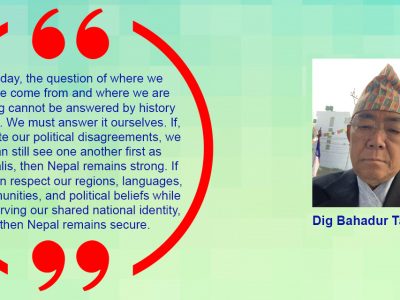
Today, the question of where we have come from and where we are going cannot be answered by history alone. We must answer it ourselves. If, despite our political disagreements, we can still see one another first as Nepalis, then Nepal remains strong. If we can respect our regions, languages, communities, and political beliefs while preserving our shared national identity, then Nepal remains secure.
But if we begin to view every relationship through the lens of political parties, every organization as a political faction, and every Nepali as either someone on our side or someone against us, then the greatest damage to our country will not occur in its geography—it will occur in our hearts.
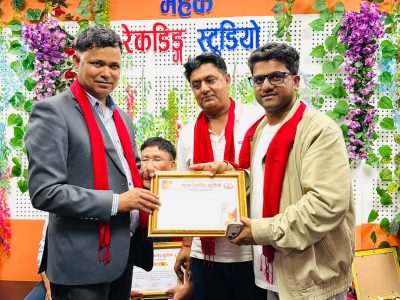
Therefore, once again, I feel compelled to make the same appeal: Let the flowers remain different, let the melodies remain different, let the languages remain different, and let the political views remain different—but let the garland never break. Because, in the end, we all share one common home— Nepal. The poem I wrote in 2007 was later honored with an award by the International Literature Society.
Facebook Comment
Related News

latest Video
Trending News
- This Week
- This Month