
The Bhotekoshi Flood: A Warning from the Himalayas and a Test of Global Climate Justice

Nepal’s tragedy should not be treated as another isolated natural disaster. It warns the world that climate change, mountain instability, transboundary rivers, and human vulnerability are converging—and that the international community must respond with science, solidarity, and justice.
The devastating Bhotekoshi flood disaster of August 26, 2026, should compel Nepal and the international community to pause and ask a much larger question: Was this simply another natural disaster, or is it a warning of a rapidly changing Himalayan environment in which climate change, glacier and permafrost instability, geological hazards, extreme weather and human vulnerability are becoming increasingly interconnected?
This question matters beyond Nepal. The Bhotekoshi/Poiqu-Sunkoshi river system crosses the China–Nepal border and ultimately connects with the wider Koshi basin toward India. What happens in the high Himalayas can therefore have consequences far beyond the immediate disaster zone.
The tragedy should become a catalyst for a new approach to Himalayan environmental governance, disaster preparedness, climate justice and international cooperation.
We must first be scientifically honest. The immediate physical mechanism of the August 26 event requires careful investigation. Preliminary satellite-based studies indicate a major high-altitude rock-and-ice mass movement and cascading downstream processes. The exact trigger, however, still requires further scientific investigation. It would therefore be irresponsible to claim that climate change alone caused the flood.
But it would be equally irresponsible to ignore the climate connection.
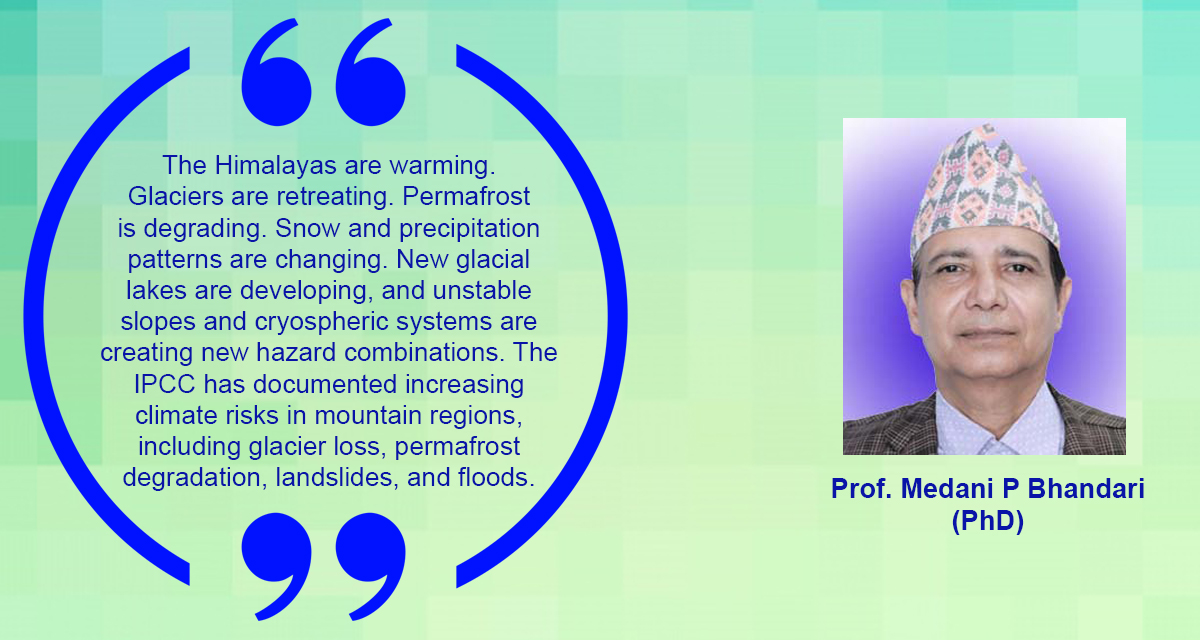
The Himalayas are warming. Glaciers are retreating. Permafrost is degrading. Snow and precipitation patterns are changing. New glacial lakes are developing, and unstable slopes and cryospheric systems are creating new hazard combinations. The IPCC has documented increasing climate risks in mountain regions, including glacier loss, permafrost degradation, landslides, and floods.
The important scientific question is therefore not simply, “Did climate change cause this flood?”
The more meaningful question is:
How has human-induced climate change altered the environmental conditions that make disasters such as Bhotekoshi more likely, more intense, or more damaging?
Modern climate science increasingly has the tools to investigate precisely this question.
A Disaster Is Rarely Caused by One Factor
Natural disasters are often presented as if they have a single cause. In reality, major disasters often result from cascading processes.
A possible sequence in a high Himalayan environment may look like this:
warming → glacier/permafrost change → slope destabilization → rock/ice collapse → rapid movement of water and debris → river surge → infrastructure destruction → human and economic losses.
Each link must be scientifically examined.
Researchers should investigate temperature trends, precipitation, glacier movement, permafrost conditions, geological structure, snow and ice conditions, hydrology, sediment movement, and the physical characteristics of the avalanche or landslide.
They should also ask whether similar conditions would have existed under a less-warmed climate.
This is the emerging field of climate attribution science.
Climate attribution does not mean blaming climate change for every disaster. It asks whether human-induced warming changed an event’s probability or severity. That distinction is crucial.
The Bhotekoshi disaster therefore deserves an independent international scientific investigation involving climatologists, glaciologists, geologists, hydrologists, geomorphologists, remote-sensing specialists, disaster scientists, economists, sociologists, and legal experts.
The Himalayas Do Not Recognize Political Borders
One of the most important lessons from Bhotekoshi is that environmental systems do not follow political boundaries.
The river system connects China, Nepal and India.
A hazard that begins in a remote mountain valley can rapidly become a transboundary disaster.
This means that disaster management cannot remain exclusively national.
China, Nepal and India need mechanisms for:
- real-time hydrological data sharing;
- glacier and landslide monitoring;
- common hazard mapping;
- joint scientific research;
- emergency communication;
- early-warning systems;
- coordinated evacuation procedures;
- disaster-response cooperation;
- climate adaptation financing.
This is not about blaming one country.
It is about recognizing a shared geographical reality.
The Himalayas are a shared ecological system.
The atmosphere is shared. Water is shared. Climate risks are shared.
Therefore, risk information must be shared as well.
The Climate-Justice Question
Another dimension cannot be ignored.
Nepal has contributed very little to the historical accumulation of global greenhouse-gas emissions compared with the world’s major industrial and high-emitting economies. Yet Nepal remains highly vulnerable to climate-related disasters because of its geography, fragile mountain ecosystems, limited infrastructure, and dependence on climate-sensitive livelihoods.
This creates a fundamental climate-justice dilemma:
Those who contributed least to the problem can suffer some of its most severe consequences. This is why Bhotekoshi should not be seen as simply a humanitarian emergency.
It is also a climate-justice issue.
Climate justice means that vulnerable countries and communities should not be left alone to bear the costs of a global problem they did little to create.
- It means strengthening adaptation.
- It means protecting vulnerable communities.
- It means financing loss and damage.
- It means transferring knowledge and technology.
- It means building resilient infrastructure.
And where international legal responsibilities are established, it means considering accountability and appropriate remedies.
Can Bhotekoshi Be Taken to International Justice?
This question deserves serious discussion—but also legal precision.
An individual victim cannot simply take a flood case directly to the International Court of Justice (ICJ). The ICJ primarily hears disputes between States and provides advisory opinions when requested through appropriate UN mechanisms.
However, international climate law has entered a new era.
In July 2025, the ICJ issued its landmark Advisory Opinion concerning States’ obligations in relation to climate change. The opinion has important implications for understanding State obligations to protect the climate system and environment and to address climate-related harms.
This does not mean that a particular country can automatically be declared legally responsible for the Bhotekoshi disaster.
Such a conclusion would require evidence. But international law provides important principles on preventing transboundary environmental harm, due diligence, cooperation, and environmental protection.
The legal question should therefore not begin with: “Who can we sue?” It should begin with:
“What happened, what was scientifically foreseeable, what information existed, what could reasonably have been done, and what international obligations apply?”
That is why preserving evidence is so important.
From Disaster Investigation to Climate-Justice Evidence
Every major climate-related disaster should now generate a comprehensive Climate Disaster Evidence Dossier.
For Bhotekoshi, such a dossier should contain:
Scientific evidence: satellite imagery, climate records, glacier observations, geological data, hydrological information, seismic records, and field investigations.
Human evidence: deaths, missing persons, displacement, livelihoods, health impacts, trauma, and community experiences.
Economic evidence- Damage to homes, roads, bridges, hydropower, agriculture, tourism, businesses and public infrastructure.
Ecological evidence: Loss of forests, wildlife habitat, river ecosystems, biodiversity, and ecosystem services.
Governance evidence: Early-warning systems, available information, emergency communication, evacuation procedures, and institutional decisions.
Legal evidence: Applicable national laws, bilateral agreements, international environmental obligations, human-rights standards and climate commitments.
Such a dossier would provide a foundation for scientific research, policy negotiations, climate-finance applications and, where appropriate, legal proceedings.
We Need a Bhotekoshi International Scientific Commission
One practical proposal deserves immediate consideration: establishing an International Bhotekoshi Scientific and Climate Justice Commission. The Commission should be independent, scientifically credible, and internationally representative.
Its responsibilities should include five major tasks.
First: Reconstruct the disaster —Scientists should determine exactly what happened, from the initial mountain instability to the downstream flood and debris processes.
Second: Conduct climate attribution-Researchers should determine whether and to what extent climate change altered the probability or severity of the conditions associated with the disaster.
Third: Calculate the full cost- The assessment should include not only destroyed infrastructure but also human, cultural, ecological, social, and long-term economic losses.
Fourth: Examine early warning and governance- The Commission should establish what information existed before the disaster, who had access to it, whether warnings were possible, and whether communities received adequate information.
Fifth: Preserve evidence for justice- The scientific record should be maintained in a form that can support future policy, diplomatic, financial, human-rights, or legal processes.
This would transform Bhote Kosi from an isolated disaster investigation into a model for understanding climate-related mountain disasters worldwide.
Loss and Damage: Nepal Needs More Than Sympathy
International sympathy is important. But sympathy alone does not rebuild a destroyed community. The international climate regime has already established the Fund for Responding to Loss and Damage, intended to assist particularly vulnerable developing countries dealing with climate-related economic and non-economic losses.
Nepal should use this international architecture aggressively and systematically.
The Bhotekoshi assessment should therefore document not only immediate physical damage but also long-term consequences.
A family may lose its house. A farmer may lose agricultural land. A student may lose access to school. A community may lose its road. A hydropower project may lose years of investment.
A tourism business may disappear. A traditional community may lose its cultural landscape.
A river ecosystem may be permanently altered. These are all losses.
Some can be measured in money. Others cannot. Climate justice must recognize both.
Early Warning Must Become a Right in Practice
The world possesses extraordinary technology. Satellites can detect changes in glaciers and slopes. Artificial intelligence can analyze enormous quantities of environmental data.
Weather models can forecast extreme conditions. Remote sensing can identify changing landscapes. Hydrological models can estimate flood risks. Yet technology is valuable only when people receive knowledge in time. A warning system is not complete when a satellite detects a dangerous condition.
It is complete only when: hazard detected → information analyzed → warning issued → warning communicated → community understands → people evacuate → people reach safety.
The last kilometer may be the most important. Remote Himalayan communities must have access to reliable communication, evacuation routes, safe shelters, and locally understandable warning systems. Local people must also be part of the system. Their observations of rivers, slopes, glaciers, rainfall, wildlife and unusual environmental changes can provide valuable information when combined with modern science.
Science Must Leave the Laboratory
The international scientific community has a special responsibility. For too long, scientists have often followed a familiar cycle:
disaster → research → paper → publication → citation → another disaster.
We need a different model: monitor → predict → warn → prepare → prevent → respond → learn.
Universities should establish rapid-response scientific teams.
Research institutions should create open environmental data platforms.
Scientists should work with governments and communities before disasters occur.
Climate attribution should become a routine component of major disaster investigations.
Environmental scientists should work much more closely with economists, sociologists, lawyers, engineers, public-health specialists, and humanitarian organizations.
No single discipline can understand a disaster of this complexity.
What Can I Do? What Can You Do? What Can We Do?
This question is personal. When we see images of destroyed communities, it is easy to ask:
Who will help? But perhaps the more powerful question is:
What can I contribute? As individuals, we can document, research, communicate, educate, support affected communities, and demand evidence-based action.
As scientists, we can share knowledge across disciplines and countries.
As universities, we can mobilize research capacity.
As environmental organizations, we can connect communities with policymakers and international institutions.
As lawyers, we can examine the legal pathways for accountability and protection.
As journalists, we can keep the issue alive after the immediate headlines disappear.
As governments, we can cooperate across borders.
As international organizations, we can mobilize technical assistance and financing.
And as citizens of the world, we can refuse to accept that vulnerable communities must repeatedly pay the price of a global problem they did little to create.
Who Will Listen? This is perhaps the deepest question.
Will anyone listen to the cry of communities living along the Bhotekoshi?
Institutions already exist to listen and act.
The United Nations Framework Convention on Climate Change has created mechanisms for addressing loss and damage.
The Santiago Network facilitates technical assistance for vulnerable developing countries.
UNDRR and the World Meteorological Organization are promoting Early Warnings for All.
The IPCC has documented the growing risks facing mountain regions.
The International Court of Justice has clarified important dimensions of international climate obligations.
The institutions exist. Knowledge exists. Technology exists. The challenge is to connect with them.
A New Himalayan Compact- The Bhotekoshi disaster should lead to a new regional initiative: A Himalayan Transboundary Climate and Disaster Cooperation Compact
China, Nepal and India should work toward a permanent mechanism covering:
- Real-time river data sharing; 2. Joint glacier and landslide monitoring; 3. Shared early-warning systems; 4. Transboundary hazard mapping; 5. Joint scientific investigations; 6. Emergency communication; 7. Community-based disaster preparedness; 8. Climate adaptation financing; 9. Loss-and-damage assessment; 10. Joint research and capacity building. This should not be viewed as charity.
It is an investment in regional stability, human security, and sustainable development.
Bhotekoshi Should Become a Global Case
The importance of Bhotekoshi goes far beyond Nepal. Mountain communities worldwide face similar challenges. The Andes, Alps, Caucasus, Hindu Kush Himalaya and other mountain systems are experiencing changing cryospheric and hydrological conditions.
A scientific framework developed for Bhotekoshi could therefore become applicable globally.
The world needs a standardized system for assessing:
climate change → mountain instability → cascading hazards → vulnerability → losses → responsibility → adaptation → justice.
Bhotekoshi can become the laboratory from which such a framework emerges.
The Moral Responsibility of Our Generation
The most important lesson from Bhotekoshi is not simply scientific.
It is moral.
We now know enough about climate change to understand that environmental risks are increasing.
We know that vulnerable mountain communities face disproportionate risks.
We know that glaciers and permafrost are changing.
We know that early-warning systems save lives.
We know that international cooperation can reduce disaster risks.
We know that climate finance is necessary.
We know that science can provide warnings.
The question is no longer whether humanity possesses knowledge.
The question is whether humanity will use that knowledge in time.
The Bhutekoshi tragedy should therefore not end with mourning. It should begin a new conversation about responsibility.
Not a conversation based on anger or political accusation, but one based on science, evidence, justice, and cooperation.
From a Cry for Help to a Global Movement
My message is not simply: “Help Nepal.” My message is: “Learn from Nepal.”
The people of the Himalayas are not merely victims waiting for international charity. They are living on the frontline of a rapidly changing planetary system.
The Bhotekoshi disaster tells us that climate change is no longer an abstract prediction about the distant future. It interacts with glaciers, rocks, rivers, infrastructure, economies, and human communities today.
Nepal cannot solve this alone.
China cannot solve it alone.
India cannot solve it alone.
The United Nations cannot solve it alone.
Scientists cannot solve it alone.
Governments cannot solve it alone.
But together we can build a system capable of reducing future suffering.
We can transform grief into evidence.
We can transform evidence into policy.
We can transform policy into prevention.
We can transform prevention into resilience.
And where responsibility is established, we can transform evidence into justice.
The Bhutekoshi disaster should therefore become a Bhutekoshi Moment—a moment when the world recognizes that the Himalayas need a new model of international cooperation.
The ultimate question is not simply: Who caused this disaster?
It is: What can we prove? What could have been prevented? Who should help those who suffer?
And most importantly: What must we do today so that tomorrow’s Himalayan communities do not have to ask the same questions after another tragedy? The answer must begin now—with science, solidarity, cooperation, and justice. The Himalayas are warning. The world must listen.
Prof. Bhandari can be reached @: [email protected]. Prof. Medani Prasad Bhandari is a globally recognized environmentalist, humanitarian, scholar, and advocate for sustainable development and social justice. With extensive international experience, he has contributed significantly to environmental conservation, climate change, biodiversity, and sustainability. He has published approximately 45 books and more than 250 scientific papers, reflecting his longstanding commitment to knowledge and global environmental action.
Facebook Comment
Related News
latest Video
Trending News
- This Week
- This Month