
Let Us Turn Human Tragedies into Opportunities for Reform, Not Political Advantage

The self-immolation of Ganesh Nepali in Kathmandu has deeply shocked Nepali society. According to publicly available news reports, the incident was preceded by a dispute with municipal police regarding a wheel lock placed on his scooter. However, the complete facts of the incident can only be established through an official investigation. Therefore, it is important to rely on evidence and verified information rather than reaching conclusions prematurely.
However, one serious question remains: what circumstances led a citizen to reach such an extreme decision? Self-immolation is not an ordinary incident. It is not only an individual tragedy but also a matter of serious reflection for society, state institutions, and public authorities.
In recent years, there has been growing public concern over such tragic incidents in Nepal. Each case may have different causes. Personal struggles, social pressures, financial difficulties, mental distress, or experiences with public institutions can affect individuals in different ways. Therefore, every incident should be examined through impartial investigation and evidence-based analysis rather than being attributed to a single cause without proper understanding.
The incident involving Ganesh Nepali has also raised discussions about public services, administrative conduct, and the relationship between citizens and state institutions. If there are areas where government or local authorities need improvement, those issues should be reviewed seriously. Citizens have a legitimate expectation of respectful treatment, accessible services, and fair procedures. However, solutions should be pursued through facts, dialogue, and responsible processes.
A concerning pattern in Nepal is that sensitive incidents are often followed by political accusations before the actual causes are fully understood. In a democracy, criticizing the government, raising questions, and demanding accountability are natural and necessary. However, using an individual’s tragic death or self-immolation as a tool for political advantage is neither appropriate nor constructive.
Political parties should focus less on gaining political benefit from such tragedies and more on understanding citizens’ suffering and finding solutions. The government, opposition parties, civil society, and the media all have a responsibility to handle such incidents with sensitivity, seek the truth, and work toward preventing similar tragedies in the future.
The role of the media is equally important. Reporting should prioritize accuracy, respect for those affected, and social responsibility. Unverified information and emotionally charged narratives can create confusion rather than contribute to meaningful public discussion.
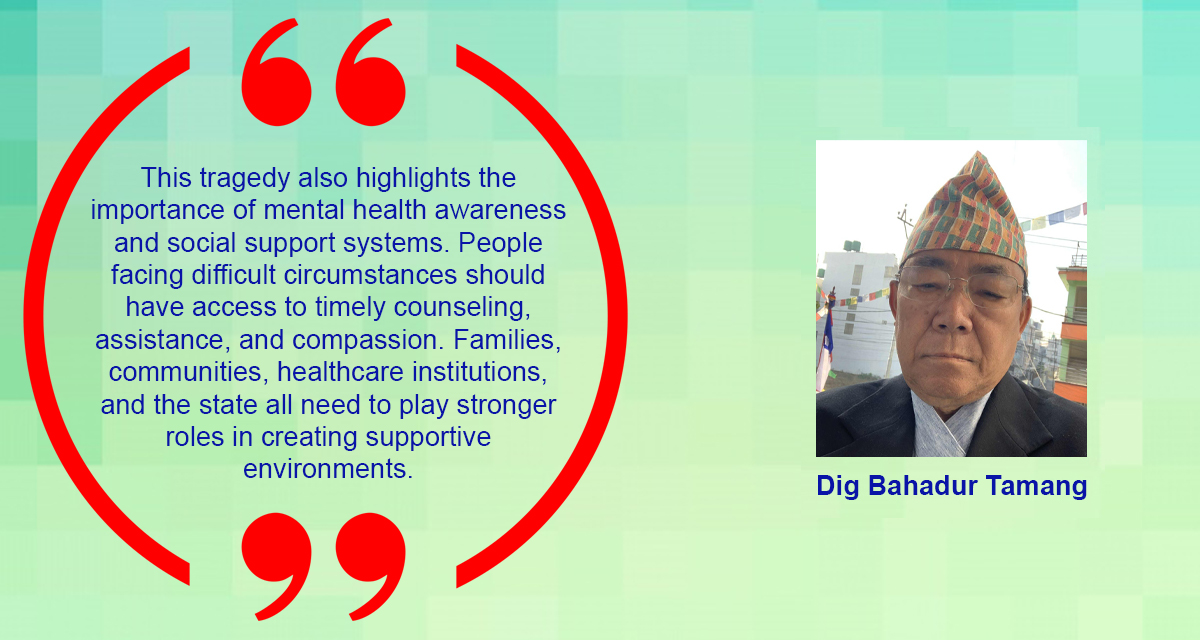
This tragedy also highlights the importance of mental health awareness and social support systems. People facing difficult circumstances should have access to timely counseling, assistance, and compassion. Families, communities, healthcare institutions, and the state all need to play stronger roles in creating supportive environments.
Ultimately, the self-immolation of Ganesh Nepali should not become merely a subject of political controversy. It should be viewed as an opportunity to improve governance, promote responsible administration, strengthen public services, and uphold human dignity. The loss of a human life is a matter far greater than political interests or accusations.
The true maturity of a society is reflected in how it responds after a tragedy. If Nepal can learn lessons of compassion, responsibility, and reform from such painful events, these tragedies may become a turning point toward positive change.
Facebook Comment
Related News
latest Video
Trending News
- This Week
- This Month