
Mero Sathi: From Aid to Shared Learning
Long before the name Mero Sathi emerged after the 2015 earthquake, Nepali and Japanese students had already begun building relationships through learning and community engagement. Nearly two decades later, that history offers a broader story about education, cultural diversity and the changing relationship between Nepal and Japan.

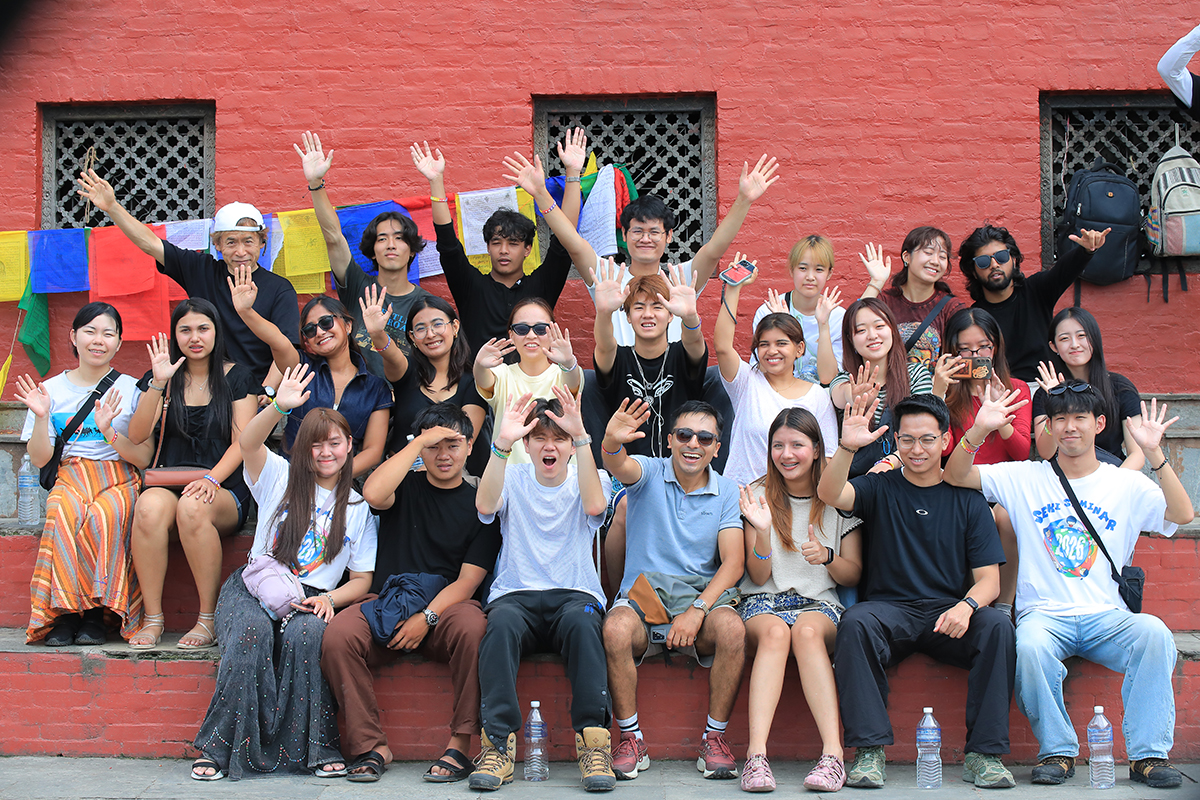
In the aftermath of Nepal’s devastating earthquake of April 25, 2015, a small wristband began circulating in Japan. Printed on it were two Nepali words: Mero Sathi — My Friend.
Japanese university students produced and distributed the wristbands as part of a wider effort to support communities affected by the disaster. Yet the phrase represented more than a fundraising campaign. The people they were trying to support were not anonymous victims in a distant country. They included people the students had met, stayed with, travelled with and learned from over several years.
The earthquake did not create the relationship that became Mero Sathi. It gave an existing relationship a name.
Before the Name
The roots of that relationship go back to 2008.
At the centre of its early development was Professor Akinori Seki of Tokyo Keizai University, who also serves as President of the Asia Association of Education and Exchange (AAEE).
In 2008, Seki began bringing students from his seminar at Tokyo Keizai University to Nepal as part of an overseas educational programme. During that first year, they travelled through several villages in Palpa, encountering communities and ways of life that could not easily be understood through tourism or classroom study. The following year, they visited Jalpa Maidan in Palpa for the first time.
Their experiences were later documented in a Japanese-language book written by Seki together with a Japanese practitioner involved in supporting Nepal, who had introduced him to the area, and a Nepali journalist familiar with the local community.
For Seki, Nepal was not simply a destination for overseas study. He was interested in the contrast between the social realities of Nepal and Japan.
Nepal is a multiethnic and multicultural society in which linguistic, religious and cultural diversity forms part of everyday life. Japan, by contrast, has long placed strong emphasis on cultural homogeneity and has increasingly faced the challenge of how people from different national and cultural backgrounds can live together.
Seki believed that Japan, as it confronted the question of multicultural coexistence, had much to learn from Nepal and its people. That conviction eventually led him to live in Nepal with his family. His children attended Nepali schools, allowing the family to experience dimensions of Nepali society that would have been difficult to understand through short visits alone.
Those experiences shaped an educational principle that would later become central to the programme: Japanese students should not simply learn about Nepal. They should learn with Nepalis.
There was also a longer-term concern behind this approach.
Around 2007, only about 8,000 Nepali nationals were living in Japan. Today, that number is around 300,000. At the time, few people in Japan imagined that the Nepali population would grow on such a scale.
Seki had already begun to consider the possibility that migration from Nepal to Japan would increase substantially. He was concerned that a society shaped by a strong sense of cultural homogeneity was not sufficiently prepared to welcome people from a country as linguistically, ethnically and culturally diverse as Nepal.
As a university educator, he saw direct exchange between young people as one way to prepare for that future. Nepali and Japanese students needed opportunities to meet as individuals before their understanding of one another was shaped mainly by stereotypes, media images or demographic categories.
The first stage began through Seki’s seminar at Tokyo Keizai University in 2008. In 2012, the framework expanded when AAEE began organizing international collaborative learning programmes in Nepal involving Nepali and Japanese university students together.
What had started as an overseas programme for one Japanese university seminar was becoming a broader space in which young people from both countries could learn with and from one another.
The name Mero Sathi did not yet exist, but its educational foundation was already in place.
Learning Through Communities
Community engagement was an important part of the early programmes.
In Jalpa Maidan, limited access to water was a significant challenge in everyday life. Seki and his students worked with local residents to support the construction of a concrete water tank.
The experience encouraged students to reconsider what international engagement should mean. People arriving from outside can easily assume that their role is to identify a problem and provide a solution. The experience in Palpa suggested a more careful approach: listen first, understand how local people themselves view their circumstances, and recognise their agency before deciding what kind of support may be appropriate.
Nepal, in this sense, was not simply a place where Japanese students conducted fieldwork. It became part of their education.
As the programmes developed, Nepali students and young people increasingly became active participants in connecting Japanese students with local communities and institutions. Among them was Kshitiz Battarai, then a Nepali student.
From 2015 onward, Battarai served as the Nepali-side programme coordinator for every Mero Sathi programme, connecting Japanese participants with Nepali students, communities and partner organizations. His continuing role would later become important to the programme’s long-term development in Nepal.
The Earthquake and the Birth of Mero Sathi
The earthquake of April 25, 2015 marked the decisive turning point.
For Seki and the Japanese students who had spent years visiting Nepal and building relationships there, the disaster was not simply a humanitarian crisis overseas. They knew some of the places, communities and people affected.
Following the earthquake, Tokyo Keizai University and AAEE worked in coordination with Nepali students to develop emergency relief and recovery activities. In Japan, the response expanded through fundraising, public events and awareness campaigns. The activities received support from Japan’s Ministry of Foreign Affairs and the Japan International Cooperation Agency (JICA), as well as cooperation from media organizations including NHK.
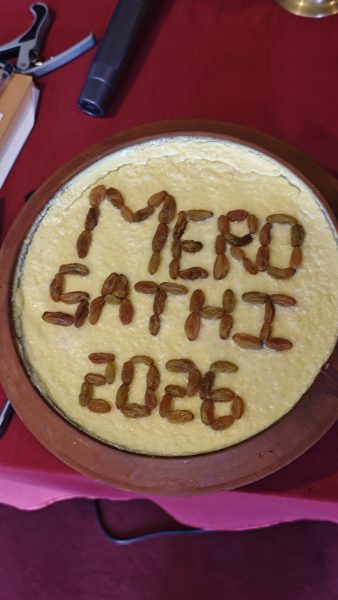
It was during this period that the wristband campaign was launched.
The words printed on the bands were Mero Sathi — My Friend.
The name reflected relationships already formed. The response was not simply based on the idea of one country helping another. The people affected included people the students already regarded as friends.
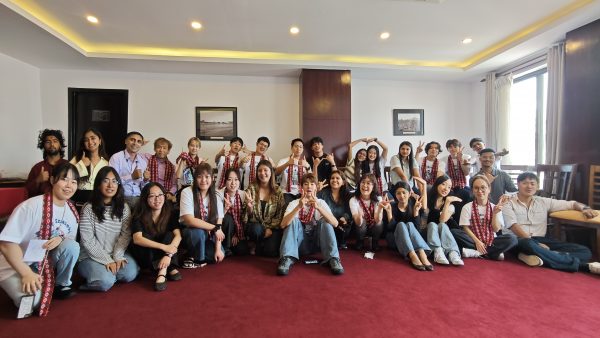
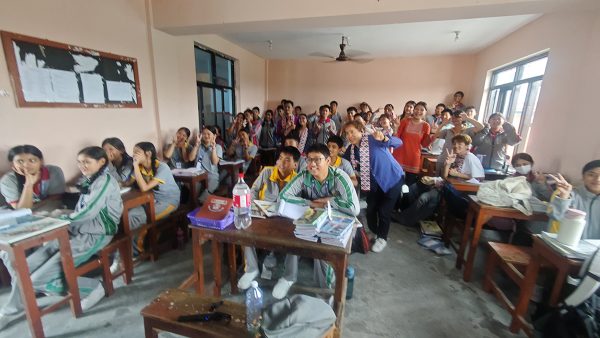
The first Mero Sathi exchange following the earthquake brought together 20 students — 10 from Japan and 10 from Nepal — in August 2015. It combined support activities, community experiences and homestays while strengthening the principle that Nepali and Japanese students should participate as partners rather than simply as hosts and visitors.
In its early phase, Mero Sathi focused heavily on earthquake recovery. Yet those involved also recognised that one-time financial assistance could not provide long-term security.
This led to livelihood-oriented initiatives, including goat donations and support for goat shelters. The aim was to help households develop continuing sources of income rather than rely only on short-term assistance. AAEE later proposed a model in which part of the income generated could also contribute to education within the community.
In Gorkha, project records note support of NPR 50,000 for a goat shelter. Earthquake-related activities also continued in Nuwakot in 2016, including goat donations.
These initiatives were modest in scale, but they reflected a broader principle: recovery should not leave people permanently defined as recipients of aid. It should support their capacity to rebuild their own lives and livelihoods with dignity.
From Relief to Learning Together
By 2017, as the immediate phase of earthquake recovery began to recede, Mero Sathi entered another stage.
From 2017 onward, AAEE and Professor Akinori Seki’s seminar at Tokyo Keizai University played central roles in transforming Mero Sathi from a programme focused primarily on post-earthquake recovery into an international multicultural collaborative learning programme in which Nepali and Japanese students learn from one another.
The change was more than organizational. The central educational question itself shifted.
Earlier programmes had asked what Japanese students could learn about Nepal. The earthquake period had added the question of what could be done to support affected communities.
Mero Sathi increasingly moved toward a more reciprocal question:
What can we learn from one another?
This shift changed the roles of the participants. Nepali students were not merely hosts, and Japanese students were not simply observers. Both entered the programme with their own knowledge, experiences, assumptions and questions. The aim was to create conditions in which each side could learn from the other while also reconsidering its own society.
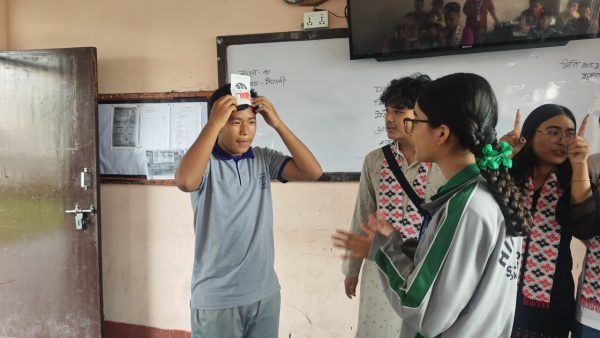
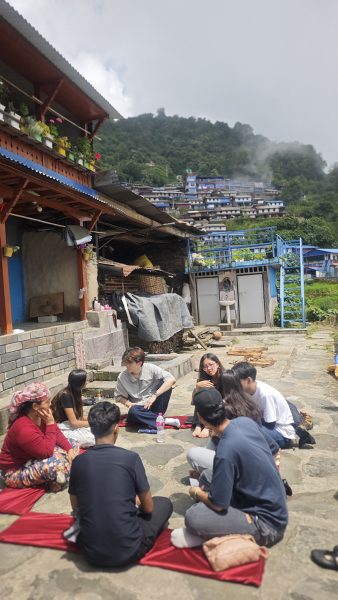
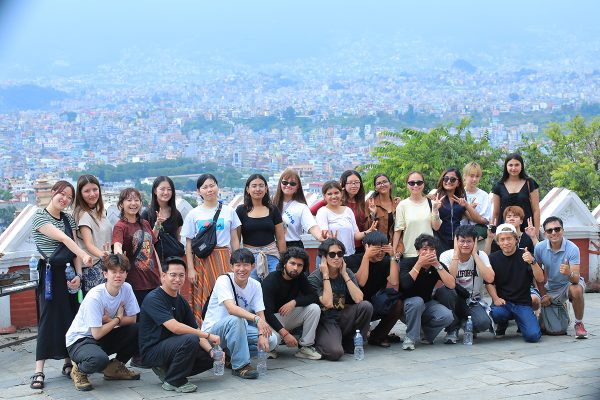
Much of that learning takes place outside conventional classrooms. Students visit schools, communities and organizations, participate in field activities and discussions, stay with local families and spend extended periods working with people from another cultural background.
Such sustained interaction can reveal assumptions participants did not previously recognise in themselves. A homestay, a shared meal, a disagreement or an unexpected difficulty may force students to reconsider ideas they had assumed were universal.
The programme has also continued to support education in tangible ways. In 2017, three second-hand laptops, educational materials and temporary internet access were provided to a school in Pokhara. In 2019, Japanese university professors and students contributed approximately NPR 720,000 toward five years of education for a student from Shamrock School.
From Participants to Partners
The COVID-19 pandemic interrupted international travel and face-to-face exchange, but it did not end the relationships developed through the programme.
Today, Mero Sathi continues through cooperation among Professor Seki’s seminar at Tokyo Keizai University, AAEE and Himavan Nepal.
Himavan Nepal was established by Kshitiz Battarai, who has served as the Nepali-side programme coordinator for every Mero Sathi programme since 2015.
This development illustrates an important aspect of the programme’s evolution. A person who first became involved as a young Nepali participant later established an organization that now helps sustain the programme for subsequent generations.
The three partners have distinct but complementary roles. Professor Seki’s seminar at Tokyo Keizai University remains rooted in university education. AAEE provides a broader framework for international collaborative learning beyond a single university seminar. Himavan Nepal coordinates with students, communities and partner organizations on the Nepali side.
The programme has therefore become both more institutional and more intergenerational.
What Nepal Can Teach Japan
The evolution of Mero Sathi also reflects a broader change in the relationship between the two countries.
International education can sometimes portray countries such as Nepal mainly as places where students from wealthier societies go to study development or social problems. Mero Sathi has increasingly moved away from that model.
Nepal is not simply a field site, and Nepali students are not present merely to explain their culture to foreign visitors. Nepal’s ethnic, linguistic and cultural diversity, its community relationships and its experience of living with difference are themselves sources of knowledge.
This has become increasingly relevant because Japanese society itself is changing.
The growth of the Nepali population in Japan — from roughly 8,000 people around 2007 to around 300,000 today — shows how rapidly the relationship between the two societies has developed. The cultures and perspectives Japanese students encounter through programmes such as Mero Sathi are increasingly part of Japanese society itself, where Nepalis are neighbours, colleagues, classmates and members of local communities.
Learning to engage with cultural difference in Nepal therefore also has relevance to the future of Japan.
At the same time, mutual learning does not require Nepal to be idealised. Nepal, like Japan, has its own inequalities, social problems and contradictions. The value of intercultural learning lies not in treating one society as a model for the other, but in recognising both its strengths and its limitations — and then applying the same critical perspective to one’s own society.
That reciprocal perspective has become one of Mero Sathi’s defining principles.
The Meaning of Mero Sathi
When Nepali and Japanese students first meet, they may initially understand one another through national images and assumptions. Sustained interaction gradually makes those categories less sufficient.
Working, travelling, discussing and sometimes disagreeing together requires participants to explain themselves, listen carefully and recognise the individual behind the national label.
This is where the name Mero Sathi continues to matter.
The project did not begin with the earthquake. Its foundations had already been laid through years of educational and community engagement. But the earthquake revealed what those relationships had come to mean. What might otherwise have been experienced in Japan simply as news from Nepal became a crisis affecting people whom participants knew personally.
The wristband expressed that change in a simple phrase:
Mero Sathi — My Friend.
More than a decade later, the programme has developed far beyond the relief activities with which the name first became associated. Students who once participated have gone on to support later programmes, while relationships formed through short-term exchanges have contributed to longer-term cooperation between individuals and organizations in both countries.
Its significance lies not in removing cultural differences, but in creating opportunities to engage seriously with them: to listen, question assumptions and recognise people from another society not simply as foreigners, hosts, visitors or recipients of assistance, but as equal participants in a shared process of learning.
Nearly two decades after the first Tokyo Keizai University students began visiting communities in Nepal, and more than a decade after two Nepali words appeared on a wristband in Japan, that principle remains at the heart of the programme:
Mero Sathi — My Friend.
Facebook Comment
Related News
latest Video
Trending News
- This Week
- This Month