
The Lonely Generation: Why Our Children Are Connected Yet Isolated

A teen hardly sits in a dinner table with generally four other people. But s/he talks to no one. His/her eyes are glued to his/her phone. Hundreds of friends and followers are just a tap away. Yet when the teen feels anxious, left out or unhappy, s/he has no one to turn to. This is the loneliness of the childhood and adolescence, the age when children are more connected than ever before yet struggle to connect to one another.
For Nepal, this should not be seen as just another Western phenomenon caused by smartphones. For the first time in history, loneliness is threatening to become a norm — and it is likely to affect children and adolescents most of all. The World Health Organization’s Commission on Social Connection found that globally, one out of every six people is lonely. And loneliness disproportionately affects adolescents and young people. Between 17 and 21 percent of surveyed people aged 13–29 said they experienced loneliness, with teenagers being among the loneliest groups of all. Moreover, compared to high-income countries, the rates were even higher in low-income countries. This is definitely a wake-up call for Nepal.
The Nepalese warning signs
In Nepal, the state of mental health among adolescents has already been a matter of concern. In 2025, UNICEF and WHO jointly released a report on mental health in Nepal. The report stated that 5.2 percent of adolescents (aged 13–19) and 18.3 percent of children (aged 6–18) experience mental health problems. Moreover, the same report highlighted that most of these children and adolescents do not get adequate help.
While the report did not specifically address loneliness, it did highlight the general lack of social, peer, and familial support. This is an important point, for while social isolation and loneliness are not exclusively a Nepalese problem, the context in which they appear as well as their effects are uniquely local.
The local causes and effects are the ones that deserve special attention. In Kathmandu, one study conducted among school-going adolescents in 2024 explored the connection between social media use and sleep deprivation, distraction from studies, disruptive behavior, cyberbullying, and anxiety
Another study conducted in Kathmandu among 401 students aged 14–17 years found that almost half of the respondents spent four to eight hours on social media per day while a significant proportion of them had had anxiety.
Meanwhile, the Nepal Health Research Council released a study in 2024 that showed that almost 40 percent of its respondents who participated in the survey had social anxiety. The study found a number of reasons for this, including trauma, discrimination, and bullying
These findings should not be taken lightly. While none of the studies quoted above are longitudinal, they all demonstrate that social isolation and loneliness may well be a growing public health concern in Nepal.
Connection is not belonging
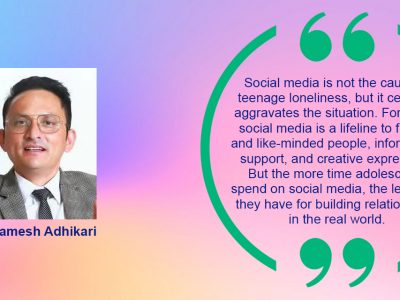
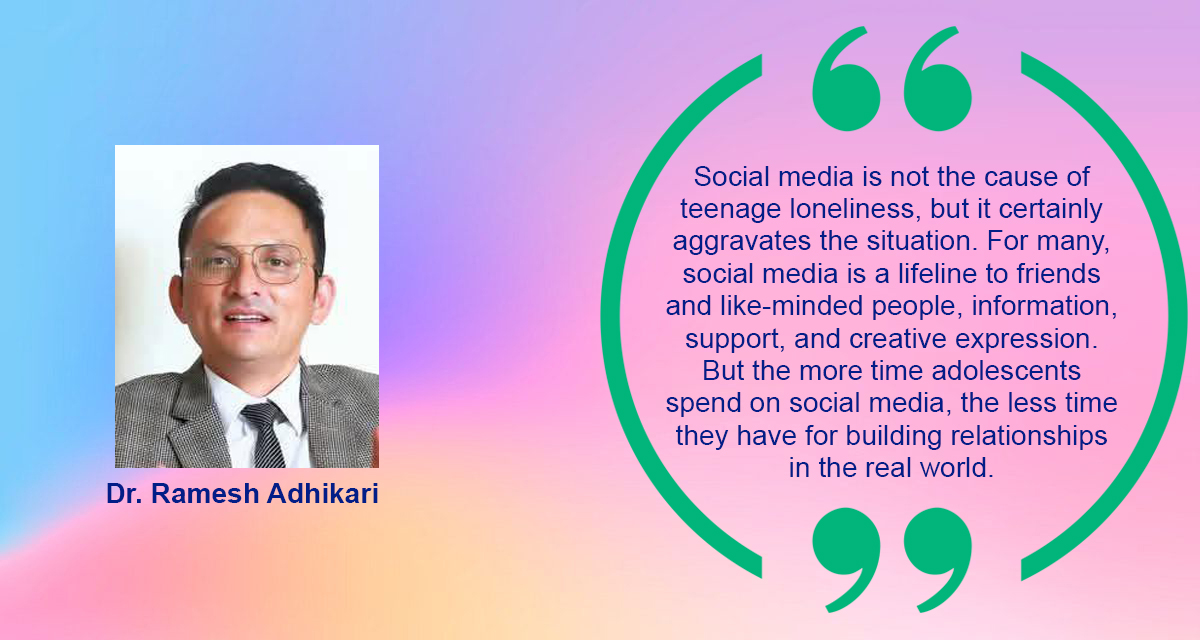
Social media is not the cause of teenage loneliness, but it certainly aggravates the situation. For many, social media is a lifeline to friends and like-minded people, information, support, and creative expression. But the more time adolescents spend on social media, the less time they have for building relationships in the real world. Worse still, the concept of loneliness itself encompasses not just being alone, but the feeling of isolation caused by a lack of or absence of desired social connections. While a student may have many social connections online, s/ he may feel incredibly lonely at school.
Comparison and validation are additional problems stemming from social media use. Children and adolescents compare themselves to people who seemingly lead better lives and have more friends. But the curated nature of social media means that the best parts are put on display while the less desirable ones are hidden. Researchers on adolescent social media use note that there is a link between social media and anxiety, depression, and poor body image, although the causal relationships between the two are complex and nuanced.
The danger presented by social media lies primarily in excessive use, which often leads to sleep deprivation and loss of real-world social connections. Other dangers stem from comparison, cyberbullying, and validation seeking. In Scotland, researchers note a link between heavy social media use and decreased self-esteem as well as increased rates of depression and anxiety. The lesson for the parents in Nepal is simple. It is not the number of hours spent on social media that is important, but whether that time was meaningful and what did the children miss by spending it on social media instead of real-world activities.
What happens inside the school
The school is the second most important social institution in a child’s life. And, just like any other social institution, it aggravates loneliness and isolation. Schools are breeding grounds for elitism and unhealthy competition. Children are sorted into the smart and the not smart, the popular and the not popular. A child who is not good at academics may feel inferior throughout his/her school life. A school bully may find it impossible to make real friends due to his/her behavior. A child who is being bullied may feel incapable or even powerless to talk to a teacher about it.
In Nepal, bullying and difficult social interactions are among the causes of social anxiety in children and adolescents, which has serious repercussions. Schools must reevaluate their approach to both social and academic behaviors and encourage inclusiveness. Excellence in academics is important, but so is sociability, communication skills, confidence, empathy, and other traits. A school administrator should not solely measure student performance by academic grades, another child’s ability to feel comfortable in a social setting matters too.
Children are losing social engagement
There is another change worth examining- the disappearance of unstructured social time. Children once spent hours playing outdoors, walking to school, visiting neighbors, arguing over games and negotiating rules without adult supervision. These experiences taught social skills that no textbook could fully reproduce. A playground is a laboratory of human relationships. Children learn how to win and lose, include others, negotiate disagreements, apologize, compromise and start again.
On the contrary, digital entertainment is not inherently harmful. But if it replaces too much physical play, conversation and face-to-face interaction, children may lose opportunities to practice these skills. The objective should therefore not be to create a technology free childhood. It should be to create a human-centered digital childhood.
Parents need to look at the mirror
Mostly in city areas, children spend time indoors and rarely they spend time with their parents too. Many parents are afraid of their children. Or rather, their children control them. In other words, parents are being manipulated by their children. Even more concerning is that many parents are being helpless and useless in the face of their own children. The best solution may be right in front of them – a simple and unstructured family activity like a shared dinner. Children should feel confident talking to their parents about their problems without being afraid of being judged or compared to siblings or classmates. The aim is not to eliminate technology from the child’s life, but rather to ensure that technology does not eliminate family life.
What schools can do
Schools in Nepal can help reduce the impact of social isolation and loneliness on children. First, social and emotional education should be given due importance, not as an extracurricular activity, but as a vital component of learning. Second, school counselors and referral systems should be available and accessible, with adequate resources to support lonely or socially isolated children. Third, schools should invest in training their teachers to work with socially isolated students as well as to be able to spot them. Fourth, schools should promote extracurricular activities, community service, and other group events, as well as encourage sports and alternative ways of learning. Fifth, students should be taught digital citizenship and social media literacy. They should understand cyberbullying and know their rights online, as well as the legal recourse available to them. Lastly, schools should have had a trusted platform where students can seek help anonymously.
UNICEF Nepal has been doing great work in the sphere of child mental health, promoting initiatives to help children express their emotions. Schools can use their platform to help students in need.
From correction to connection
Perhaps, the biggest problem in addressing the loneliness crisis in children is the tendency for adults to treat it like a behavior problem or disorder. When a child is withdrawn, he is labeled aloof and anti-social, even when s/he has no intention of being so. When a teenager is spends a lot of time online, s/he is labeled lazy, when, in reality, s/he may be trying to cope with something s/he cannot confront directly. Sometimes all a child needs is another person who will listen to him/her without judging. Nepal needs more high-quality research on children’s loneliness, social media use, bullying, sleep deprivation, and social support. It also needs better child and adolescent mental health services, which is currently lacking, especially outside the capital city. Recent works on the state of childhood in Nepal document the lack of access to mental health services and the need to address this urgent concern.
The WHO’s report on social connection is a welcome reminder that social connection and loneliness are not individual issues, but matters of public health. This view needs to be institutionalized in Nepal’s education sector.
In Sum, a child does not need hundreds of followers to feel valuable. S/he needs someone to care if s/he is alright. S/he needs a friend to listen to him/her. S/he needs better social skills, taught to him/her by his/her peers and teachers. S/he needs his/her parents’ attention. S/he needs a school that cares about his/her social life as much as about his/her grades.
Social media is unlikely to disappear from the lives of children. Similarly, AI and other technologies will likely become a bigger part of childhood in the future. But it is our combined responsibility to ensure that children do not lose their ability to connect with each other in the process of adapting to the changing world.
Dr. Ramesh Adhikari, PhD is an educationist, researcher and social contributor
Facebook Comment
Related News
latest Video
Trending News
- This Week
- This Month