
When Disaster Strikes, the Character of the State Is Revealed

Natural disasters do not come with a red-card warning. They do not ask whether a country is prepared, whether a family is ready, or whether a government has finished its plans. Floods, landslides, earthquakes, and other calamities can arrive suddenly and with devastating force. Within moments, peaceful communities can be transformed into scenes of destruction. Homes disappear, roads and bridges are swept away, fertile land is damaged, livelihoods are destroyed, and, most painfully, human lives are lost.
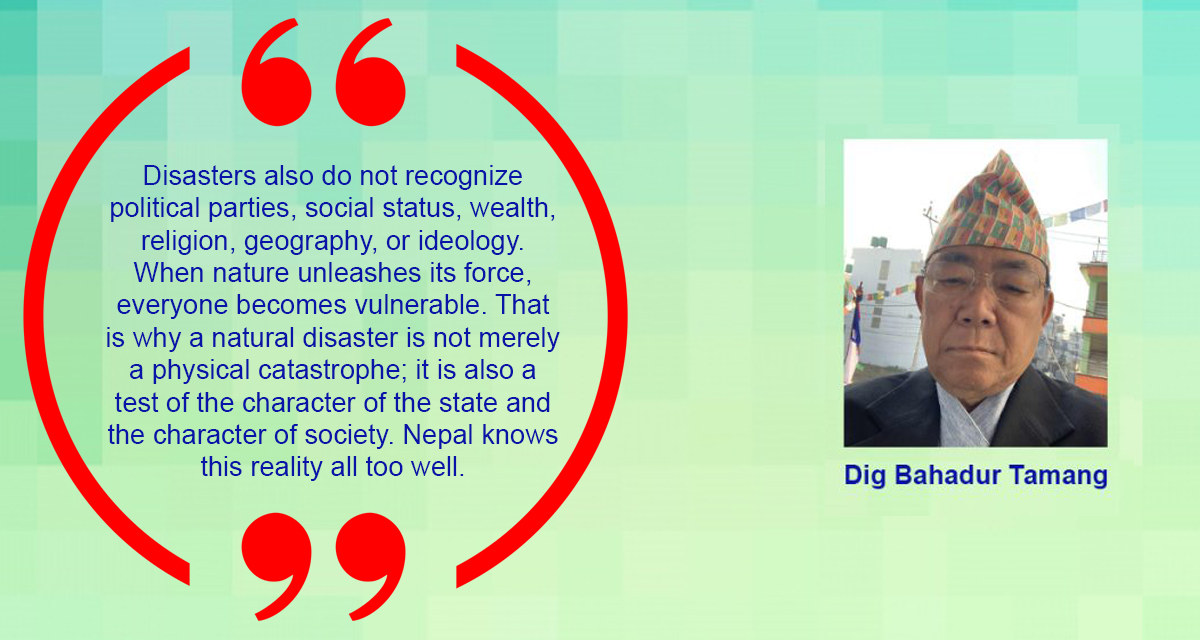
Disasters also do not recognize political parties, social status, wealth, religion, geography, or ideology. When nature unleashes its force, everyone becomes vulnerable. That is why a natural disaster is not merely a physical catastrophe; it is also a test of the character of the state and the character of society. Nepal knows this reality all too well.
I still remember the devastating earthquake of April 25, 2015. It was a Saturday morning when Nepal was struck by a massive earthquake of approximately magnitude 7.8. The country was suddenly thrown into fear, confusion, and grief. Homes collapsed, historical structures were destroyed, families were separated, and thousands of lives were lost. Before the country had recovered from the first shock, another major earthquake struck on May 12, deepening the suffering.
My own village experienced the destruction firsthand. After the first earthquake, my house was damaged but remained standing. I thought that, despite the cracks and damage, perhaps it could still be repaired. But when the second major earthquake came, the house could no longer withstand the force. It was split into two pieces.
I still preserve the photograph of that house on my cell phone. That photograph means much more to me than a picture of a damaged building. It represents a part of my personal history. It reminds me that behind every disaster statistic is a human story. A number in a government report may say how many houses were destroyed, but it cannot describe the memories contained within those walls. It cannot measure the emotional cost of losing the place where a family lived, celebrated festivals, raised children, and built a life.
That personal experience is one reason I look at the recent devastation in the Bhotekoshi region with particular sadness. For people watching from a distance, it is easy to discuss floods, landslides, rescue operations, government budgets, relief funds, and political responsibility. Television programs can debate the situation for hours, politicians can exchange accusations, and social media can become filled with arguments. But for a family that has suddenly lost its home, those political arguments have little immediate meaning.
They need shelter. The injured need medical attention. Families of missing people need search and rescue. Children need food, clothing, protection, and stability. Older people and vulnerable citizens need to know that the state has not forgotten them. Older people and vulnerable citizens need to know that the state has not forgotten them.
In a democracy, governments must be held accountable. The opposition has every right to ask difficult questions. Journalists have a responsibility to investigate and scrutinize government performance. Citizens have every right to express disagreement. These are not threats to democracy; they are essential parts of democracy.
But democracy also requires political maturity. There is a time for political competition and a time when humanity must come first. When citizens are trapped by floods, when families are searching for missing relatives, and when communities are struggling to survive, political differences should never become more important than human life.
If the government led by Prime Minister Balen Shah is making genuine efforts to mobilize state agencies, rescue victims, provide relief, and coordinate recovery, those efforts should be acknowledged. Giving credit where credit is due does not make someone a blind supporter of the government. In the same way, criticizing the government when it fails does not mean wishing for the government to fail.
A healthy democracy should allow us to do both. Unfortunately, Nepal’s political culture has often struggled with this simple principle. Too frequently, we judge policies according to who proposed them rather than whether they are good for the country. We praise something when it comes from our political side and condemn the same idea when it comes from someone we oppose. This creates a political culture in which loyalty can become more important than truth. That is dangerous.
We should learn to judge governments by their actions, their results, and their commitment to the public—not by political slogans or personal loyalty. If a government performs well, we should have the courage to say so. If it makes mistakes, we should have the courage to question it. Support should never be unconditional; principles should be.
At the same time, acknowledging good government work must never mean giving the government a free pass. If rescue operations are delayed, questions must be asked. If relief does not reach the people who need it most, the government must explain why. If public resources are misused, there must be accountability. If official statements do not match the realities faced by people on the ground, citizens and journalists have every right to demand clarification.
But criticism should be based on facts rather than political prejudice. This is particularly important in the age of social media. During a disaster, misinformation can spread almost as quickly as the disaster itself. False reports about casualties, missing people, rescue operations, or relief distribution can create unnecessary panic and confusion. At a time when people are already frightened, irresponsible information can cause additional harm.
Government officials, political leaders, journalists, civil society organizations, and ordinary citizens all have responsibilities. We should question the government when necessary, but we should also question misinformation when necessary.
Nepal’s current political situation also deserves a broader perspective. The frustration of the Nepali people did not appear overnight. Years of concerns about unemployment, corruption, weak governance, administrative delays, uneven development, and political patronage have contributed to a desire for change. This helps explain why new political leadership has attracted so much public attention. But new does not automatically mean perfect.
The Balen Shah administration is facing a test of its own. Citizens who support new leadership expect a different political culture—one based on transparency, accountability, efficiency, institutional reform, and measurable results. That expectation should be taken seriously. If new faces simply repeat the old habits, then the change will be cosmetic rather than structural.
Those who support the government therefore have an important responsibility. Their role should not be to defend every government decision. Instead, they should encourage the government to correct mistakes, listen to criticism, strengthen institutions, and improve its performance. For Balen Shah, public trust should not be viewed simply as political popularity. It should be understood as a responsibility.
The present disaster provides an opportunity to demonstrate whether the government can strengthen Nepal’s disaster preparedness, improve coordination among government agencies and local authorities, make public institutions more responsive, ensure transparency in relief distribution, and connect emergency assistance with long-term reconstruction.
Good performance deserves recognition. But good governance also requires honesty about failures and the willingness to correct them.Popularity is not an achievement by itself. The real achievement is turning public trust into better institutions and measurable results.
For the people of Bhotekoshi, however, all of these political questions are secondary at this moment. They need action rather than speeches. They need roads and bridges restored. They need food, medicine, clean water, electricity, shelter, and security. Families of missing people need continued search and rescue. Those who have lost their livelihoods need assistance to rebuild their lives.
Most importantly, they need to know that the state will not disappear once the television cameras leave. The government’s true test will therefore not be the number of press conferences it holds or the number of statements it issues. The true test will be whether assistance reaches the people who need it.
Results—not rhetoric—must be the measure of government performance.
But a disaster tests society as well as government. It asks us what kind of people we are. Do political actors use people’s suffering as an opportunity for political campaigning, or do they put victims first? Do social media users spread rumors, or do they share verified information? Do organizations seek publicity from disaster relief, or do they provide genuine assistance? Do ordinary citizens help their neighbors regardless of political affiliation?
These questions matter because disaster does not belong to one party or one government. Floodwaters do not ask which political party a victim supports. Landslides do not check someone’s voting record. Earthquakes do not distinguish between rich and poor. Death does not stop to ask about ideology. Suffering has no political party. Pain has no ideology.
That is why disaster response should rise above partisan divisions. None of this means democracy should become silent during a crisis. The press must remain free. The government must remain accountable. Opposition parties must continue to perform their democratic roles. Parliament must continue to scrutinize the government. But priorities matter.
When people’s lives are at risk, the first priority cannot be political arithmetic. It cannot be about who gains or loses power. It cannot be about who might win the next election. The priority must be human life. Elections come and go. Governments rise and fall. Political alliances change. Leaders become popular and later face criticism. But a life lost in a disaster cannot be restored by a political speech.
A child who loses a parent cannot have that loss erased by an election victory. A family that loses its home cannot rebuild its life through political arguments. This is why our political consciousness must retain its humanity, especially during times of crisis.
Whether one supports or opposes Balen Shah is ultimately a smaller question than whether Nepal’s citizens are safe. If the government does something well, it should be acknowledged. If it does something wrong, it should be criticized. If an established political party offers a sound proposal, it should be considered on its merits. If it makes a serious mistake, it should be challenged.
That, in my view, is what independent thinking means. We should choose policies over personalities, results over slogans, and strong institutions over individual popularity. The people of Bhotekoshi do not need to know our political ideology right now. They need compassion, solidarity, and practical support.
The message should therefore be simple:
Let the government do its job. Hold it accountable where necessary. Question what is wrong. And give credit where credit is due. Political competition has its place. Democratic disagreement has its place. Parliamentary scrutiny has its place. But human compassion must stand above all of them when people’s lives are at stake. After all, a government is not the private property of any political party.
Government belongs to the people. The state belongs to the people. And in a time of crisis, the state’s first responsibility is to protect the lives and dignity of its citizens. Perhaps that is why I believe the story of Nepal’s disasters deserves to be written—not simply as a record of earthquakes, floods, landslides, demonstrations, and destruction, but as a story of ordinary people who have repeatedly endured extraordinary circumstances.
From the earthquake that destroyed my village home to the devastation now affecting communities in Bhotekoshi, I have learned that disaster leaves behind more than physical destruction. It leaves memories, photographs, grief, uncertainty, and questions about what kind of country we want to build. But disaster also reveals something powerful: resilience. Nepal has suffered many calamities, yet its people continue to stand, rebuild, help one another, and move forward. That resilience deserves to be remembered.
History may not remember every speech delivered during a crisis. It may not remember every political argument made in Parliament or on social media. But it will remember how a nation responded when its people were suffering. It will remember who helped. It will remember who stood beside ordinary people when they needed help the most.
Nepal does not need blind support or blind opposition. It needs something more difficult and more valuable: Unity in times of disaster, accountability in governance, and humanity in politics.
About the Author
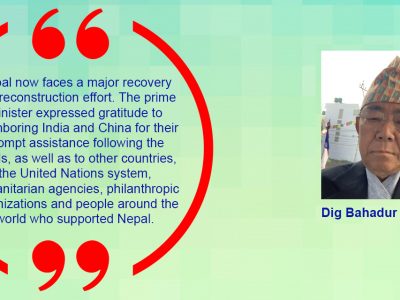
Dig Bahadur Tamang is a writer, literary analyst, and independent commentator whose work focuses on contemporary social issues, travel writing, essays, commentary, short stories, and fiction. His writing explores society, human experience, current affairs, and the many dimensions of everyday life through an independent and reflective perspective. His work seeks to build a meaningful connection between literature, society, and contemporary public discourse.
Facebook Comment
Related News
latest Video
Trending News
- This Week
- This Month