
When Nepal Is in Crisis, the Nation Must Come First

Nepal is once again facing the devastating consequences of a major natural disaster. Floods and landslides have taken lives, destroyed homes and livelihoods, and left thousands of families struggling to cope with unimaginable loss. Some families have lost loved ones. Others have lost their homes, farms, and sources of income. Many are still waiting anxiously for news of relatives who remain missing.
In moments like this, ordinary Nepalis are not asking for miracles. They are asking for the basics: a government that responds effectively, political leaders who put aside partisan differences, relief that reaches those who need it most, and accountability when wrongdoing occurs.
“According to the latest figures released by Nepal Police as of the morning of September 6, 2026…According to the latest figures released by Nepal Police as of the morning of Bhadra 20, the Bhotekoshi disaster had claimed 1,344 lives, while 4,898 people remained unaccounted for. A total of 8,631 people had been rescued alive, with 7,912 security personnel deployed in search and rescue operations. Search efforts and DNA collection for identifying victims are continuing, meaning these figures could change as authorities gather more information.
Behind every number is a human being. Behind every statistic is a family grieving, a future interrupted, and a life forever changed. At a time when more than a thousand people have lost their lives and thousands remain unaccounted for, we should pause and ask ourselves a fundamental question: Are we putting the needs of disaster victims ahead of political calculations?
If our public debate becomes dominated by partisan interests, political accusations, and competition for advantage rather than rescue, relief, and recovery, then we have lost sight of what matters most. Search and rescue operations are still underway. Thousands of families remain in limbo, waiting for word about their loved ones. At this critical moment, the government, political parties, security agencies, local governments, civil society organizations, and the media should have one overriding priority: Save lives. Find the missing. Care for the injured. Deliver relief. And help displaced families rebuild their lives safely and with dignity.
A National Emergency Should Rise Above Politics
In times of crisis, political parties and leaders should be able to put their differences aside and work together for the public good. That does not mean abandoning political principles. It means recognizing that there are moments when the national interest must come first. Unfortunately, Nepal’s political culture has often struggled with this distinction. Even when citizens are facing extraordinary hardship, political competition can quickly turn into a contest over who can portray the government as a failure.
There is a legitimate place for political criticism. In a democracy, the government must be held accountable. Opposition parties have a responsibility to raise concerns, identify weaknesses, and demand answers. The media must ask difficult questions, and citizens have every right to expect transparency.
But there is a difference between holding the government accountable and turning a national emergency into a political battlefield.
A person whose home has been swept away is not primarily concerned with which party is in power. They want to know when assistance will arrive. A parent whose child is missing wants to know whether search teams are looking. A family that has been displaced needs food, medicine, shelter, and reassurance that the government has not forgotten them. That is why political leaders should ask themselves: At a time of national crisis, are we acting primarily as representatives of our parties—or as leaders serving the nation?
Hold the Government Accountable—Without Getting in the Way of Relief
The government should face tough questions. How is relief being distributed? How many people have been affected? Where are domestic and international donations being collected? How are those funds being used? Who is responsible for managing them? And what mechanisms are in place to ensure transparency and accountability? These are reasonable questions. In fact, they are essential questions. But accountability should not come at the expense of effective rescue and relief operations.
Where there are shortcomings, the government should be pressed to improve. Where there is credible evidence of corruption, investigations should follow. But where rescue workers and relief agencies are doing their jobs, they should receive the cooperation they need. That is what responsible opposition looks like.
In a parliamentary democracy, the opposition’s role is not simply to wait for an opportunity to bring down the government. It also has a responsibility to work constructively when the country faces an emergency. The government, for its part, should not treat every criticism as an attack or every political opponent as an adversary. During a crisis, cooperation is not a sign of weakness. It is a sign of political maturity.
A Responsibility for the Media and Social Media
Social media has transformed the way people receive information and participate in public life. It has given ordinary citizens a powerful voice and made it easier than ever to share information and demand accountability. But with that power comes responsibility. Unverified claims, speculation, sensational headlines, and emotionally charged content can spread across social media in a matter of minutes. Once misinformation takes hold, correcting it can be far more difficult.
Some YouTube channels and online platforms have developed a tendency to attribute major events to foreign powers or to make serious allegations without providing credible evidence. Such claims should be approached with caution. If there is evidence of foreign interference, it should be presented, investigated, and evaluated through appropriate legal and institutional channels. But an allegation does not become a fact simply because it is repeated often enough.
Nepalis have every right to question their own government, political leaders, institutions, and public officials. A healthy democracy depends on citizens who are willing to ask difficult questions. But there is a clear difference between asking legitimate questions and making accusations without evidence.
Freedom of expression is one of democracy’s greatest strengths. Responsible expression helps strengthen it; reckless expression can undermine public trust.
The Questions Surrounding the “Green Army” Deserve a Clear Answer
The discussion surrounding the group referred to as the “Green Army” has raised a number of questions that deserve careful and transparent examination. Who established the group? What is its purpose? How is it organized? Where does its funding come from? And are its activities consistent with Nepal’s Constitution and applicable laws? These are legitimate questions, and the government should address them through a credible investigation.
If investigators find evidence that any organization is engaging in activities that threaten Nepal’s sovereignty, national security, or social harmony, the appropriate authorities should take action under the law. At the same time, we must remember an essential principle of justice: An allegation is not the same thing as proof. Investigations should be based on facts and evidence, not political pressure or public speculation. If wrongdoing is established, those responsible should be held accountable. If allegations are unfounded, innocent individuals should not be subjected to unnecessary public condemnation. National security is too important to become a political talking point.
Nepal Must Speak Clearly and Credibly About Climate Change
For Nepal, climate change is not a distant or theoretical concern. Its effects are increasingly visible across the Himalayas, the hills, and the Terai. Flooding, landslides, extreme rainfall, and other climate-related hazards pose serious risks to vulnerable communities and already fragile infrastructure. Nepal therefore has every reason to make its voice heard internationally. It is both appropriate and necessary for Nepal’s leaders to raise the country’s concerns at the United Nations and other international forums.
But international advocacy must go beyond powerful speeches. If Nepal wants greater international support for climate-related loss and damage, it needs credible data, scientific evidence, strong institutions, sound legal arguments, and sustained diplomatic engagement. In other words, Nepal needs to turn its experience into evidence and its evidence into effective diplomacy. The government should therefore develop a long-term national strategy grounded in science, facts, law, and diplomacy—not simply emotion or political rhetoric.
Relief Funds Must Be Protected From Corruption
Disaster relief funds exist to help people who have already lost homes, livelihoods, property, and loved ones. If such funds are misused for personal or political gain, the consequences are particularly serious. Anyone who diverts relief resources for personal benefit should be held accountable, regardless of political affiliation, social standing, or official position. But accountability must be based on evidence. Social media allegations should not replace due process. Investigative authorities must conduct impartial inquiries, and those found responsible for wrongdoing should face appropriate legal consequences.
At the same time, we should recognize those who are doing the right thing. Government employees, security personnel, volunteers, local officials, community organizations, and ordinary citizens who are working around the clock to help disaster victims deserve recognition and support. Good governance requires both accountability for wrongdoing and appreciation for public service. Can Nepal Rise Above Partisan Politics? Nepal’s political leadership now has an opportunity for serious self-reflection.
Political parties will compete during elections. The government and opposition will disagree in Parliament. Political philosophies and policy priorities will differ. That is part of democracy. But when disaster strikes, human life must come before political advantage. Supporting the government during an emergency does not mean endorsing every government decision. Cooperation does not require anyone to abandon their political beliefs. It simply means recognizing that, in a national emergency, the welfare of citizens must take priority over partisan interests.
The government also has responsibilities. A disaster should never become an excuse for a lack of transparency. Every donation should be properly recorded. Relief should be distributed according to need, not political connections. Decision-making should be transparent, and credible allegations of misconduct should be investigated independently. The opposition should ask itself: In our effort to hold the government accountable, are we keeping the suffering of ordinary citizens at the center of the conversation?
The media should ask: Are we informing the public, or are we simply chasing the next sensational story? Social media creators should ask: Are we prepared to take responsibility for the consequences of sharing information that has not been verified? And citizens should ask themselves: Are we forming our opinions based on facts, or are we allowing rumors to make our decisions for us?
This Is a Test for the Entire Nation
A national disaster is not only a test of the government. It is a test of the opposition. It is a test of the media. It is a test of civil society. And it is a test of every citizen. Our challenge is to make sure that a natural disaster does not become a political disaster as well. Political parties will disagree. That is normal. But when the country faces an extraordinary emergency, there should also be room for cooperation and a basic national consensus. Question the government, but do not obstruct relief. Investigate corruption, but do not condemn people without evidence. Examine possible foreign interference, but do not turn every event into a conspiracy. Demand transparency, but also recognize genuine public service.
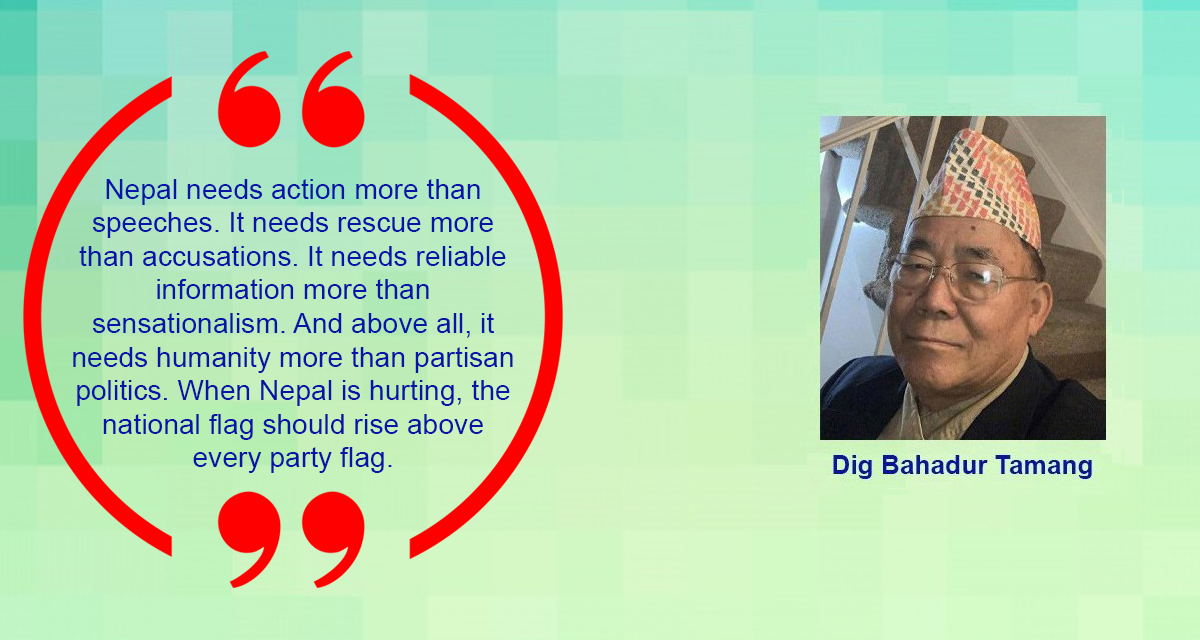
Nepal needs action more than speeches. It needs rescue more than accusations. It needs reliable information more than sensationalism. And above all, it needs humanity more than partisan politics. When Nepal is hurting, the national flag should rise above every party flag. History may not ultimately ask which political party we supported when our fellow citizens were suffering. It may ask a more important question: Where did we stand when our country needed us?
The answer should be clear. The government must do its job. The opposition must hold the government accountable while cooperating where the national interest requires it. The media must pursue truth, context, and evidence. Investigative authorities must address credible allegations of corruption. Those who serve their communities with courage and integrity should be recognized. And every one of us should remember that, in times of crisis, humanity and the national interest must come before partisan politics. Because politics has its place in a democracy. But when the country is in crisis, no political interest should come at the expense of the nation.
Facebook Comment
Related News
latest Video
Trending News
- This Week
- This Month