
From Himal to Sagar: A New H₂O Doctrine for Planetary Survival
The Himal to Sagar (H₂O) Doctrine: How a Wounded Nepal Can Lead the Planet in the Age of Cryospheric Collapse

Prologue: The Cry of Langtang Lirung
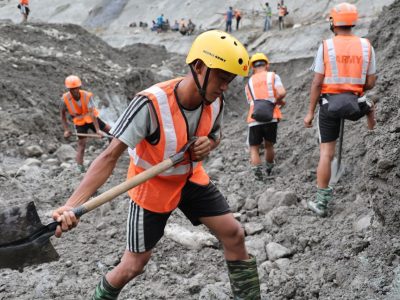
On the morning of August 26, 2026, the earth beneath the northern Himalayas did not merely shake; it ruptured under the weight of an unholy thermal burden. High above the Rasuwa district of Nepal, at an altitude exceeding 5,200 meters, a 200,000-square-meter mass of glacier ice and destabilized bedrock detached from the flanks of Langtang Lirung. Falling more than 1,200 vertical meters into the valley floor below, the impact released kinetic energy equivalent to a moderate- magnitude earthquake. Within minutes, the compressed frictional heat and pulverized ice generated a terrifying, hyper-mobile slurry—millions of cubic meters of mud, ice, and debris—that coursed down the Lhende Khola and the Bhotekoshi- Trishuli river systems.
Entire villages and small towns were erased from the map. Bridges, schools, and vital hydroelectric installations were sheared off their foundations like matchsticks. More than 1,400 lives were extinguished in a single morning, with thousands more buried beneath metres of suffocating gray silt.
As I walked through the mud-caked ruins of Rasuwa days later, looking into the hollow eyes of a mother who had lost her three children and her ancestral home in the span of thirty seconds, a profound, unsettling truth crystallized. This was not a localized “natural disaster.” It was an act of planetary violence. It was the physical manifestation of an ecosystem breaking under the strain of global thermal expansion.
Rasuwa is not an isolated mountain tragedy; it is an early-warning signal for the entire human species. The ice that collapsed in the high Himalayas of Nepal is the exact same water—H2 O—that will, months from now, submerge the low-lying coastlines of Bangladesh, swallow the coral atolls of Tuvalu, flood the streets of Miami, and erode the dykes of the Netherlands.
The high mountain peaks (Himal) and the deep ocean basins (Sagar) are not separate geographies divided by nation-states. They are two ends of a single, continuous, thermodynamic conveyor belt. What happens at 5,000 meters above sea level dictates the survival of human beings living zero meters above it.
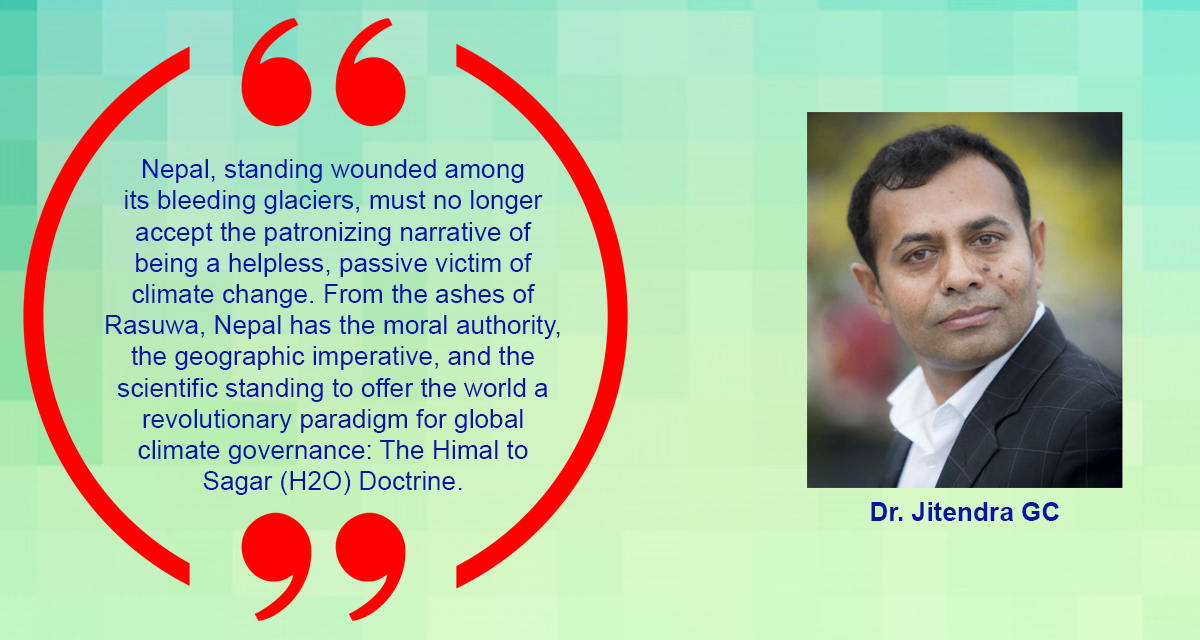
Nepal, standing wounded among its bleeding glaciers, must no longer accept the patronizing narrative of being a helpless, passive victim of climate change. From the ashes of Rasuwa, Nepal has the moral authority, the geographic imperative, and the scientific standing to offer the world a revolutionary paradigm for global climate governance: The Himal to Sagar (H2 O) Doctrine.
I. The Physics of H2 O: Two Sides of a Single Planetary Coin
To understand the necessity of this doctrine, one must first confront the brutal, unyielding physics of the cryosphere. The Hindu Kush Himalaya (HKH) region— often termed the “Third Pole”—contains the largest reserve of frozen freshwater on Earth outside the polar ice sheets. It feeds ten of Asia’s largest river systems, supplying life, agriculture, and energy to 240 million people in the mountains and
1.65 billion people downstream.
Yet, this massive planetary water tower is melting at a rate that defies conventional ecological models. The benchmark HI-WISE Assessment Report published by the International Centre for Integrated Mountain Development (ICIMOD) revealed a terrifying acceleration: glaciers across the Hindu Kush Himalaya disappeared 65 percent faster in the 2010s than in the preceding decade. Between 1990 and 2020, the HKH lost roughly 12 percent of its total ice area. Under current global emissions trajectories, glaciologists project that up to 80 percent of the current glacier volume in the Himalayas will be gone by the year 2100.
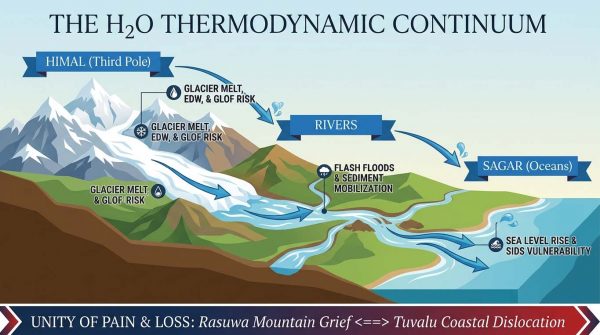
The Intergovernmental Panel on Climate Change (IPCC) Sixth Assessment Report explicitly confirms that elevation-dependent warming is amplifying temperature increases at high altitudes at nearly double the global average rate. When greenhouse gas emissions trap heat in the atmosphere, the high-altitude glaciers melt, destabilize permafrost, and trigger catastrophic cascading hazards—ice
avalanches, landslide-dammed lake outbursts, and debris flows.
When that ice melts, it does not disappear. It undergoes a phase change from solid to liquid, accelerating downhill through steep river channels, laying waste to mountain communities, before discharging into the Indian Ocean, the Bay of Bengal, and the global marine system. There, it contributes directly to thermal expansion and global sea-level rise.
Consider the arithmetic of grief:
- In Rasuwa, Nepal: A 1.2-kilometer vertical drop of collapsed glacial ice converts into a roaring torrent of 490 million cubic meters of water and sediment, erasing families in
- In the Bay of Bengal and Pacific Atolls: That exact same volume of water arrives as incremental millimeter rises in sea level, driving saltwater intrusion into agricultural lands, drowning freshwater aquifers, and displacing coastal farmers into urban slums.
The tears shed by a mother in the high valleys of the Himalayas and the tears shed by a mother in the low-lying deltas of the Sundarbans or the Marshall Islands are chemically identical, triggered by the exact same molecular compound: H2 O. They are victims of the same structural injustice. By isolating mountain hazards from marine hazards, the global climate diplomacy framework—from COP summits to UNFCCC working groups—has committed a fundamental conceptual error. We have treated the headwaters and the estuaries as separate geopolitical silos, failing to grasp that the planet’s hydrosphere operates as a single, indivisible thermodynamic system.
II. Sacred Ice and Moral Injustice: The Ethos of Planetary Guardianship
There is a deep, bitter irony in the geography of climate change. The indigenous communities of Rasuwa, the Sherpas of Khumbu, the Tamangs of the high valleys, and the islanders of the South Pacific have contributed virtually nothing to the historical accumulation of atmospheric carbon. Nepal’s share of global greenhouse gas emissions stands at an infinitesimal 0.02 percent.
For millennia, these mountain communities did not view the Himalayas as mere real estate or natural resources to be extracted. They viewed them as sacred, living sanctuaries. In Eastern philosophy and Vedic cosmology, nature is not an object of human conquest; it is the divine matrix of life itself.
As the Atharva Veda (12.1.12), in the ancient Bhumi Sukta (Hymn to the Earth), proclaims:
माता भूमिः पुत्रो अहम् पृथिव्याः ।
पर्जन्यः पिता स उ नः पिपर्तु ।।
(“Earth is my Mother, I am the child of the Earth.
The cosmic rain is my father; may he nurture and protect us.”)
This biocentric worldview—where mountains are worshipped as Abode of the Gods (Devabhumi) and rivers as living mothers (Lokmata)—fostered centuries of sustainable stewardship. Mountain dwellers lived in sacred equilibrium with the cryosphere. Yet today, these very guardians are paying the ultimate price for an industrial model of hyper-consumption powered by fossil fuels thousands of miles away.
The romantic poets of the West once caught glimpses of this sacred bond. William Wordsworth, contemplating the fragile majesty of the natural world in Tintern Abbey, famously wrote:
“Nature never did betray
The heart that loved her; ’tis her privilege, Through all the years of this our life, to lead From joy to joy…”
Today, however, industrial civilization has betrayed nature, and in doing so, it has betrayed the most vulnerable human beings on Earth. When a hanging glacier breaks off in Rasuwa due to atmospheric superheating, it represents a breakdown of the sacred covenant between humanity and the biosphere.
Climate injustice is not an abstract ethical debate; it is a structural body count. It is the economic reality wherein small, Least Developed Countries (LDCs) are forced to divert up to 20 percent of their national budgets toward emergency disaster response, infrastructure repair, and climate adaptation, taking on expensive sovereign debt to rebuild bridges that will simply be washed away again by the next thermal surge.
The time for meekly begging for discretionary adaptation funds at international summits is over. Nepal must step forward not as a petitioner, but as the moral conscience of a warming world.
III. The Five Pillars of the Himal to Sagar (H2 O) Doctrine
To transform this moral outrage into actionable, systemic planetary reform, Nepal proposes The Himal to Sagar (H2 O) Doctrine. This doctrine establishes a comprehensive, legally binding, and scientifically grounded framework designed to bridge high-altitude mountain ecosystems and low-lying coastal zones into a unified global governance regime.
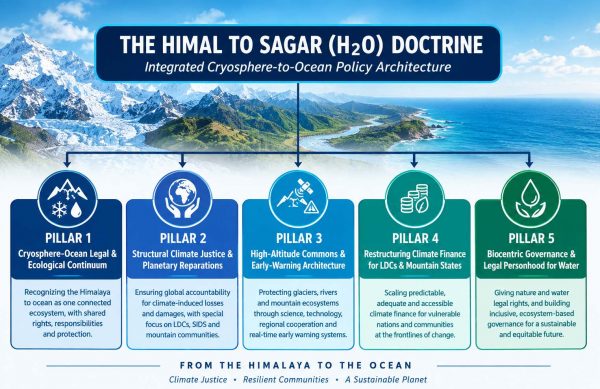
Pillar 1: Cryosphere-Ocean Legal & Ecological Continuum
The doctrine establishes that high-altitude glaciers (Himal) and low-altitude oceans (Sagar) constitute a single, non-severable legal and ecological domain under international law.
- Analytical Mechanism: Just as international maritime law (UNCLOS) governs the high seas, international environmental law must extend its jurisdiction to the “High Cryosphere” as a vital planetary life-support Any action that accelerates cryospheric melt—specifically fossil fuel expansion and carbon emissions above agreed threshold limits— must be recognized as an indirect, unlawful discharge into the global marine and atmospheric commons.
- Governance Application: UN Framework Convention on Climate Change (UNFCCC) mechanisms must merge high-altitude mountain hazards and coastal sea-level rise metrics into a unified scientific assessment framework. Loss and damage calculations for mountain flash floods and coastal inundations must be linked using shared thermodynamic indices.
Pillar 2: Structural Climate Justice & Planetary Reparations
The doctrine shifts the discourse from discretionary “climate aid” to obligatory “planetary reparations.”
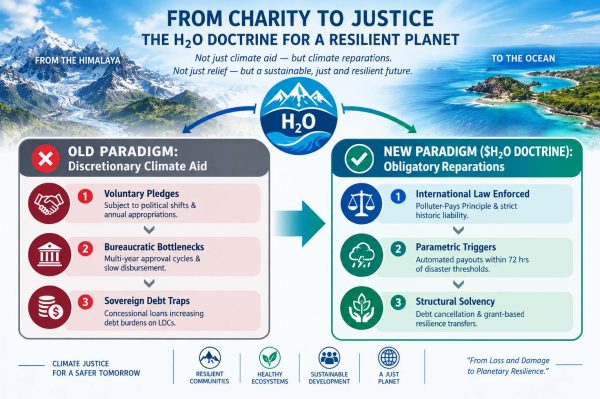
- Analytical Mechanism: Grounded in the foundational legal principle of polluter pays (sic utere tuo ut alienum non laedas), high-emitting nations and major carbon-producing corporations (“Carbon Majors”) bear strict liability for transboundary loss and damage caused by cryospheric
- Governance Application: The doctrine calls for a legally binding global mechanism that automatically triggers financial transfers to impacted communities in LDCs within 72 hours of a certified cryospheric or coastal climate catastrophe (such as the Rasuwa glacier collapse). These transfers must be structured as non-repayable grants, not interest- bearing loans that compound sovereign
Pillar 3: The High-Altitude Commons & Transboundary Early-Warning Architecture
Human life cannot be protected without real-time, high-altitude environmental intelligence.
- Analytical Mechanism: The HKH region contains thousands of unmonitored hanging glaciers, glacial lakes, and permafrost The H2 O Doctrine declares high-altitude environmental monitoring data a “Global Public Good.”
- Governance Application: Mandating the creation of a Global High- Altitude Early Warning and Satellite Surveillance System under UN By integrating high-resolution radar satellite telemetry, thermal sensors, ground-based seismic monitoring, and AI-driven predictive modeling, the system must provide downstream communities—from mountain villages to coastal estuaries—with real-time hazard warnings.
As the World Bank notes, universal early warning coverage can prevent over $35 billion in global annual asset and well-being losses.
Pillar 4: Restructuring Global Climate Finance for LDCs & Mountain States The current international financial architecture—dominated by the IMF, World Bank, and commercial credit rating agencies—is fundamentally unfit for the climate crisis era.
- Analytical Mechanism: LDCs facing recurrent climate disasters are trapped in a fiscal death spiral: disaster hits, revenues fall, borrowing costs rise, credit ratings drop, and debt servicing squeezes out vital public spending on health, education, and adaptation.
- Governance Application: The doctrine demands:
- Automatic Climate Debt Cancellation for LDCs and Small Island Developing States (SIDS) facing severe climate shocks.
- The inclusion of Debt-for-Climate Resilience Swaps, allowing vulnerable nations to redirect debt payments into local ecosystem restoration, watershed management, and disaster risk reduction.
- Direct allocation of at least 25 percent of the UNFCCC Loss and Damage Fund specifically to high-altitude cryospheric risk zones and their downstream river
Pillar 5: Biocentric Governance & Legal Personhood for Water Systems Technical fixes alone will not save humanity; we require a legal and philosophical paradigm shift that recognizes the intrinsic rights of nature.
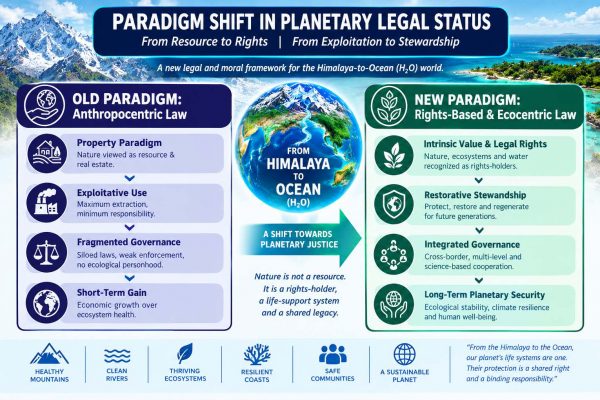
- Analytical Mechanism: Drawing from Eastern spiritual traditions and indigenous jurisprudence, the H2 O Doctrine advocates for granting Legal Personhood to major glaciers, river systems, and oceanic ecosystems.
- Governance Application: Under this framework, a river like the Bhotekoshi-Trishuli or a glacier like Langtang Lirung is recognized not as a inert natural asset, but as a living entity possessing the fundamental legal right to exist, persist, regenerate, and flow International courts must allow designated indigenous and local community guardians to sue polluters and states on behalf of the ecosystem itself.
IV. A Strategic Roadmap to Globalize the H2 O Doctrine
A doctrine, no matter how intellectually compelling, remains a mere academic exercise unless it is backed by diplomatic muscle and strategic coalition-building. Nepal must launch a sophisticated diplomatic offensive to institutionalize the H2 O Doctrine across the global stage.
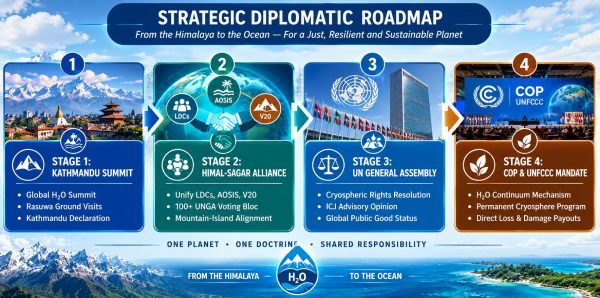
Step 1: Convening the “Kathmandu Himal-Sagar Planetary Summit”
Nepal should immediately issue an invitation to leaders from both mountain nations (Bhutan, Peru, Kyrgyzstan, Tajikistan, Ethiopia) and low-lying island states (Tuvalu, Maldives, Fiji, Barbados, Bangladesh). Hosting this summit in Kathmandu
—with an on-site diplomatic delegation visiting the disaster zone in Rasuwa—will firmly anchor global media and diplomatic attention on the physical realities of cryospheric collapse.
Step 2: Forging the “Himal-Sagar Alliance” (The H2 O Bloc)
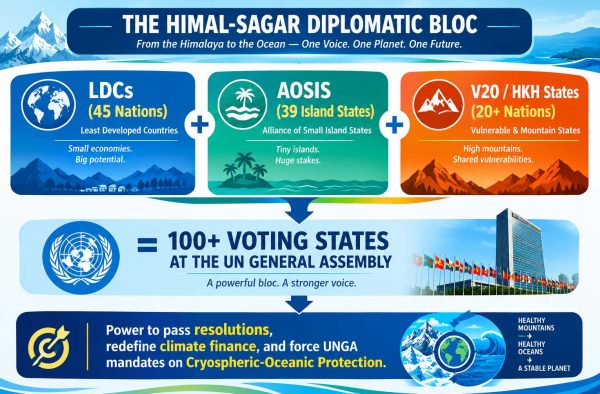
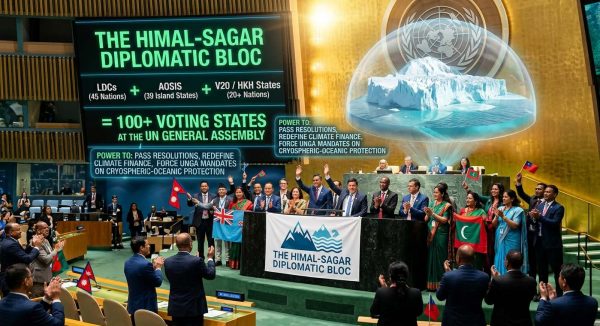
Historically, mountain countries (LDCs) and island states (AOSIS) have operated in separate diplomatic corridors at UN climate negotiations. Nepal must spearhead the formal creation of the Himal-Sagar Alliance, uniting the 45 Least Developed Countries, the 39 members of AOSIS, and the Climate Vulnerable Forum (V20).
Together, this voting bloc represents over 100 sovereign nation-states at the United Nations General Assembly—a voting majority capable of shifting UN agendas, passing landmark resolutions, and reshaping global climate negotiation dynamics.
Step 3: Tabling a UN General Assembly Resolution
Working through the Himal-Sagar Alliance, Nepal must draft and table a historic UNGA Resolution titled: “Protection of the Global Cryosphere and Oceans as an Indivisible Planetary Commons.”
This resolution should formally request an Advisory Opinion from the International Court of Justice (ICJ) regarding the legal obligations of major historical emitting states to prevent cryospheric collapse and compensate vulnerable states for cascading mountain-to-ocean loss and damage.
Step 4: Institutionalizing Cryosphere Protection in COP and UNFCCC
Nepal and its allies must demand the creation of a dedicated UNFCCC Permanent Work Programme on the Cryosphere and High-Altitude Water Towers, elevating mountain ecosystems to the same institutional status currently granted to forests (REDD+) and oceans (Blue Economy).
V. an Epilogue: A Covenant with the Earth
The tragedy in Rasuwa was a dark, sorrowful day in the history of Nepal. But it must not be remembered merely as a monument to destruction. Let it be remembered as the moment the world woke up to the undeniable reality of cryospheric collapse. Let it be the crucible from which a new paradigm of planetary leadership was born.
We have spent decades delivering speeches, writing policy briefs, signing non- binding declarations, and expressing condolences after every disaster. Yet the ice continues to retreat. The waters continue to rise. The air continues to heat.
If humanity is to survive the tumultuous centuries ahead, we must abandon the
arrogant delusion that we can master, exploit, and pollute nature without consequence. We must rediscover the ancient, enduring wisdom of those who walked these mountains and navigated these oceans before us—a wisdom that recognized that the mountain, the river, the forest, and the sea are bound together in an eternal, sacred dance.
The rivers that flow from the snow-capped summits of the Himalayas down to the deep waters of the Indian Ocean do not recognize human borders, political parties, or economic ideologies. They obey only the laws of physics, fluid dynamics, and ecological balance.
To save Rasuwa is to save Tuvalu. To protect the glaciers of Langtang is to safeguard the streets of Miami, the fields of Bengal, and the coastlines of the Pacific.
We do not need another round of hollow promises or bureaucratic paralysis at global climate summits. We need a new covenant with our planet. We need The Himal to Sagar (H2 O) Doctrine. The mountains have delivered their warning in thunderous avalanches of ice and rock. The oceans are rising to answer. The world must now choose: will we listen and transform, or will we allow the waters to wash away our civilization?
Nepal has made its choice. It stands ready to lead.
Key Data & Research Report References
- ICIMOD HI-WISE Report (2023): Water, Ice, Society, and Ecosystems in the Hindu Kush International Centre for Integrated Mountain Development, Kathmandu.
- Key Finding: Glaciers vanished 65% faster in the 2010s compared to the previous Up to 80% of current glacier volume will disappear by 2100 under high-emissions scenarios.
- IPCC AR6 Special Report on the Ocean and Cryosphere in a Changing
Climate (SROCC): Intergovernmental Panel on Climate Change, Geneva.
- Key Finding: High-mountain warming rates exceed global averages, accelerating glacier mass loss and escalating downstream multi- hazard risks including GLOFs, ice avalanches, and sea-level rise
- Rasuwa Glacial Collapse Disaster Data (August 2026):
- Location & Event: Langtang Lirung / Lhende Khola / Bhotekoshi- Trishuli Corridor, Nepal-China Border.
- Scale: Glacier detachments at ~5,200m altitude dropping ~1.2 km vertically; millions of cubic meters of pulverized ice and debris; 1,400+ casualties, thousands missing, US $2.64B+ infrastructure
- World Bank Disaster Risk & Early Warning Assessment (2023):
- Key Finding: Universal access to early warning services globally prevents $13 billion in direct asset losses and $22 billion in well-being losses annually.
Author Dr. Jitendra GC is a public policy scholar and now-Kathmandu-based climate diplomacy practitioner focusing on climate justice, planetary governance, and advocacy for the Himalaya–Ocean continuum, who formerly served as the think tank,lead at the Sajha Foundation Nepal.)
Facebook Comment
Related News

latest Video
Trending News
- This Week
- This Month