
Nepali Attire: A National Identity Fading in the Name of Modernity

Now that I have passed the age of seventy-five, I sometimes find myself feeling like a stranger in my own country. Times have changed. Society has changed. The way people think and live has changed. Technology has brought the world to our fingertips, and the younger generation is pursuing new dreams and new possibilities. All of this is a natural part of progress.
And yet, when I pause and look back, I sometimes wonder whether some of the defining features of our national identity have been left behind somewhere along the way. One of those important symbols is our traditional Nepali attire.
I still remember my childhood and younger years, when wearing a daura-suruwal and a Nepali topi to school was quite common. Whether in villages or cities, traditional Nepali clothing was an ordinary part of everyday life. Government officials were commonly seen wearing daura-suruwal, a coat, and the Nepali topi. The topi was more than something worn on one’s head. It was a visible expression of identity, culture, dignity, and one’s connection to the nation.
In those days, wearing a Nepali topi was considered appropriate, and in some circumstances necessary, when entering important government institutions such as Singha Durbar. Senior officials regarded the daura-suruwal, coat, and topi as part of the dignity and decorum expected of their positions. Even members of the royal family were known to wear garments made from locally produced fabrics.
At that time, clothing was not merely a matter of personal taste. It was closely associated with official dignity, national pride, and a sense of being Nepali.
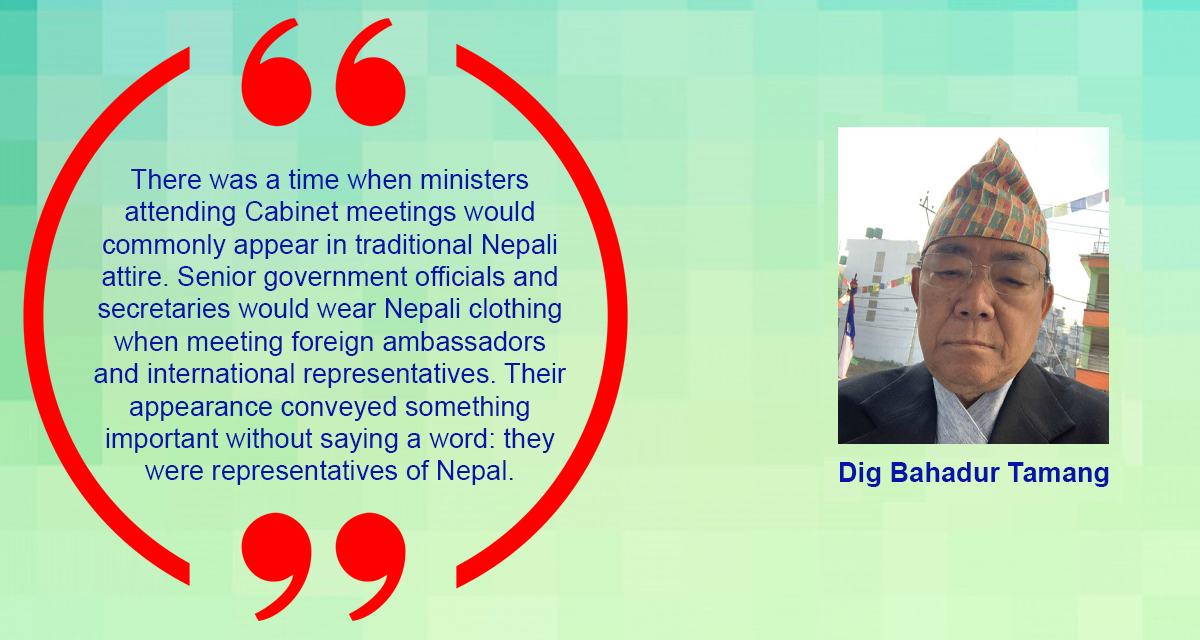
There was a time when ministers attending Cabinet meetings would commonly appear in traditional Nepali attire. Senior government officials and secretaries would wear Nepali clothing when meeting foreign ambassadors and international representatives. Their appearance conveyed something important without saying a word: they were representatives of Nepal.
Standing before foreign guests in traditional Nepali attire gave those occasions a distinctive sense of national character. For many members of the older generation, such clothing did not diminish Nepal’s dignity; if anything, it enhanced it. But today, things are quite different.
From government offices to public ceremonies, the presence of traditional Nepali attire has gradually declined. At some formal events, it can be difficult to distinguish government representatives from officials in other countries simply by looking at what they are wearing. Western-style suits, ties, coats, and other contemporary clothing have become the norm. Traditional Nepali attire—including the daura-suruwal, topi, gunyu-cholo, and other indigenous forms of dress—is increasingly reserved for special occasions, national celebrations, or cultural events.
This naturally raises a question: Why did this change happen?
Is traditional Nepali clothing somehow incapable of being modern? Does wearing a daura-suruwal make someone look outdated? Has wearing a Nepali topi come to be associated with old-fashioned thinking? Or have we gradually begun to confuse modernity with simply imitating foreign styles?
Modernity itself is certainly not a bad thing. As society evolves, clothing changes. Eating habits change. Architecture changes. The way we work changes. In today’s fast-paced world, it is perfectly reasonable for people to choose clothing that is comfortable, lightweight, and practical.
Therefore, it would neither be realistic nor necessary to insist that every Nepali person wear traditional attire at all times. But that is not really the issue. The real question is the place of Nepali attire in formal national life.
Every nation has symbols of its identity. There is a national flag, a national anthem, a national language, and a national emblem. Traditional national attire can also serve as an important cultural symbol. Clothing alone does not define patriotism, but it can give visible expression to a nation’s identity.
Japan, for example, has found ways to preserve traditional clothing while embracing modern life. India, too, maintains a strong presence of traditional attire in political and formal settings. In Bhutan, national dress is deeply integrated into the country’s official culture. Around the world, many nations have embraced modernity without allowing their traditional clothing to disappear.
So why has Nepal moved so far in the opposite direction?
One possible reason is that we may have come to misunderstand what modernity really means.
Being modern means being willing to embrace new ideas. It does not mean abandoning everything valuable from the past. Modernity does not require us to erase our identity. Using science and technology is modern. Advancing education is modern. Respecting democratic values is modern. Competing confidently in a global economy is modern.
But looking down on our own culture, language, art, and traditional clothing cannot reasonably be called modernity.
At times, we seem to have developed a mindset in which looking foreign is equated with looking modern. Speaking English may be viewed as a sign of greater education. Wearing foreign brands may be associated with greater prosperity. Western clothing may be regarded as more sophisticated.
Over time, such attitudes can create an unfortunate sense of inferiority toward our own cultural traditions. If younger generations begin to see the daura-suruwal as something belonging only to their grandparents’ generation while viewing suits and ties as the symbols of modernity, our traditional national attire may gradually disappear from public life.
But we cannot place the entire responsibility on the younger generation.
Young people learn from the society they grow up in. If those holding the highest public offices do not value our traditional attire, how can we expect ordinary citizens to regard it as something worthy of pride?
When the prime minister, ministers, members of parliament, secretaries, ambassadors, and other senior officials appear in traditional Nepali attire at important national occasions, it sends a powerful cultural message to society. Talking about nationalism and national pride in speeches is one thing; demonstrating that pride through one’s conduct is another.
Patriotism is not limited to defending borders, displaying the national flag, or standing for the national anthem. National identity is also reflected in our everyday conduct, culture, language, art, history, and traditions. Nepal’s soil, air, landscapes, and cultural heritage are important parts of who we are. Traditional Nepali attire is one small but meaningful part of that identity.
At the same time, one point deserves to be made very clearly: wearing Nepali clothing does not automatically make someone patriotic, just as wearing Western clothing does not make someone unpatriotic.
Patriotism goes far deeper than clothing. Honesty, public service, responsibility, a sense of duty, and respect for fellow citizens are among its essential foundations. A corrupt person does not become patriotic simply by putting on a daura-suruwal. Likewise, an honest and dedicated public servant does not become unpatriotic simply because he or she wears a suit.
But that does not mean we should dismiss the cultural significance of traditional clothing altogether.
If we gradually begin to regard our national symbols as unnecessary or outdated, we may eventually weaken the visible expression of our national identity. Clothing is only one example. Similar questions can arise about our languages, folk music, traditional dances, architecture, customs, and cultural practices.
Globalization has brought the world closer together. That is a tremendous opportunity. But there is a difference between becoming more connected to the world and losing ourselves in the process.
I believe Nepal should now have a serious national conversation about restoring traditional Nepali attire to a respected place in formal public life.
This does not mean forcing every government employee to wear a daura-suruwal every day. Rather, traditional Nepali attire could be encouraged for national celebrations, state ceremonies, important diplomatic meetings, parliamentary occasions, and other significant formal events.
At the same time, Nepali clothing itself can evolve. We can develop contemporary versions of the daura-suruwal using comfortable fabrics, modern tailoring, and designs suitable for today’s professional environment. We can also encourage modern formal attire for women that reflects Nepal’s rich cultural heritage while remaining practical and contemporary.
There is no need for a battle between tradition and modernity. We cannot preserve tradition simply by placing it behind glass in a museum. Traditions remain alive when they are allowed to evolve and become part of contemporary life.
Today, at seventy-five, I have lived through two very different Nepals. I remember a Nepal in which traditional clothing was an ordinary and recognizable part of everyday life. Today, I see a Nepal in which it can sometimes be difficult to recognize our own government officials by their attire.
And so, this change naturally leaves me with a question:
In the name of modernity, we have not changed the soil beneath our feet. We have not changed the air we breathe. We have not changed the sky above us. So why, then, did we change our traditional clothing?
Perhaps the answer lies in the passage of time. Perhaps it lies in globalization. Perhaps it lies in a change in our collective mindset.
But one thing seems clear: we do not have to give up our identity in order to become modern.
We should learn from the world and embrace what is good and useful. But we should not forget the good things that belong to our own home. There is absolutely nothing wrong with wearing Western clothing. The question is simply this:
When we wear traditional Nepali clothing, do we feel proud of being Nepali—or do we feel embarrassed?
If one day wearing a Nepali topi, a daura-suruwal, or another traditional Nepali outfit in front of foreign guests once again becomes a source of genuine pride, it will represent more than the return of a style of clothing. It will symbolize the return of confidence in our own identity.
Times will continue to change. Clothing will change. Styles will change. But the soul of a nation should not be allowed to disappear.
In building a modern Nepal, we do not need to carry every aspect of the past with us. But neither should we leave behind those traditions that keep our distinctive identity alive.
Traditional Nepali attire is more than clothing. It is a visible language of our history, our memories, and our identity.
Let us become modern. Let us move forward with the world. Let us stand shoulder to shoulder with other nations. But let us do so without forgetting who we are.
Let us embrace the future with confidence—not by abandoning our identity, but by carrying our Nepali identity with us into the modern world.
note
• Daura — a long, collarless traditional shirt/tunic that wraps and fastens across the front.
• Suruwal — traditional trousers, generally tapered toward the ankles.
• Nepali topi — traditionally worn with the daura-suruwal, especially for formal or informal.
Facebook Comment
Related News

latest Video
Trending News
- This Week
- This Month